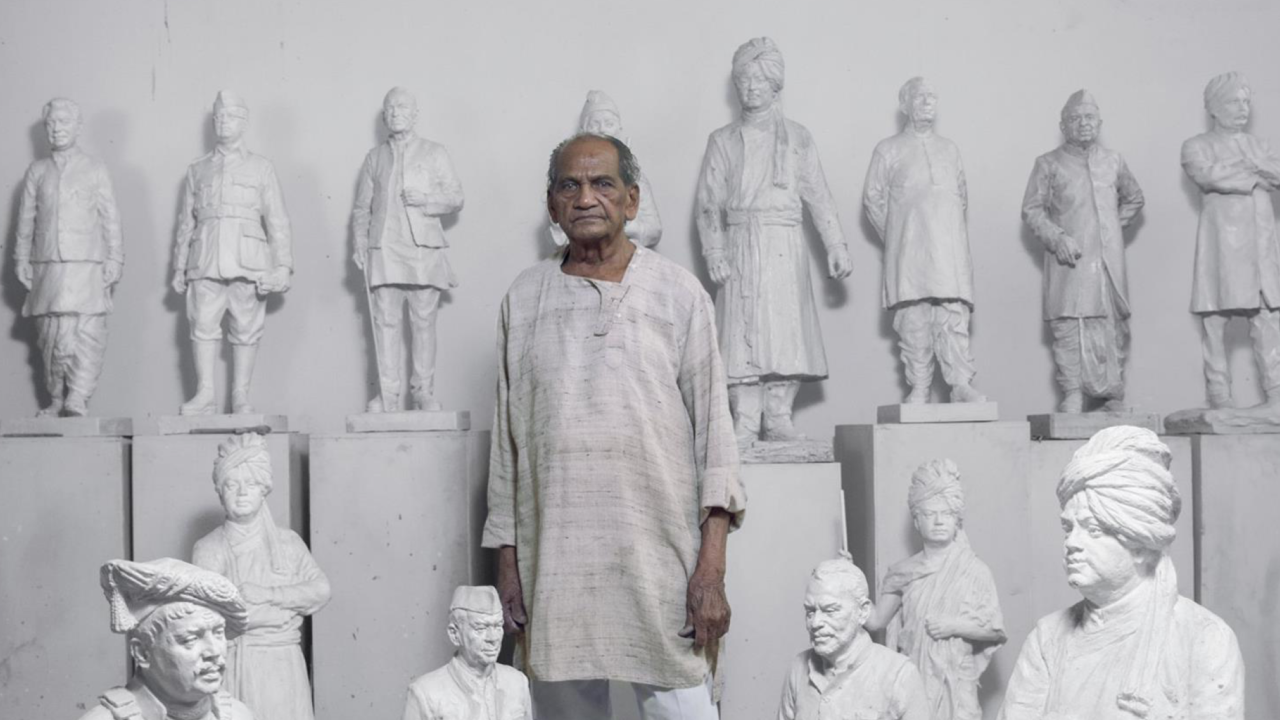
Ram Vanji Sutar’s story is simple to tell and easy to relate to. He was a village boy from Maharashtra who grew up to design the world’s tallest statue and spent his final years working from a studio in Noida, quietly shaping how India remembers its leaders in bronze and stone. For people living in Noida, Greater Noida and the YEIDA region, his life is not just a national story but also a local one, because many of his famous works started as clay models in Sector 63 and metal casts in nearby Sahibabad.
From Small Village To National Artist
Ram Vanji Sutar was born on 19 February 1925 in Gondur village in Dhule district of Maharashtra. As a young student he loved drawing and modelling, and this talent took him to the Sir J. J. School of Art in Mumbai, where he studied sculpture and graduated with a gold medal.
After college, he did not become famous overnight. He first joined the Archaeology Department as a modeller, helping restore sculptures at the Ajanta and Ellora caves, and later worked in the Ministry of Information and Broadcasting in New Delhi as a Technical Assistant (Model) in the Exhibition Division. In 1959 he left this safe government job to work on his own as a freelance sculptor, starting with small public commissions before bigger opportunities came his way.
The Statues Everyone Asks About
When people search for “Ram Sutar” online, they usually want to know which famous statues he made. A few names appear again and again in official summaries and exam notes:
- The Statue of Unity in Gujarat, a 182 metre statue of Sardar Vallabhbhai Patel on the Narmada river, recognised as the world’s tallest statue and officially credited to him as designer.
- The seated Mahatma Gandhi in a meditative pose at the Parliament House complex in New Delhi, with a larger version at Vidhana Soudha in Bengaluru.
- The equestrian statue of Chhatrapati Shivaji Maharaj in the Parliament complex, one of the works most often mentioned in tributes after his death.
- The “Statue of Prosperity” of Kempegowda at Bengaluru’s international airport, a 108 foot high bronze that greets travellers.
His company profile also notes that he has made more than 200 monumental sculptures in about sixty years, including statues of Jawaharlal Nehru, Indira Gandhi, Dr B. R. Ambedkar, Maulana Azad, Subhas Chandra Bose, Maharaja Ranjit Singh and many other leaders. His bronze bust of Mahatma Gandhi has been installed in hundreds of locations in India and abroad, making it one of the most widely seen Indian sculptures in the world.
The Noida And Ghaziabad Connection
Behind these big statues is a workshop system that looks more like a factory than a traditional art studio. Official company information explains that the main clay modelling studio of Ram Sutar Fine Arts Pvt Ltd is in Noida’s Electronic City, at A 40–41, Sector 63. The studio sits on a 2,000 square metre plot, with about 12,000 square feet of built space where artists and technicians build full body clay models, heads and smaller versions of future monuments.
The heavy metal casting is done in a large foundry in Sahibabad, Ghaziabad, with an 80,000 square foot shed and a capacity of around 10,000 kilograms of casting per day. To handle giant statues like the Statue of Unity or Kempegowda, the team uses industrial robots and CNC machines to scale up the forms accurately from small clay models.
This means that the Noida–Ghaziabad belt, planned and serviced by agencies such as Noida Authority, the UP Government and YEIDA, and connected through Noida Metro and local roads under Noida Police, is also a hidden hub for India’s biggest public sculptures. Residents who pass through Sector 63 or the industrial pockets of Ghaziabad may be moving right past the place where future national icons are taking shape.
Awards And Honours People Search For
Common search questions about Ram Sutar also focus on his awards. The main ones are clearly recorded in official and semi official sources:
- Padma Shri in 1999 from the Government of India, for his contribution to sculpture.
- Padma Bhushan in 2016, one of the country’s highest civilian awards.
- Tagore Award for Cultural Harmony (2016 award year), announced in 2018, for promoting cultural harmony through his art.
- Maharashtra Bhushan Puraskar, the highest civilian honour of Maharashtra, conferred on him in 2025 for his lifetime work, including the Statue of Unity and many other public monuments.
These awards sit alongside professional honours like honorary doctorates and international recognitions that his official site lists, showing that his work is respected by government bodies, cultural institutions and fellow artists.
Last Years In Noida And Lasting Legacy
Ram Vanji Sutar lived and worked almost to the age of 100. Public broadcaster reports confirm that he died at his residence in Noida in December 2025 after age related illness, and they describe him as the designer of the Statue of Unity and a Padma Bhushan awardee. Tributes from national leaders also highlight how his sculptures have become part of India’s visual identity, from Parliament to airports and city centres.
For residents of Noida, Greater Noida and YEIDA, his story is more than a list of statues. It shows how a city better known today for IT parks, expressways and metro lines is also home to a studio and foundry that helped create the tallest statue in the world and many of the leader statues seen on TV and in textbooks. That mix of art, industry and public life is what makes his journey relevant to the everyday searches people do about “who made the Statue of Unity,” “which statue did Ram Sutar create” and “where is his studio in Noida.”
Key official and primary sources used for this story
- Ram Sutar official site (main)
https://ramsutar.in - Ram Sutar official “Awards and Recognition”
https://confluence.services/ramsutar.in/awards-and-recognition/ - All India Radio / DD News obituary (Prasar Bharati)
https://www.newsonair.gov.in/renowned-sculptor-ram-vanji-sutar-designer-of-statue-of-unity-passes-away-at-100/ - Statue of Unity official information (height, location, designer)
https://visitsou.com/blogs/key-information-the-statue-of-unity/