The question sounds simple enough. How far is Noida from Delhi? But anyone who actually lives in Noida and commutes to the capital knows that the answer depends entirely on where in Noida you are starting from, where in Delhi you are going, what time of day it is, and whether you are in a car, on the metro, or in a cab.
This guide gives you the real numbers for 2026 — verified distances, honest travel times including traffic, current metro fares, and a straight answer on which option makes the most sense depending on what you are trying to do.
The Short Answer First
The straight-line distance between Noida and Central Delhi is approximately 12 kilometres. The driving distance via the fastest route, the DND Flyway, is around 18 kilometres from central Noida sectors. From Greater Noida, the distance to Delhi climbs to approximately 42 kilometres by road.
Those numbers mean nothing without traffic context. A distance of 18 kilometres on the DND at 7am on a weekday can take anywhere from 25 minutes to over an hour depending on the day and the season. The same 18 kilometres at 11pm takes under 20 minutes. This guide addresses all of that.
Route 1: DND Flyway — The Fastest and Most Used
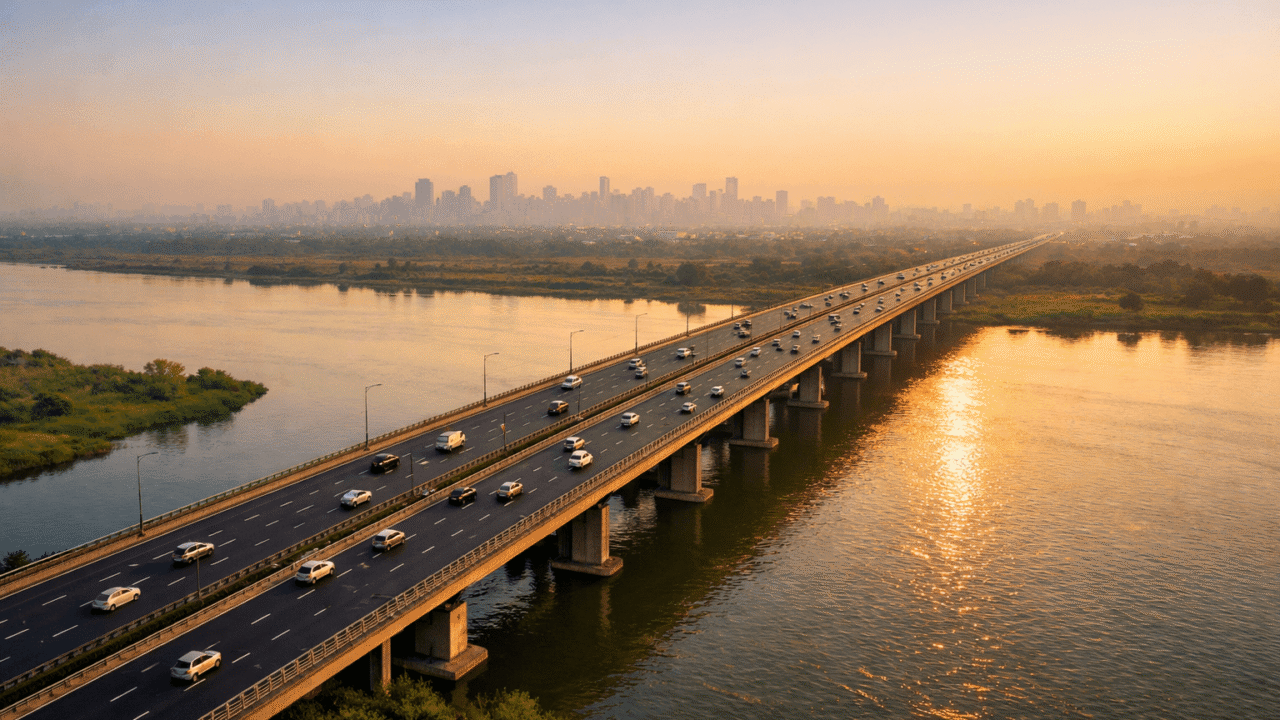
The Delhi-Noida Direct Flyway, universally called the DND, is the primary road connection between Noida and Delhi. It spans approximately 7.5 kilometres over the Yamuna River, connecting Noida directly to Maharani Bagh and the Ring Road in south-east Delhi, and is the starting point for onward travel to Connaught Place, Lajpat Nagar, India Gate, South Delhi and the airport.
The DND Flyway has been completely toll-free since October 2016 following an Allahabad High Court order, a status upheld by the Supreme Court in December 2024 and confirmed permanently in May 2025. This makes it India’s first major expressway to become toll-free through judicial intervention, and the single best piece of commuting news Noida residents have received in a decade.
Total driving distance from central Noida sectors via DND to central Delhi: approximately 18 to 20 kilometres. Travel time in normal conditions: 25 to 35 minutes. Travel time during peak morning hours on weekdays: 45 to 75 minutes. Travel time late evening or weekend: 20 to 25 minutes.
The DND works best for: residents in Sectors 14 to 30, commuters headed to South Delhi, Lajpat Nagar, Defence Colony, India Gate, and anyone going to the Ring Road corridor.
Route 2: NH-9 Via Anand Vihar and Ghaziabad
NH-9 from Noida to Delhi passes through several busy neighbourhoods and covers approximately 24 kilometres, with a typical travel time of around one hour. It connects Noida to East Delhi via the Anand Vihar and Ghaziabad corridor, making it the natural route for residents in Sectors 55 to 62, Indirapuram, Vaibhav Khand and the eastern Noida belt.
This route is useful for travel to East Delhi, Anand Vihar, Ghaziabad railway station and the eastern corridor of Delhi, but it is considerably slower than the DND on most days due to the volume of commercial traffic on NH-9. During peak hours it is best avoided if the DND is accessible from your sector.
Route 3: Kalindi Kunj Bridge
Kalindi Kunj connects Noida to South Delhi via a bridge over the Yamuna, and is the natural choice for residents in Sectors 37 to 50, Okhla and the south-eastern Noida belt. The route via the Outer Ring Road from this crossing covers approximately 47 kilometres and passes the Okhla Bird Sanctuary, Rashtriya Prerna Sthal, Raj Ghat and Red Fort, making it the longest driving route but the best option for anyone headed to Saket, Jasola, Okhla, Tughlaqabad or the southern Delhi corridor.
Traffic at Kalindi Kunj is notoriously heavy during morning and evening peak hours. The bridge itself becomes a bottleneck, and it is not uncommon to spend 20 to 30 minutes crossing what is a very short stretch of road. On weekends and after 9pm on weekdays it is considerably freer.
The Metro: The Option That Always Wins on Predictability
No guide to Noida-Delhi commuting is complete without an honest case for the metro, because for a large section of Noida’s working population it is simply the better choice — not because it is the fastest in pure time terms, but because it is the only option with a guaranteed arrival time.
The Delhi Metro Blue Line connects Noida directly to Central Delhi, covering the full stretch from Noida Electronic City through Noida City Centre, Noida Sector 18, Botanical Garden, Noida Sector 62, and all the way to Dwarka Sector 21 via Rajiv Chowk, spanning approximately 56 kilometres across the full line.
For a Noida resident, the most relevant Blue Line journey is from Noida City Centre or Noida Sector 18 to Rajiv Chowk, which sits at the centre of Connaught Place and is the most connected interchange station in the entire Delhi Metro network. That journey takes approximately 35 to 45 minutes and connects you to every other metro line in Delhi without stepping outside.
Blue Line fares range from a minimum of Rs 10 to a maximum of Rs 60 depending on distance. The journey from Noida City Centre to Rajiv Chowk costs Rs 40. From Noida Electronic City it is Rs 50 to most Central Delhi stations.
Metro timings: trains on the Blue Line run from approximately 6am to 11pm, with a frequency of around 3 to 5 minutes during peak hours. On Sundays the first train from Noida side runs slightly later. Check the DMRC app for exact first and last train timings from your station.
The metro works best for: IT professionals in Sectors 62 and 63 heading to Connaught Place, Barakhamba, Karol Bagh or Dwarka. Young professionals with no car or who prefer to avoid parking costs in Delhi. Anyone travelling to Rajiv Chowk for shopping, restaurants, cinema or onward connections.
The Aqua Line Connection: Noida Metro to Delhi Metro
Residents in Greater Noida, Pari Chowk, Knowledge Park and the expressway sectors have an additional option through the Noida Metro Aqua Line.
The Noida Metro Aqua Line runs 29.7 kilometres from Noida Sector 51 down to Depot Station in Greater Noida, with 21 stations connecting major residential and commercial hubs including Sector 50, Sector 76, NSEZ and Pari Chowk. Aqua Line fares range from Rs 10 to Rs 50.
The Aqua Line connects to the Delhi Metro Blue Line via a 420-metre skywalk between Noida Sector 51 on the Aqua Line and Sector 52 on the Blue Line. This walkway allows passengers to interchange without exiting and re-entering through separate gates.
For a Greater Noida resident, a typical journey to Central Delhi would be: board Aqua Line at Pari Chowk, ride to Sector 51, walk the skywalk to Sector 52, board Blue Line toward Delhi, ride to Rajiv Chowk. Total journey time is approximately 60 to 75 minutes depending on waiting time, and the total cost is around Rs 80 to 90 combining both metro fares.
Cab and Auto: What It Actually Costs in 2026
A cab from central Noida sectors to Connaught Place via DND costs approximately Rs 200 to Rs 350 in normal traffic on Ola or Uber. Surge pricing during peak hours can push this to Rs 450 to Rs 600. An auto-rickshaw for the same journey, if you can find one willing to go to Delhi, will cost Rs 150 to Rs 200 by meter.
From Greater Noida to Central Delhi, cab costs are significantly higher — expect Rs 500 to Rs 800 under normal conditions and Rs 900 to Rs 1,200 during peak surge. This is where the Aqua Line plus Blue Line combination becomes the clear cost-winner for daily commuters.
Bus: The Most Affordable Option
Delhi Transport Corporation buses run from Noida’s Ganpati Mandir to Delhi Gate with a travel time of approximately one hour and ten minutes over 40 kilometres, at a frequency of every 15 minutes. The ticket costs Rs 15.
DTC buses are the cheapest option for commuters who are not in a hurry and whose origin and destination align with the bus route. For domestic workers, daily labourers and price-sensitive commuters, the bus remains the backbone of the Noida-Delhi connection and carries an enormous volume of passengers that the metro does not reach.
The Right Route for Your Situation
The honest summary is this. If you are driving to South Delhi or Central Delhi from Sectors 14 to 50, use the DND — it is free, fast in normal conditions, and the most direct. If you are headed to East Delhi or the Ghaziabad corridor, NH-9 is your natural route. If you are a daily office commuter going to Connaught Place, Barakhamba or Karol Bagh, the metro wins on cost and predictability every single time. If you are in Greater Noida, the Aqua Line to Blue Line combination is the only sensible public transport option. If you are price-sensitive and not in a hurry, the Rs 15 DTC bus from Ganpati Mandir is unbeatable value.
The last thing worth saying: the distance between Noida and Delhi has not changed in decades. What has changed dramatically is the quality of the road connections, the expansion of the metro network, and the toll-free status of the DND. By any historical comparison, Noida is better connected to Delhi in 2026 than it has ever been. For the hundreds of thousands of people who make this journey every day, that is worth knowing.
Official Links
- DMRC Journey Planner and Fare Calculator: https://www.delhimetrorail.com
- Noida Metro (NMRC) Official: https://nmrcnoida.com
- Delhi Transport Corporation Bus Routes: https://dtc.delhi.gov.in