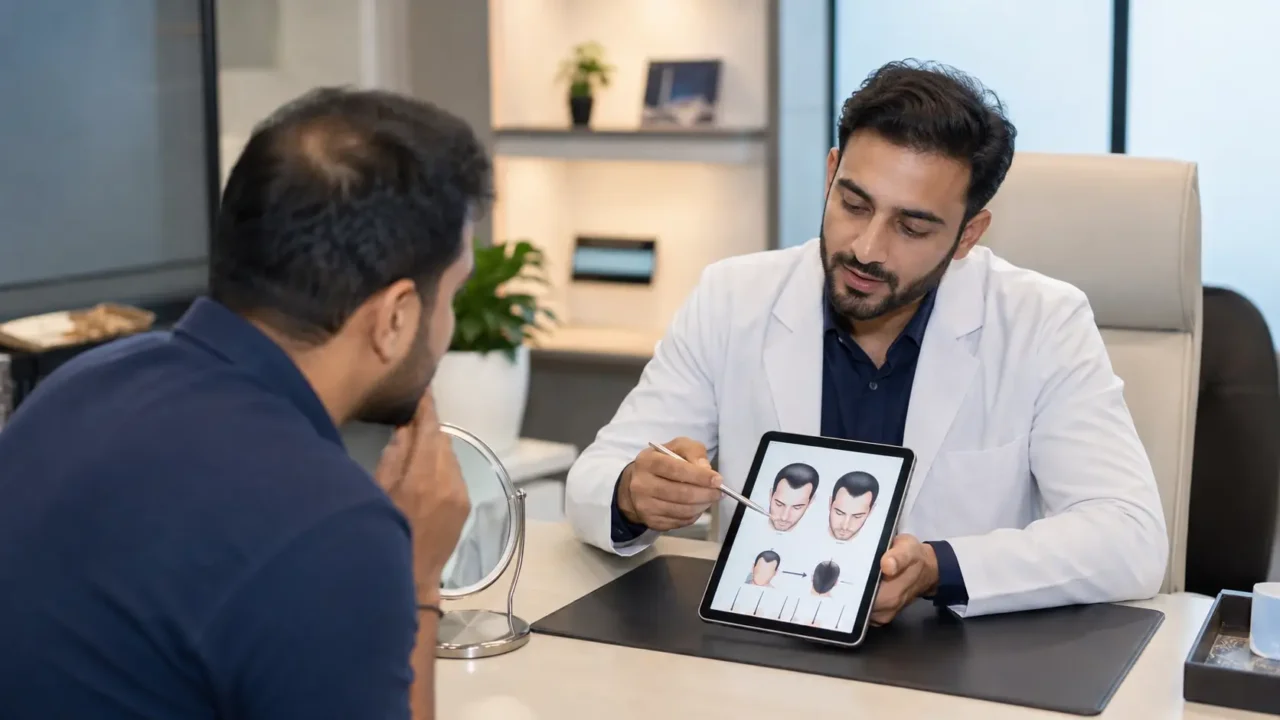
Hair transplantation is a cosmetic procedure, but the setting in which it is performed is expected to meet medical and surgical safety requirements.
The Ministry of Health and Family Welfare’s Clinical Establishments framework includes specific minimum standards for hair-transplant centres, covering medical staff, procedure facilities, emergency equipment, pre-procedure assessment, patient monitoring and informed consent.
For someone considering a hair transplant in Noida, Greater Noida or Greater Noida West, these standards provide a useful framework for questions to ask before booking a procedure.
One important limitation: this guide explains the official minimum standards. It does not certify or rate individual clinics, and Pulse of Noida has not independently determined that any named centre is compliant or non-compliant.
At a glance
- Hair-transplant procedures require a proper medical setup, not simply a salon-style environment.
- The official standards provide for pre-procedure and pre-anaesthetic assessment.
- A hair-transplant centre is expected to have an appropriately equipped procedure or operating room.
- Emergency equipment, oxygen, resuscitation capability and emergency medicines are part of the prescribed setup.
- Qualified medical and support staff are required.
- Post-procedure monitoring facilities are expected.
- The centre should have arrangements for hospital backup in an emergency.
- Patients should receive information and provide informed consent before the procedure.
Is a hair transplant simply a cosmetic salon procedure?
No.
The Ministry of Health and Family Welfare’s minimum standards treat a hair-transplant centre as a medical facility capable of carrying out a surgical procedure and dealing with possible complications.
The standards contemplate a day-care surgical setup or hospital environment, rather than a conventional beauty salon.
For patients, this means the appearance of a clinic or the attractiveness of its advertising is not enough to establish whether it has the medical infrastructure expected for the procedure.
What should happen before the procedure?
The official standards include requirements relating to patient assessment before surgery.
These include pre-procedure evaluation and pre-anaesthetic checks.
Before agreeing to a procedure, a patient can therefore ask:
- Who will medically assess me before the transplant?
- Will a pre-anaesthetic assessment be carried out?
- Who has determined that I am medically suitable for the procedure?
- What medicines, allergies or existing conditions should I disclose?
- What investigations are required before surgery?
Patients should provide accurate information about their medical history, medicines and allergies rather than treating the procedure as a purely cosmetic appointment.
Who should be present during a hair transplant?
The standards provide for medical and support personnel appropriate to the procedure.
They include requirements for:
- A doctor
- A qualified nurse
- An operation-theatre technician or assistant
- Anaesthesia support, including a standby anaesthetist as prescribed by the standards
Patients can ask the centre to identify the medical professional responsible for their procedure and the support staff who will be present.
The official standards also provide for display of the medical person in charge and their State Medical Council registration number.
A patient’s decision should therefore not be based only on a clinic’s brand name, social-media following or promotional claims.
What facilities should the procedure room have?
The minimum standards provide for an appropriately equipped operating theatre or procedure room suitable for hair-transplant surgery.
A patient does not need to conduct a technical inspection of the facility, but reasonable questions can still be asked before treatment.
For example:
- Where will the procedure be performed?
- Is this the centre’s designated procedure or operating room?
- How are instruments sterilised?
- What infection-control procedures are followed?
- Where will I be observed immediately after the procedure?
A centre should be able to explain its clinical setup clearly.
Why emergency preparedness matters
Although hair transplantation is generally planned in advance, medical complications can still occur during or after a procedure.
The official minimum standards therefore include emergency preparedness.
Specified infrastructure includes items such as:
- Resuscitation equipment
- Defibrillator
- Oxygen
- Emergency medicines
- Facilities for responding to a medical emergency
The standards also contemplate hospital backup or an arrangement with an appropriate hospital for situations that require a higher level of care.
Before undergoing the procedure, a patient can reasonably ask:
“If I develop a serious complication, what is your emergency protocol and where would I be transferred?”
A clear answer is more useful than a general assurance that the procedure is completely safe.
Should patients be monitored after the procedure?
Yes.
The standards include provision for post-operative monitoring.
This means a centre should have an appropriate space and process for observing a patient after the procedure rather than treating completion of the transplant as the end of clinical responsibility.
Patients should ask how long observation is normally required and what symptoms after discharge require urgent medical attention.
What should you know about consent?
The official framework requires prior informed consent.
In practical terms, a patient should understand the proposed procedure before agreeing to it.
Questions can include:
- What procedure will be performed?
- Who will perform it?
- What are the expected benefits?
- What are the material risks and possible complications?
- What alternatives exist?
- What happens if the procedure has to be stopped or modified?
- What follow-up care will be required?
Consent should not simply be treated as a form to sign immediately before the procedure.
Patients should have an opportunity to understand what they are agreeing to and ask questions.
What about patient privacy?
Patient privacy is also part of the official standards.
This is especially relevant in cosmetic medicine, where clinics may use photographs showing hair-loss patterns or before-and-after results.
Patients should ask how photographs and medical information will be stored and whether images could be used for promotional purposes.
A clinic should not assume that consent to treatment automatically means consent to publish a patient’s photographs.
If photographs may be used publicly, patients should understand and specifically agree to that use.
Can you check whether a doctor is registered?
The minimum standards require display of the medical person in charge along with their State Medical Council registration information.
Patients can ask for the responsible doctor’s:
- Full name
- Medical registration number
- Relevant professional qualification
- Role in the actual procedure
If a centre uses technicians or other support personnel, patients can also ask which parts of the procedure are performed by the doctor and which tasks are delegated.
Do not rely solely on titles used in advertisements or social-media profiles.
Does a clinic need emergency hospital backup?
The official standards provide for an emergency hospital backup arrangement.
This matters because a standalone day-care centre may not have the capability to manage every serious complication.
Before the procedure, ask:
- Which hospital receives patients if an emergency occurs?
- How would transfer happen?
- Does the centre have a formal backup arrangement?
The purpose is not to assume that an emergency will occur. It is to establish whether there is a plan if one does.
What should you be cautious about when comparing clinics?
Price, photographs and online reviews may all influence a patient’s choice, but they do not establish compliance with medical standards.
Be cautious about choosing a centre solely because of:
- Very large discounts
- Claims of guaranteed results
- Celebrity or influencer endorsements
- Before-and-after photographs without medical context
- A quoted number of grafts without an individual clinical assessment
- Promises that complications are impossible
- Pressure to pay immediately
- Unclear information about who will perform the procedure
A credible centre should be willing to discuss its medical team, procedure, risks, emergency arrangements and follow-up process.
Questions to ask before booking a hair transplant
A practical pre-booking checklist:
- Who is the doctor responsible for my procedure?
- What is the doctor’s medical registration number?
- Who will carry out the different stages of the transplant?
- Will I undergo a medical and pre-anaesthetic assessment?
- Where exactly will the procedure take place?
- What emergency equipment is available?
- Is an anaesthetist available as required?
- What hospital backup arrangement exists?
- How will I be monitored after the procedure?
- What complications should I watch for after discharge?
- What follow-up care is included?
- What photographs will be taken, and how will they be used?
- Will I receive and have time to understand the consent form before surgery?
These questions cannot guarantee a particular outcome, but they can help a patient understand whether a centre is treating the transplant as a medical procedure rather than merely a cosmetic service.
Are hair-transplant centres regulated in Uttar Pradesh?
The Ministry of Health and Family Welfare’s Clinical Establishments portal lists Uttar Pradesh among the States that have adopted the Clinical Establishments (Registration and Regulation) Act, 2010.
The Act provides a framework for registration and minimum standards for clinical establishments.
For a Noida resident, a useful additional check is therefore to ask the centre about its applicable clinical-establishment registration and the authority under which it operates.
Pulse of Noida has not used the existence or absence of a web listing to certify any particular local centre.
What if something does not feel right before the procedure?
A patient is entitled to ask questions before proceeding.
If a clinic cannot clearly identify the doctor, explain the procedure, discuss risks, describe its emergency arrangements or provide time to understand the consent process, it is reasonable to seek clarification or another medical opinion before committing.
For medical questions about an individual’s suitability for hair transplantation, diagnosis or treatment, consult an appropriately qualified medical professional.
The key takeaway
A hair transplant should be approached as a medical procedure requiring appropriate clinical safeguards, not simply as a cosmetic purchase.
The official standards give patients a practical framework to check four areas before choosing a centre:
Who is treating you, where the procedure will happen, what happens if there is an emergency, and what information you receive before giving consent.
Those questions can be asked before paying for or undergoing the procedure.
Official sources
- Ministry of Health and Family Welfare: Clinical Establishments, Allopathic Minimum Standards
- MoHFW: Minimum Standards for Hair Transplant Centre
- Clinical Establishments: About the Act and States/UTs adopting it
Medical disclaimer: This article is for general informational purposes and does not constitute medical advice, diagnosis or a recommendation of any clinic, doctor or treatment. Hair-transplant suitability, risks and outcomes vary by individual. Consult an appropriately qualified medical professional before undergoing any procedure. Pulse of Noida does not certify or endorse any clinic mentioned or operating in the region.