Yoga does not have to mean difficult postures or hour-long sessions. A simple daily practice built around breathing, movement and stillness can become a practical way to reconnect with the body in an increasingly sedentary, screen-heavy life.
There is a moment in almost every morning when the day has not fully taken over yet.
The phone may already be nearby. Messages are waiting. Work, school runs, traffic, meetings and household responsibilities will soon begin.
But for a few minutes, there is still a choice.
- To sit.
- To breathe.
- To move.
- To notice how the body actually feels.
That simple idea sits close to the heart of yoga.
Today, yoga is often presented through images of flexibility, complex postures and fitness routines. But its traditional scope is much wider. Physical postures are only one part of a practice that also includes breathing, concentration, meditation and awareness.
For modern life, that wider understanding may be the more useful one.
Yoga does not need to become another performance target.
It can simply become part of the day.
From an Ancient Discipline to an Everyday Practice
Yoga developed within India’s philosophical traditions over centuries.
Maharishi Patanjali is associated with systematising yogic thought through the Yoga Sutras. In the classical eightfold framework, yoga includes ethical disciplines, personal observances, physical postures, regulation of breathing, concentration and meditation.
The eight limbs are:
- Yama: Ethical restraints
- Niyama: Personal observances
- Asana: Physical postures
- Pranayama: Regulation of breathing
- Pratyahara: Withdrawal of the senses
- Dharana: Concentration
- Dhyana: Meditation
- Samadhi: Deep absorption
The familiar yoga mat therefore represents only one part of a much larger tradition.
This distinction matters.
If yoga is understood only as stretching, people who are not naturally flexible may assume it is not for them.
If it is understood as a practice of movement, breathing and awareness, it becomes much more accessible.
You do not need to touch your toes.
You do not need to perform a headstand.
You do not need to begin with twenty rounds of Surya Namaskar.
You can begin by breathing consciously for two minutes.
Why Yoga Feels Particularly Relevant Today
Modern daily life often asks the body to remain still while the mind stays constantly occupied.
A person may spend hours sitting at a desk, commuting, looking at a screen and moving between one digital task and another.
Movement becomes scheduled rather than natural.
Attention becomes fragmented.
Even rest can involve another screen.
Yoga offers a useful counterpoint because it combines three things that are often separated in modern routines:
Movement. Breath. Attention.
The World Health Organization recommends regular physical activity for adults, including aerobic and muscle-strengthening activity across the week.
Yoga can contribute to a more active lifestyle, but it should not automatically be treated as a substitute for walking, cardiovascular activity or appropriate strength training.
Its role is complementary.
Research reviewed by the US National Center for Complementary and Integrative Health suggests yoga may support areas including stress management, sleep, balance and general mental and emotional well-being.
That does not make yoga a treatment for every condition.
It simply means that regular practice can form one useful part of a broader healthy routine.
Pranayama: Begin With the Breath
We breathe continuously, but rarely pay attention to it.
Pranayama changes that.
It introduces deliberate awareness and regulation of breathing.
For beginners, Pranayama does not need to involve forceful techniques or long periods of breath retention.
A gentle practice can be enough.
Diaphragmatic Breathing
Sit comfortably.
Keep the spine upright without becoming rigid.
Breathe through the nose.
Notice the abdomen expand naturally while inhaling and soften while exhaling.
Do not force the breath.
Spend about two minutes simply observing the rhythm.
The value lies in attention, not intensity.
Anulom Vilom
Anulom Vilom is an alternate-nostril breathing practice.
Sit comfortably and gently regulate airflow through the nostrils.
Inhale through one nostril, change sides and exhale through the other.
Continue slowly.
For a beginner, there is no need for prolonged breath retention.
About three minutes is enough for this routine.
Bhramari
Bhramari introduces a soft humming sound during exhalation.
Sit quietly.
Inhale gently through the nose.
Exhale with a comfortable humming sound.
Repeat for a few rounds.
The sound does not need to be loud.
The focus is on a smooth exhalation and awareness of breathing.
A 30-Minute Yoga Routine You Can Actually Follow
The best routine is not necessarily the most advanced one.
It is the one you can repeat.
A practical 30-minute session can be divided into six simple stages.
| Time | Practice |
|---|---|
| 0 to 2 minutes | Sit quietly and observe natural breathing |
| 2 to 8 minutes | Gentle Pranayama |
| 8 to 11 minutes | Warm-up and mobility |
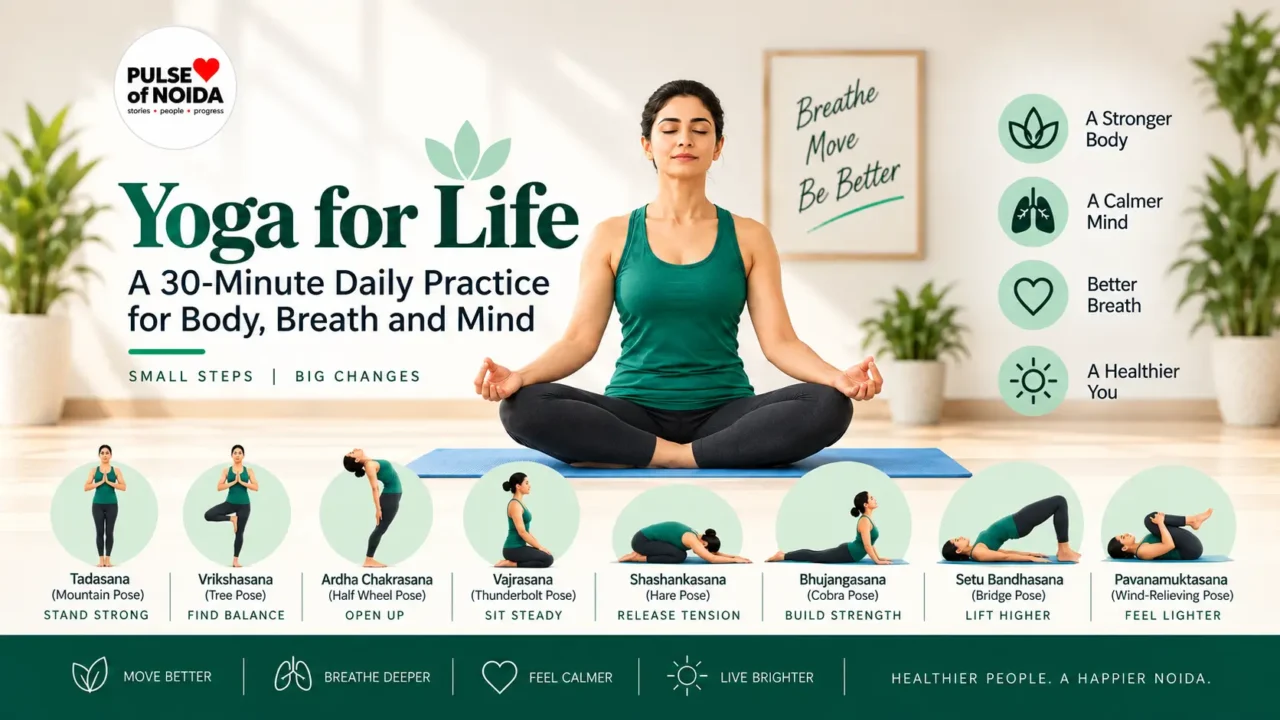
| 11 to 23 minutes | Eight simple asanas |
| 23 to 28 minutes | Shavasana |
| 28 to 30 minutes | Quiet sitting |
Total: 30 minutes
The entire practice can be completed without rushing.
Eight Asanas for an Everyday Routine
These postures are not chosen because they look impressive.
Together, they introduce standing, balance, gentle extension, seated movement and floor-based postures.
1. Tadasana | Mountain Pose
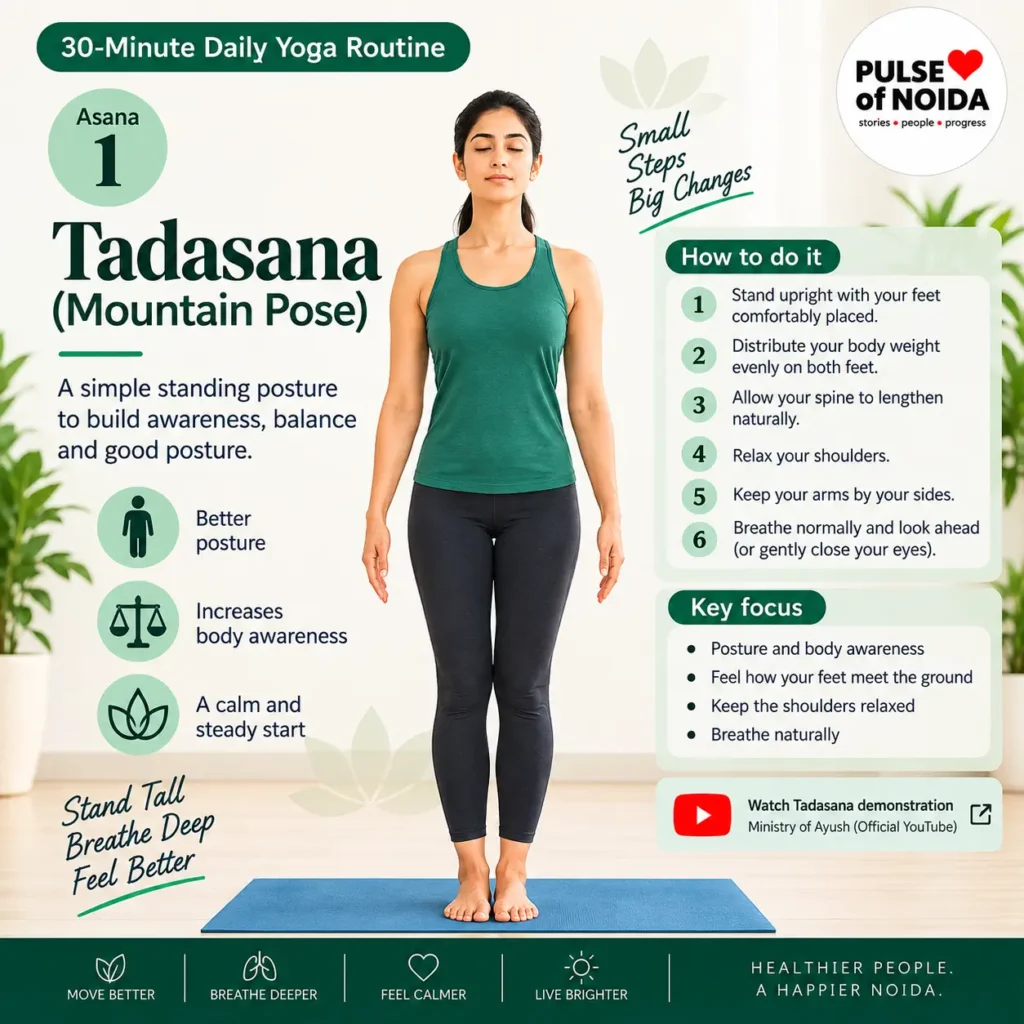
Stand upright with the feet comfortably placed.
Distribute your weight evenly.
Relax the shoulders and allow the spine to lengthen naturally.
Tadasana is a useful starting point because it asks you to notice something basic: how are you standing?
Are you leaning to one side?
Are the shoulders tense?
Are you locking the knees?
Yoga can begin with that awareness.
Watch Tadasana in the official Common Yoga Protocol
2. Vrikshasana | Tree Pose
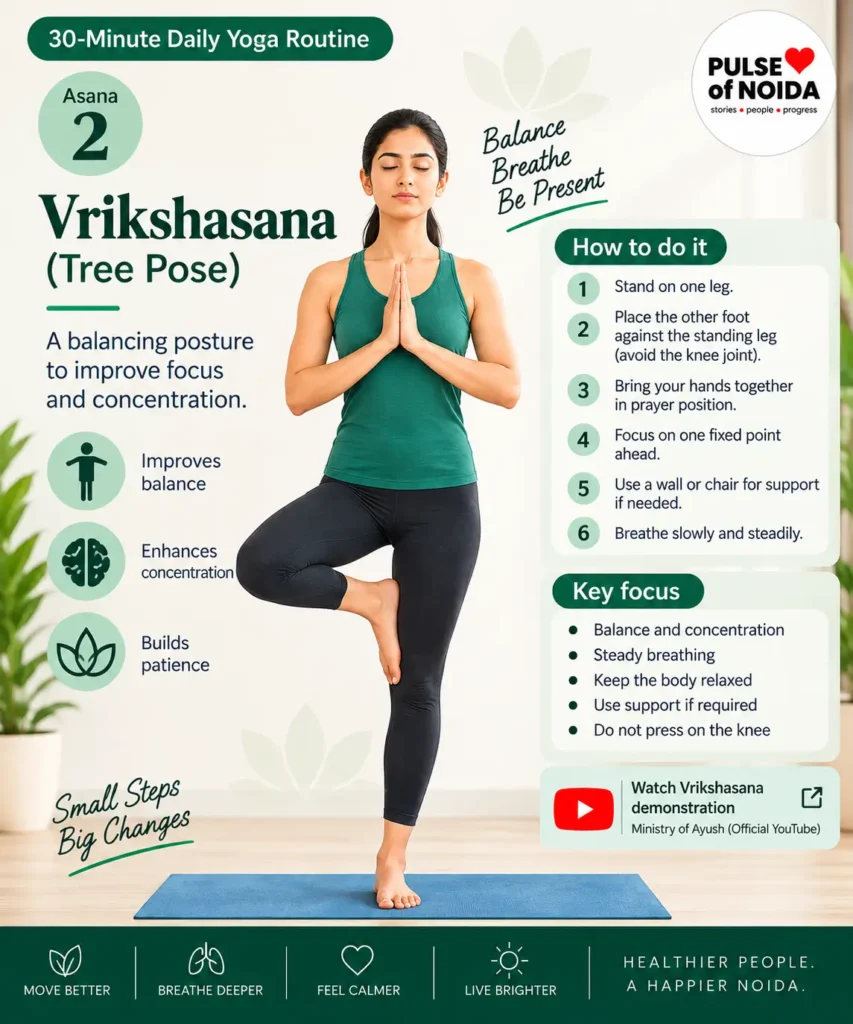
Stand on one leg and place the other foot against the standing leg at a comfortable level.
Avoid pressing directly against the knee.
Look at one fixed point ahead.
Use a wall or chair if needed.
Tree Pose introduces balance and concentration.
Support is perfectly acceptable.
The purpose is to practise balance, not prove that you can avoid using help.
Watch the official Ministry of Ayush Vrikshasana demonstration
3. Ardha Chakrasana | Standing Half-Wheel Pose
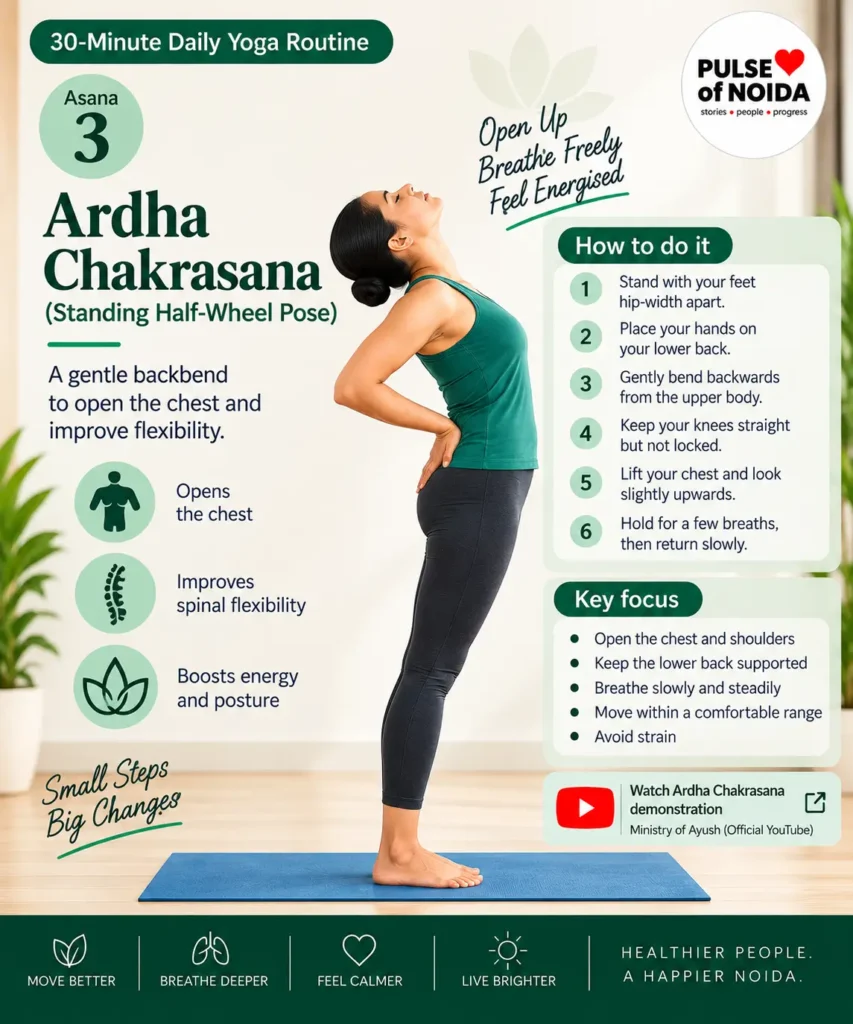
Stand upright and move gently into a small backward bend.
Keep the movement controlled.
There is no need to bend deeply.
The objective is simply to introduce gentle extension through the standing body.
Watch Ardha Chakrasana in the official Common Yoga Protocol
4. Vajrasana | Thunderbolt Pose
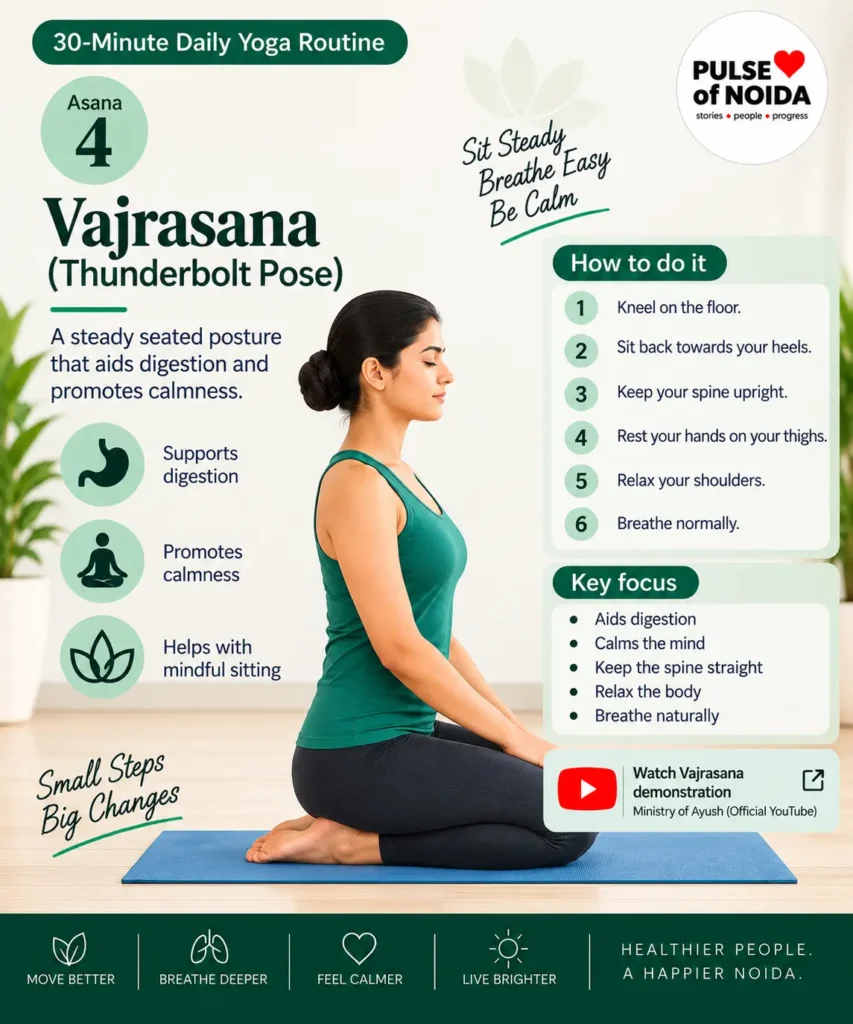
Kneel and sit back towards the heels if the knees and ankles are comfortable.
Keep the torso upright and allow the hands to rest on the thighs.
If kneeling is uncomfortable, use another seated position or a chair.
A yoga posture should be adapted to the body, not the other way around.
Watch Vajrasana in the official Common Yoga Protocol
5. Shashankasana | Hare Pose
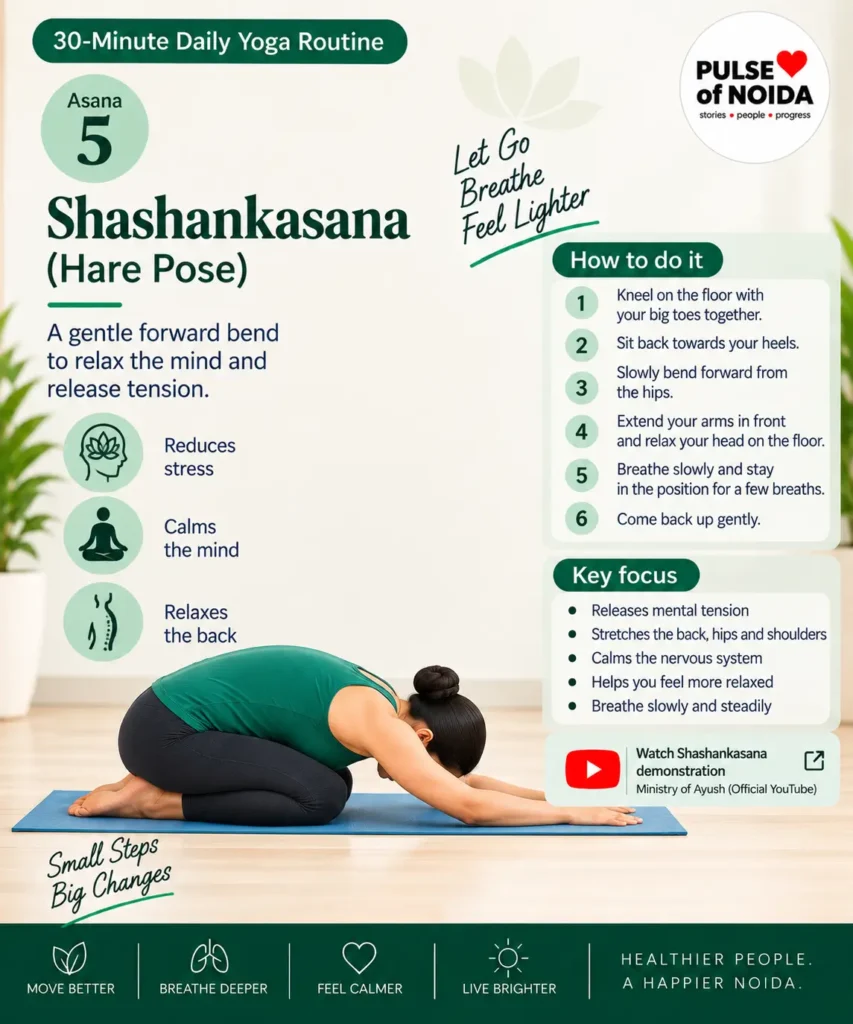
From a comfortable kneeling position, gradually move the torso forward.
Allow the arms to extend comfortably.
Do not force the forehead towards the floor.
The movement should feel controlled and relaxed.
The Common Yoga Protocol uses the transliteration Sasankasana for this posture.
Watch Sasankasana in the official Common Yoga Protocol
6. Bhujangasana | Cobra Pose
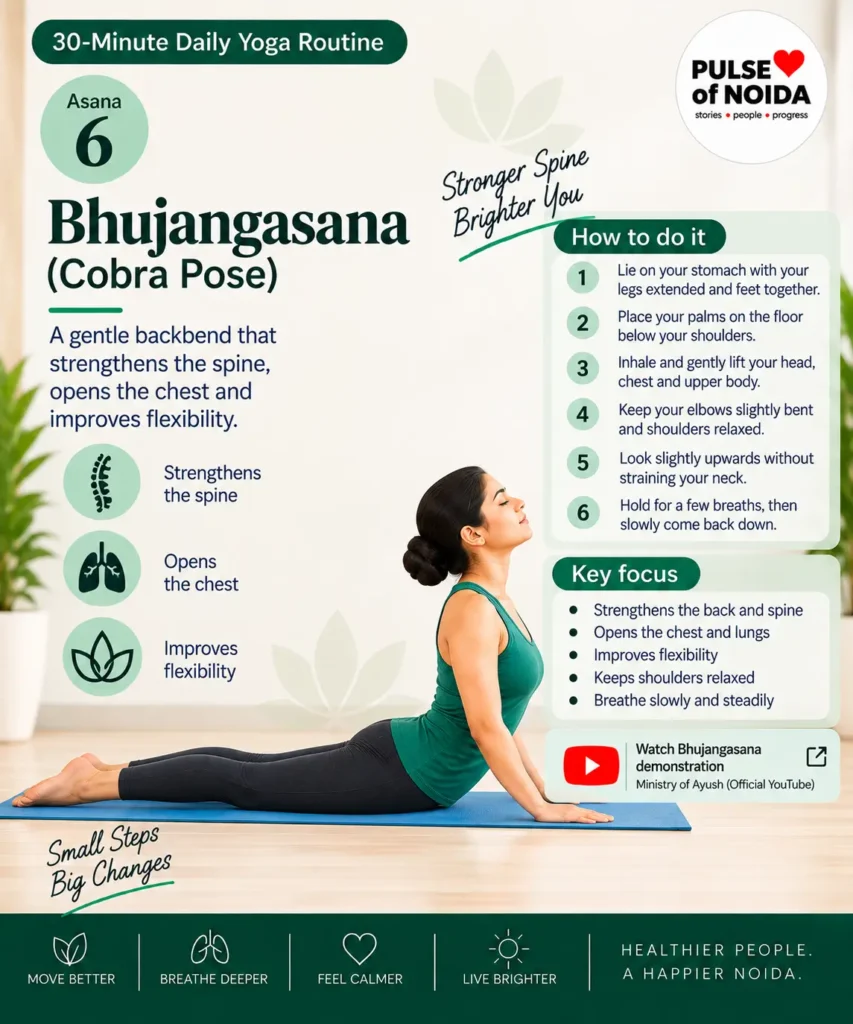
Lie on the abdomen.
Place the hands near the chest.
Gently lift the upper chest.
Do not push aggressively through the hands or force the lower back.
A smaller movement performed comfortably is enough.
Watch Bhujangasana in the official Common Yoga Protocol
7. Setu Bandhasana | Bridge Pose
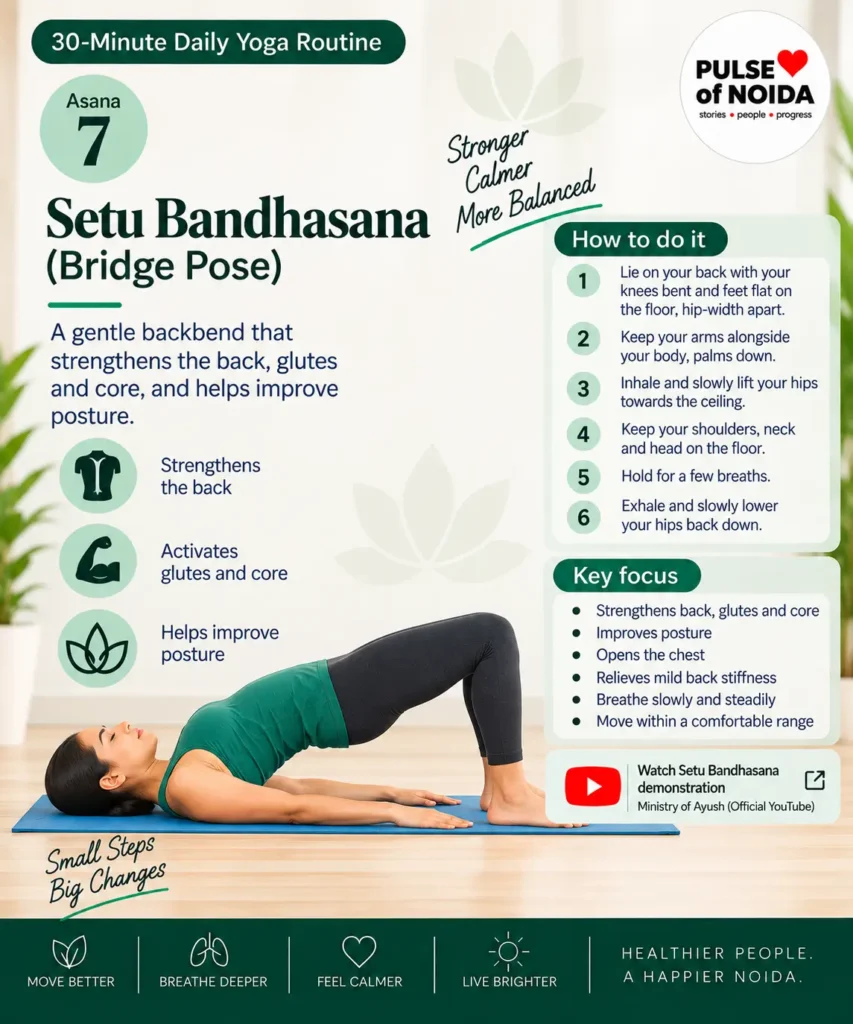
Lie on the back with the knees bent and feet on the floor.
Lift the hips gradually.
Pause at a comfortable height.
Lower slowly.
The movement should remain controlled from beginning to end.
Watch Setubandhasana in the official Common Yoga Protocol
8. Pavanamuktasana | Knee-to-Chest Pose
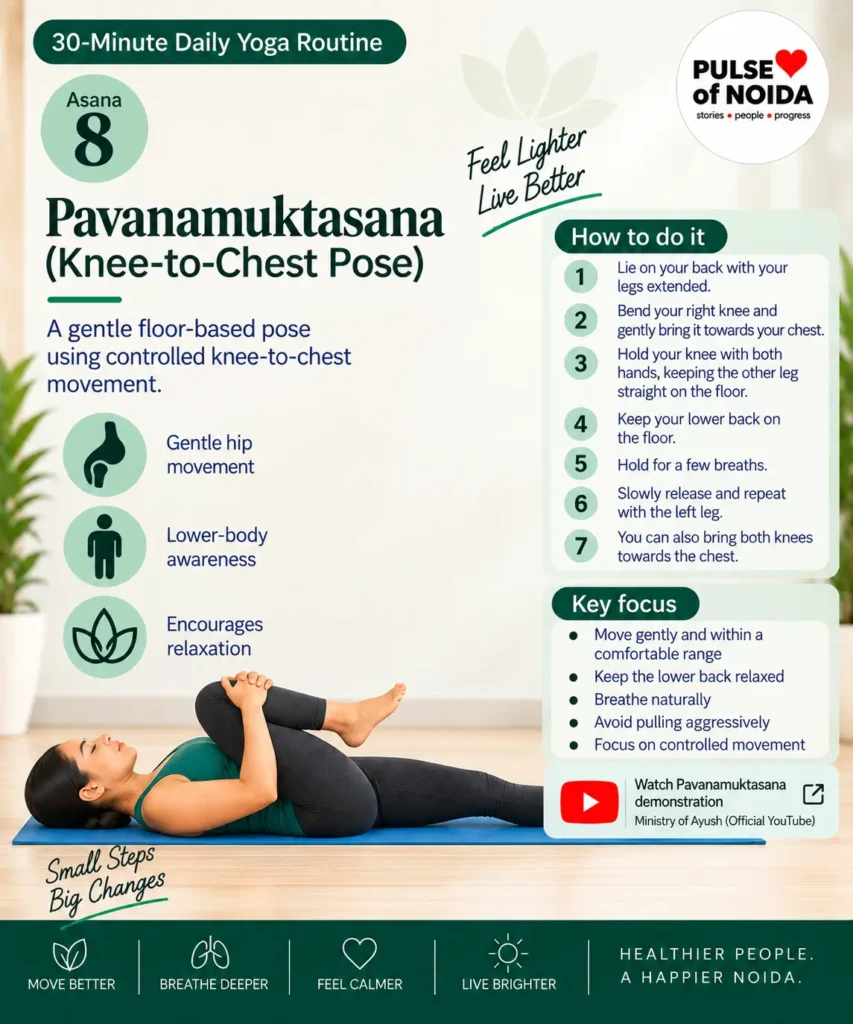
Remain on the back.
Bring one knee gently towards the torso.
Change sides.
If comfortable, bring both knees in.
Avoid pulling aggressively.
The objective is gentle movement, not maximum range.
Watch the official Ministry of Ayush Pavanamuktasana demonstration
Then Do Something That Feels Increasingly Unusual: Nothing
After the asanas, lie down for Shavasana.
For five minutes, stop trying to achieve anything.
Allow the legs to relax.
Rest the arms comfortably away from the body.
Close the eyes if comfortable.
Move attention gradually from the feet upwards through the body.
Notice the legs.
The abdomen.
The hands.
The shoulders.
The face.
Notice where tension remains.
Then simply allow the breathing to continue naturally.
Shavasana can look like the easiest posture in yoga.
In practice, it can be one of the most difficult.
Modern life has trained us to fill almost every empty moment.
A message.
A notification.
A video.
Another task.
Shavasana asks for something different.
Stay still. Stay awake. Do nothing for a few minutes.
What Can Yoga Reasonably Help With?
Yoga is often surrounded by exaggerated wellness claims.
It is better to stay with what evidence reasonably supports.
Research reviewed by NCCIH suggests yoga may support several areas of well-being.
Stress Management
Movement, breathing and focused attention can create a structured break from everyday demands.
Yoga has been studied for its possible role in managing perceived stress and supporting general well-being.
Sleep
Some research suggests yoga may support sleep in certain groups.
Persistent sleep problems, however, should be properly evaluated rather than self-treated through yoga alone.
Balance
Standing postures such as Vrikshasana challenge balance directly.
Balance becomes increasingly relevant as people age.
Mental and Emotional Well-Being
Yoga may support general mental and emotional well-being.
It should not replace professional care when a mental health condition requires treatment.
Mobility and Body Awareness
Yoga encourages controlled movement through different positions.
It can also make people more aware of everyday physical habits.
Are you sitting for too long?
Are your shoulders constantly raised?
Are you holding your breath when concentrating?
Are you repeatedly favouring one side of the body?
Sometimes the first benefit of a practice is simply noticing.
Is 30 Minutes Really Enough?
For establishing a yoga habit, 30 minutes provides enough time for the breathing, mobility, asanas and relaxation in this routine.
But 30 minutes of yoga should not be confused with an entire fitness programme.
Adults still need to consider their broader activity levels.
A balanced routine can include:
- Regular walking or aerobic activity
- Appropriate strength training
- Yoga
- Less prolonged sitting
- Regular everyday movement
Yoga can become one part of that larger pattern.
Morning Yoga or Evening Yoga?
There is no universal answer.
Morning practice works well for some people because the day has not yet become crowded with demands.
Others may find evening practice easier.
The better time is the one that actually fits your life.
A theoretically perfect routine that you repeatedly miss is less useful than a simpler practice you can maintain.
Do You Need Surya Namaskar Every Day?
No.
Surya Namaskar can be included if you are comfortable with the sequence.
But a meaningful yoga practice does not depend on completing a particular number of rounds.
For beginners, becoming comfortable with breathing, individual postures and controlled transitions may be more useful than chasing repetition.
Yoga Is Not a Competition With Your Own Body
One of the easiest mistakes is to turn yoga into another measure of performance.
How far can you bend?
How long can you hold a pose?
How many rounds can you complete?
Can you perform a more difficult posture than last month?
That approach can obscure the more useful questions.
Can you move comfortably?
Can you breathe naturally?
Can you recognise when something hurts?
Can you stop before forcing the body?
Bodies differ.
Age differs.
Mobility differs.
Injury histories differ.
The practice should reflect that.
Five Simple Rules for Safer Practice
- Do not continue through sharp or unusual pain
- Begin with simple, controlled movements
- Use support when balance requires it
- Modify or skip a posture if it does not suit your body
- Seek qualified guidance when learning unfamiliar techniques or practising with an injury or health condition
Forceful breathing, prolonged breath retention and extreme postures are not appropriate for everyone.
A Daily Routine, Not a 30-Day Challenge
There is a tendency to package wellness into short challenges.
Seven days.
Twenty-one days.
Thirty days.
Transformation photographs.
Before and after.
Yoga does not need that pressure.
Its value may be much quieter.
A few minutes of breathing every morning.
A little more awareness while standing.
A few controlled movements.
Five minutes of stillness.
Then doing it again the next day.
And the day after that.
Over time, the most important change may not be a more complicated posture.
It may be that movement, breathing and stillness stop feeling like special activities.
They simply become part of the way you live.
That may be the most practical meaning of yoga for life.
Your 30-Minute Routine at a Glance
2 minutes: Quiet breathing
6 minutes: Pranayama
- Diaphragmatic breathing
- Anulom Vilom
- Bhramari
3 minutes: Gentle mobility
12 minutes: Eight asanas
- Tadasana
- Vrikshasana
- Ardha Chakrasana
- Vajrasana
- Shashankasana
- Bhujangasana
- Setu Bandhasana
- Pavanamuktasana
5 minutes: Shavasana
2 minutes: Quiet sitting
Total: 30 minutes
Safety Note
Yoga is generally considered safe for healthy people when practised appropriately, but injuries can occur.
Beginners should learn unfamiliar postures carefully and may benefit from guidance from a qualified yoga instructor.
People with existing injuries, balance problems, cardiovascular conditions, glaucoma, spinal problems, recent surgery or other medical conditions may require modifications. Pregnancy and older age may also require individual guidance.
Forceful breathing exercises, prolonged breath retention and extreme postures are not appropriate for everyone.
This article provides general wellness information and is not a substitute for individual medical advice.
Official Sources
Ministry of Ayush, Government of India
Yoga Resources and Common Yoga Protocol
Morarji Desai National Institute of Yoga, Ministry of Ayush
Common Yoga Protocol 2026 | Official Video
World Health Organization
https://www.who.int/news-room/fact-sheets/detail/physical-activity
US National Center for Complementary and Integrative Health
Yoga: Effectiveness and Safety
https://www.nccih.nih.gov/health/yoga-effectiveness-and-safety