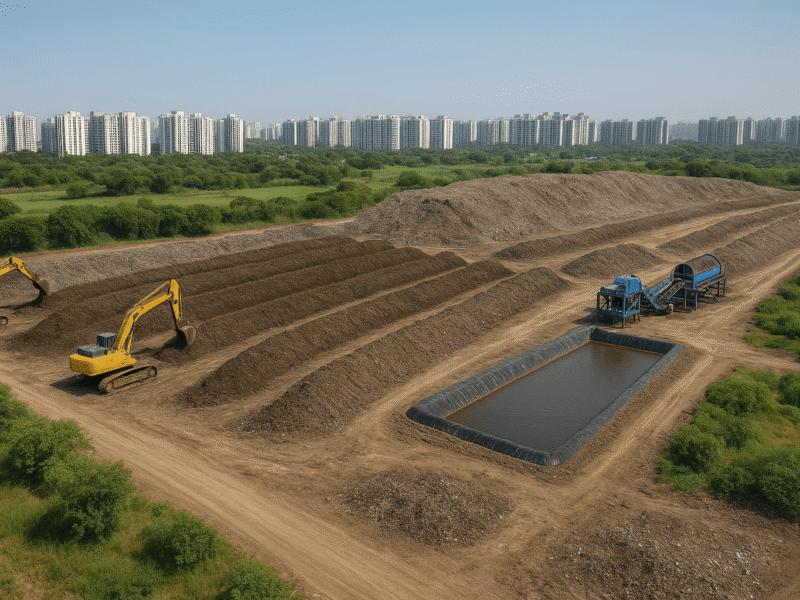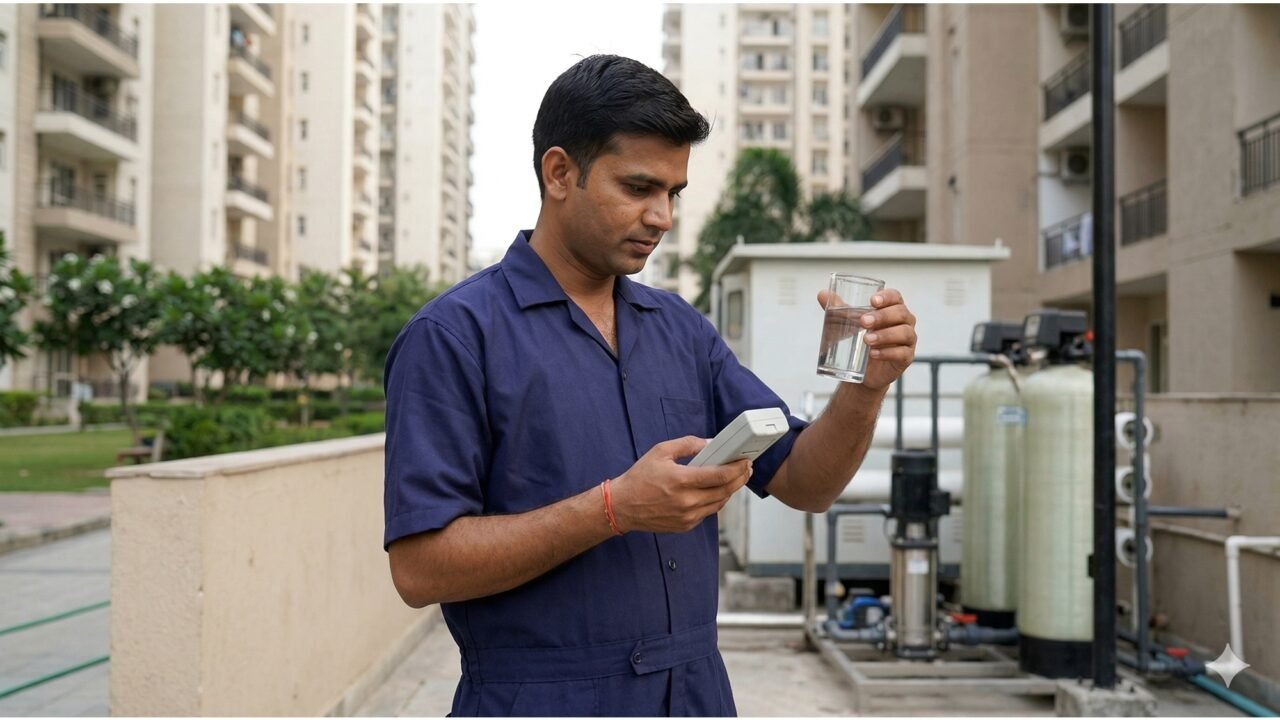
If tap water in your Noida apartment tastes unusually salty, leaves white deposits on taps, or suddenly feels different from what you are used to, the issue may not always begin at the city-supply level. In many group housing societies, water quality at the final household tap can be shaped by multiple layers such as storage tanks, internal pipelines, booster systems, filters, treatment equipment, and maintenance practices.
That is why residents should treat water quality concerns as a practical society-level issue first, and then escalate properly if required. Based on the official-source pack you collected, BIS IS 10500 remains the benchmark for drinking-water standards, Noida Authority provides official complaint channels, and unresolved grievances can be escalated through Uttar Pradesh’s Jansunwai or IGRS route. The same source pack also indicates that society-specific test reports are generally not published in a public Noida Authority dashboard, so residents often need to ask their AOA or maintenance office directly.
Why water quality can vary inside a Noida society
In a group housing setup, the water reaching your kitchen or bathroom tap may pass through several internal stages after entering the society. These can include underground reservoirs, overhead tanks, internal plumbing lines, pumps, and treatment or filtration systems.
The official material reviewed for this explainer shows that Noida’s building regulations require group housing projects above a certain height to have overhead tanks and booster pumps. The legal-regulatory framework cited in your source pack also indicates that maintenance responsibility for common facilities generally shifts to the association after handover and formation. In practical terms, that means the quality of water at the flat level can be influenced by society-side maintenance just as much as by the incoming supply.
What BIS says about TDS
TDS stands for Total Dissolved Solids. In simple terms, it reflects the amount of dissolved minerals and salts in water.
According to the BIS IS 10500 specification cited in your source pack, the acceptable limit for TDS is 500 mg/l, while the permissible limit in the absence of an alternate source is 2,000 mg/l. That distinction matters. A number above 500 does not automatically mean the water is unfit for every purpose, but it does mean the water is moving away from the ideal benchmark for drinking water under BIS.
The same official-source pack also cites BIS training material explaining that water below 500 mg/l generally has better palatability, while water becomes increasingly less pleasant as TDS rises beyond 1,000 mg/l. High TDS can also contribute to scaling and mineral buildup in pipes, geysers, and household appliances.
A practical point residents should remember
TDS is useful, but it is not the full story. A high TDS reading may explain taste or scaling issues, but residents should still ask for a proper lab report rather than relying only on one handheld reading. Your official-source pack specifically recommends asking for both physical-chemical and microbiological test reports.
What residents should ask their AOA or maintenance office for
Because there is no publicly available society-wise water-quality dashboard identified in the official-source pack, residents should ask their own AOA, maintenance office, or facility team for records relevant to their tower or society.
1) Recent water quality test reports
Ask for the latest laboratory report, ideally from a NABL-accredited facility if available. The report should not be limited to TDS alone. It should cover the broader drinking-water quality parameters the society is testing for.
2) Tank cleaning records
Ask when the underground reservoir and overhead tanks were last cleaned and disinfected. The official-source pack cites government maintenance guidance that supports regular cleaning and disinfection, and it is reasonable for residents to ask for the actual society cleaning schedule and dated service records.
3) WTP or treatment logs
If your society has a water treatment or filtration setup, ask for operating logs, output readings, or maintenance history. These records can help residents understand whether the problem is temporary, tower-specific, or recurring.
4) Source mix information
Ask whether the society is using treated supply, borewell water, tanker water, or a combination. Mixed sources can affect consistency, especially from one block or tower to another.
Who is generally responsible inside a society
The official legal-regulatory references in your source pack point to a layered structure. Builders or their appointed agencies initially maintain common areas and common water infrastructure, but after handover and the formation of the association, maintenance responsibility for common facilities generally shifts to the AOA or association framework.
For residents, the practical meaning is simple. If the issue appears limited to one flat, it may be a home plumbing or filter issue. If it affects a tower, the problem may be in tower storage or internal lines. If it affects multiple blocks, the society-level storage, treatment, or maintenance system may need checking.
What to check before filing a complaint
Before escalating, residents should do a few simple checks:
Compare points inside the home
Check whether the issue appears only in the kitchen tap, only in one bathroom, or across the flat.
Check with neighbours
Ask whether nearby flats or the same tower are facing the same issue. Shared symptoms usually point to a common system-level issue.
Note visible symptoms
Record whether the issue is about taste, smell, colour, sediment, scaling, staining, or low pressure.
Check your own filter status
If you use RO or filtration equipment at home, confirm whether the filter service is overdue.
These steps help make the complaint more specific and more useful.
How to file a water complaint properly in Noida
The official-source pack identifies the Noida Authority “Reach Us” page as the primary city-level route for civic complaints and notes a WhatsApp grievance number, 9205559204, for submitting complaints. The same pack says complaint messages should include name, address, and complaint details.
A better complaint format
Instead of writing “water is bad,” residents should include:
- society name, tower, flat number, and sector
- date and time when the issue was noticed
- type of issue: high TDS reading, salty taste, smell, low pressure, residue, or visible particles
- whether neighbours are facing the same issue
- whether the society has shared any recent cleaning or testing record
- photos, screenshots, or meter readings if available
A specific complaint is easier to track than a general complaint.
When to escalate to Jansunwai
If the matter remains unresolved after using the local complaint route, the official-source pack identifies Uttar Pradesh’s IGRS / Jansunwai system as the state-level escalation path for unresolved civic grievances.
Residents should usually escalate when:
- the problem is persistent
- the society does not share records despite repeated requests
- the issue affects multiple homes
- the local complaint response is incomplete or delayed
Final takeaway
This is not a story about blaming one side. It is a practical guide for residents living in apartment societies where water quality at the tap can depend on more than one layer of infrastructure and maintenance.
If you are concerned about water in your society, start with records, not rumours. Ask your AOA or maintenance office for the latest test reports, tank cleaning records, and treatment logs. Use BIS TDS benchmarks as a reference point, but do not rely on TDS alone. And if the issue is not resolved, use the official Noida Authority route first, then escalate through Jansunwai if required.
Official Sources
- BIS IS 10500:2012 Drinking Water Specification
- Jal Jeevan Mission safe drinking water guidance
- Noida Authority Jal-Sewer Division
- Noida Authority Reach Us / Lodge Grievances
- Noida Building Regulation document
- UP RERA builder-buyer agreement reference
- UP REAT order reference
- UP Jansunwai / IGRS escalation reference