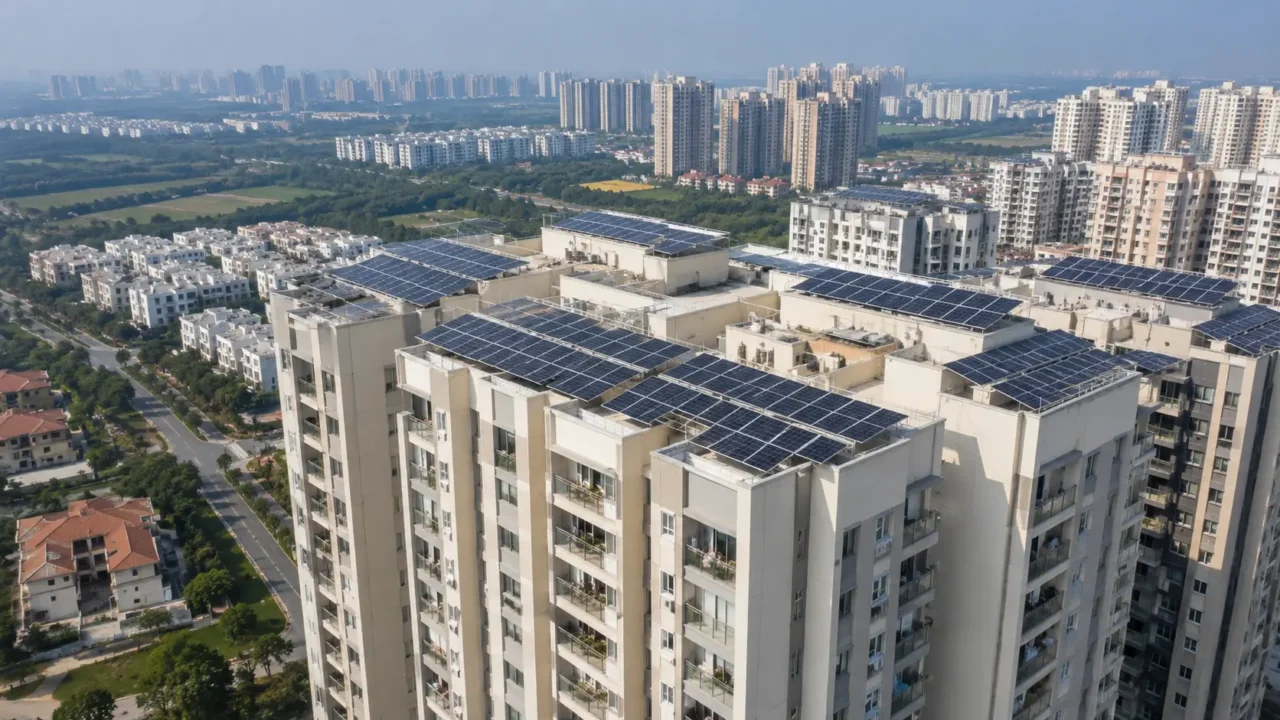
Arihant Arden in Sector 1, Greater Noida West, has commissioned a large grid-connected rooftop solar plant to supply electricity to lifts, water pumps, corridor lights, club facilities and other common infrastructure.
Current information attributed to Noida Power Company Limited and the Arihant Arden Apartment Owners Association describes the commissioned plant as a 500 kWp rooftop solar system. It is expected to reduce the electricity purchased from the grid for common-area operations.
The project does not supply solar electricity directly to individual apartments. Household electricity connections and domestic bills will continue through the existing metering arrangement.
Residents may benefit indirectly if lower common-area electricity expenditure reduces pressure on maintenance charges or allows the association to redirect funds to other shared services.
Arihant Arden solar project at a glance
Location: Arihant Arden, Sector 1, Greater Noida West
Reported commissioned capacity: 500 kWp
Main use: Common-area electricity
Facilities covered: Lifts, pumps, corridors, club facilities and shared infrastructure
Apartment owners expected to benefit: 1,519
Reported central financial assistance: ₹80 lakh
Estimated annual generation: 6 lakh to 7.5 lakh electricity units
Projected annual saving: ₹40 lakh to ₹45 lakh
Electricity for individual flats: No
Distribution company: Noida Power Company Limited
These figures are based on statements attributed to NPCL and the AOA. The generation and savings numbers are projections. Their accuracy can be assessed only after sufficient operational and billing data becomes available.
Why the capacity needed additional verification
The Arihant Arden AOA issued an original rooftop-solar tender in July 2025 describing the proposed system as 500 kVA.
That tender was cancelled on 8 November 2025 because of administrative and technical review considerations. The AOA said a revised tender would be issued with updated technical specifications and timelines. The revised tender document is not currently visible on the AOA’s public tender page.
This matters because kVA and kWp are different technical units.
- kWp usually refers to the rated peak output of the solar-panel array.
- kVA generally refers to apparent electrical power and may describe inverter or connected equipment capacity.
The earlier tender’s use of 500 kVA should therefore not be treated as confirmation of the final solar-panel capacity.
More recent information attributed directly to NPCL and the AOA describes the commissioned plant as 500 kWp. Pulse of Noida is using that commissioned-project description while clearly disclosing the different unit used in the cancelled tender.
What will the plant power?
The rooftop plant has been designed to meet part of the electricity demand from the society’s common facilities.
These can include:
- Lifts
- Water pumps
- Corridor and basement lighting
- Security infrastructure
- Club and administrative facilities
- Sewage-treatment equipment
- Common ventilation systems
- Other shared electrical services
The electricity generated during daylight hours can offset part of the energy that the society would otherwise purchase from the grid.
It does not mean every apartment receives a direct rooftop-solar connection.
What does 500 kWp mean?
Kilowatt-peak, written as kWp, is the rated peak output of a solar photovoltaic system under standard test conditions.
A 500 kWp plant does not produce 500 kilowatts continuously.
Actual output changes according to:
- Sunlight
- Cloud cover
- Temperature
- Dust
- Shadows
- Panel orientation
- Inverter performance
- System downtime
- Maintenance quality
The installed capacity is therefore a technical rating, not a guarantee of continuous generation.
How much electricity could the project generate?
NPCL-attributed information says the plant is expected to generate approximately 6 lakh to 7.5 lakh units of electricity annually under normal operating conditions.
The actual annual output may vary because of weather, panel cleaning, equipment performance and operational downtime.
A reliable performance assessment should compare:
- Monthly solar generation
- Electricity purchased from the grid
- Pre-installation electricity bills
- Post-installation electricity bills
- System downtime
- Maintenance costs
- Financing costs
At least 12 months of data will be needed to understand how the plant performs across summer, monsoon and winter conditions.
How much could the society save?
The Arihant Arden AOA expects the project to save approximately ₹40 lakh to ₹45 lakh annually on common-area electricity expenditure.
This should be described as a projected saving, not an audited result.
Actual financial savings will depend on:
- Electricity generated
- Electricity tariff
- Billing and metering arrangements
- Maintenance expenses
- Inverter and equipment performance
- Loan or financing costs
- System downtime
- Replacement costs over the plant’s life
Residents should ask the AOA to publish periodic generation and billing reports so that the projected benefit can be compared with the actual result.
How does the government subsidy work?
The official PM Surya Ghar portal states that group housing societies and resident welfare associations can receive central financial assistance of ₹18,000 per kW for solar installations serving common facilities, including EV charging, up to a maximum eligible capacity of 500 kW.
At the displayed scheme rate, the theoretical maximum for a fully eligible 500 kW common-facility installation would be ₹90 lakh.
However, NPCL-attributed project information says Arihant Arden received ₹80 lakh in central financial assistance within 30 days of commissioning approval. For Arihant Arden, the reported project-specific assistance is ₹80 lakh, rather than the scheme’s theoretical maximum of ₹90 lakh.
The difference may relate to final eligible capacity, approved costs, scheme processing or other project-specific conditions. No public subsidy-release document reviewed by Pulse of Noida explains the calculation.
What role did NPCL play?
According to the current project information, NPCL provided technical guidance, regulatory approvals and grid-synchronisation support.
Grid synchronisation is important because a large rooftop system must operate safely with the electricity distribution network. The installation must comply with applicable technical and metering requirements before it can be connected.
NPCL also provides rooftop-solar information and calculation tools for consumers in its service area. Societies should begin discussions with the distribution company before finalising the system design or signing a vendor contract.
Residents who are unsure which electricity company serves their property can refer to Pulse of Noida’s NPCL versus PVVNL electricity connection guide.
Is Arihant Arden the first society to do this?
Current reporting describes the project as Gautam Budh Nagar’s first high-rise residential rooftop-solar project under the PM Surya Ghar scheme.
NPCL has also described it as a pioneering project for the district.
Pulse of Noida has not reviewed a complete official register of every rooftop-solar installation in Delhi-NCR.
Publicly available evidence does not establish that Arihant Arden is the first such society in the entire Delhi-NCR region.
The safer conclusion is that it is a significant early example of a large common-area rooftop-solar project in a Greater Noida West high-rise society.
What other RWAs and AOAs should learn
Arihant Arden’s experience shows that community rooftop solar involves more than placing panels on unused terraces.
1. Start with 12 months of electricity bills
The association should examine at least one year of common-area electricity consumption.
The review should establish:
- Monthly consumption
- Daytime demand
- Seasonal peaks
- Sanctioned load
- Applicable tariff
- Electricity used by lifts and pumps
- Available rooftop area
The system should be designed around actual demand and safe rooftop capacity, not only around the maximum subsidy available.
2. Conduct a structural and technical assessment
High-rise rooftops may contain:
- Water tanks
- Fire-safety equipment
- Utility rooms
- Communication systems
- Restricted-access areas
- Waterproofing layers
- Maintenance pathways
The feasibility study should examine:
- Structural capacity
- Wind-load requirements
- Shadow-free space
- Panel anchoring
- Waterproofing
- Lightning protection
- Fire access
- Cable routes
- Maintenance access
- Safety near water tanks and electrical equipment
Appropriate structural and electrical certification should be obtained before installation.
3. Obtain transparent resident approval
A major capital project should be approved through a documented and transparent process.
Residents should receive information on:
- Total project cost
- Subsidy assumptions
- Financing
- Expected generation
- Expected savings
- Payback period
- Vendor selection
- Warranty
- Maintenance
- Insurance
- Technical risks
- Financial risks
Meeting minutes, voting records and approvals should be retained.
4. Confirm subsidy eligibility before calculating returns
The published subsidy rate does not mean that every society will automatically receive the maximum amount.
Eligibility and final financial assistance can depend on:
- Approved project capacity
- Metering arrangement
- Common-area load
- Documentation
- Vendor compliance
- Distribution-company approval
- Scheme rules in force at the time
The Arihant Arden case itself shows why societies should distinguish the theoretical maximum subsidy from the amount finally approved.
5. Use a competitive and transparent tender
The tender should specify:
- Solar-panel standards
- Inverter specifications
- Design capacity
- Expected generation
- Performance guarantees
- Monitoring system
- Product warranties
- Installation warranty
- Maintenance period
- Safety requirements
- Insurance
- Delay penalties
- Payment milestones
The lowest financial bid may not provide the best lifetime value.
The AOA’s earlier decision to cancel its original tender for administrative and technical review also demonstrates that specifications may need to be revised before a project is commissioned.
6. Understand the financing cost
A project can produce electricity savings but still create financial pressure if it is funded through expensive borrowing.
Associations should calculate:
- Interest costs
- Repayment schedule
- Monthly cash flow
- Expected electricity saving
- Maintenance expenditure
- Reserve-fund commitments
- Equipment-replacement costs
- Risk if generation falls below projections
The financial model should be shared with residents before approval.
7. Publish actual performance
Once the system is operational, residents should receive regular information on:
- Units generated
- Grid electricity purchased
- Monthly electricity bill
- System downtime
- Cleaning and maintenance expenditure
- Financing repayments
- Net monthly saving
- Difference between projected and actual performance
Transparent reporting is essential because residents ultimately fund and depend on the society’s common services.
What residents should watch during the first year
Arihant Arden’s rooftop solar plant has only recently become operational.
The strongest evidence of success will not be the installed capacity alone. It will be the plant’s performance over a complete year.
Residents should watch for:
- Summer generation
- Monsoon generation
- Winter generation
- Maintenance frequency
- Inverter downtime
- Panel cleaning
- Electricity-bill reduction
- Financing costs
- Actual net saving
- Impact on maintenance charges
Greater Noida and Noida have experienced sharp growth in electricity demand during peak summer conditions. Rooftop solar for common facilities could become one part of the response, but it cannot replace reliable grid infrastructure or careful energy management. See Pulse of Noida’s explainer on rising power demand across Noida and Greater Noida.
Why the project matters
Large high-rise societies consume substantial electricity through shared facilities.
If the Arihant Arden plant produces the expected generation and savings, it could offer a useful model for other housing societies with:
- Sufficient rooftop space
- High daytime common-area demand
- Strong financial governance
- Transparent resident approval
- Appropriate structural capacity
- Reliable maintenance arrangements
The project should not be judged only by its launch announcement.
Its real value will become clear when residents can see a full year of generation, electricity bills, maintenance expenses and net savings.
Editorial disclosure
The commissioned capacity, subsidy received, expected generation, number of apartment owners and projected savings are based on current information attributed to NPCL and Arihant Arden AOA representatives.
The AOA’s public tender page separately records that an earlier tender describing a 500 kVA system was cancelled in November 2025 for administrative and technical review.
Pulse of Noida has disclosed both records to distinguish the earlier tender specification from the subsequently reported commissioned capacity.
Source attribution
This article is based on:
- Arihant Arden AOA official tender and cancellation notices
Original tender and cancellation records:
https://www.arihantardenaoa.org/tender.asp - PM Surya Ghar official subsidy information
Central financial assistance rates and eligibility for group housing societies:
https://pmsuryaghar.gov.in/ - NPCL rooftop-solar information
Net metering and rooftop solar guidance for consumers in the NPCL service area:
https://www.noidapower.com/rooftop-solar - Current reporting quoting NPCL spokesperson Manoj Jha and Arihant Arden AOA president Nishit Kant Chaturvedi
Hindustan Times report on the project’s commissioning, capacity, subsidy amount, generation estimates and savings projections:
https://www.hindustantimes.com/cities/noida-news/g-b-nagar-commissions-1st-rooftop-solar-project-in-a-high-rise-residential-society-101784139551890.html