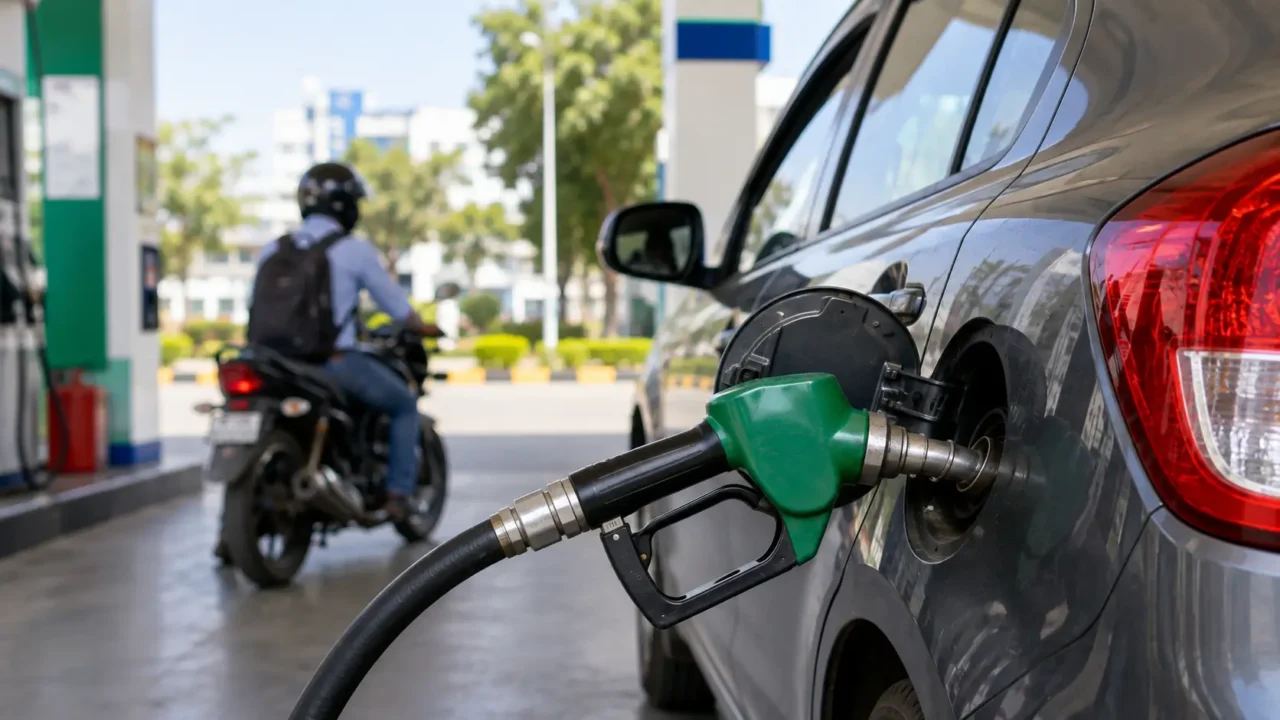
If you drive a petrol car or two-wheeler in Noida, E20 is no longer simply a future fuel target. The Ministry of Petroleum and Natural Gas says that from April 2026, petrol sold across India is mandated to contain 20% ethanol and meet a minimum Research Octane Number of 95.
For owners of older vehicles, however, that national policy does not answer every model-specific question. The government has reported that extensive trials found no compatibility issue or adverse impact on vehicle performance from E20, while the Automotive Research Association of India, or ARAI, says vehicles specifically validated for E20 undergo extensive durability and performance testing. For an individual older car or motorcycle, manufacturer guidance remains the safest source for model-specific compatibility and maintenance advice.
At a glance
- E20 is petrol blended with 20% ethanol.
- From April 2026, the government says petrol sold across India is mandated at the E20 level with a minimum RON of 95.
- ARAI says E20-compatible vehicles undergo extensive durability, performance and reliability testing.
- ARAI’s laboratory testing of validated vehicles found a fuel-efficiency difference in the range of 2% to 6%.
- Real-world mileage can also vary because of driving conditions, maintenance, vehicle condition and driving behaviour.
- Owners of older cars and bikes should check the guidance for their exact model rather than relying on generic compatibility lists circulating online.
What exactly is E20 petrol?
E20 is petrol containing 20% ethanol. India’s Ethanol Blended Petrol Programme has progressively increased the proportion of ethanol blended with petrol, and the government’s current position is that E20 is now the national petrol baseline rather than an upcoming target.
For residents interested in the other side of this transition, Pulse of Noida has previously examined how ethanol demand connects Noida with the sugarcane economy of Western Uttar Pradesh.
What does the government say about vehicle compatibility?
The Government of India says its assessment of E20 was supported by research involving Indian Oil Corporation, ARAI and the Society of Indian Automobile Manufacturers. It has stated that extensive field trials found no compatibility issues or adverse impact on vehicle performance with E20.
That is an important national finding, but owners should distinguish it from a model-specific certification.
A petrol vehicle sold years before the E20 transition may have been designed and certified under different fuel specifications. Whether a particular model has specific maintenance requirements, component recommendations or manufacturer instructions should therefore be checked against the vehicle maker’s official information.
What does ARAI say about E20-ready vehicles?
ARAI said in July 2026 that vehicles developed as E20-compatible undergo structured validation covering durability, performance and reliability. According to ARAI, manufacturers test vehicles across different categories for approximately 40,000 to 60,000 kilometres under laboratory and field-testing programmes.
These evaluations include the engine, fuel lines and other vehicle components that can be affected by fuel characteristics.
This is another reason owners should be cautious about blanket online claims applying the same conclusion to every car or motorcycle irrespective of model, age or manufacturer specification.
Will E20 reduce mileage?
This is one of the biggest questions for vehicle owners.
ARAI says standard laboratory tests on validated vehicles found the fuel-efficiency difference associated with E20 to be within a range of 2% to 6%. It also cautions that actual fuel consumption depends on factors such as driving behaviour, road conditions and the baseline condition of the vehicle.
The qualification matters. A laboratory range for validated vehicles should not be converted into a promise that every vehicle in Noida will lose exactly 2% to 6% mileage.
Traffic conditions, tyre pressure, servicing, air-conditioning use, driving style and the mechanical condition of an older vehicle can all affect what an owner actually observes.
I have an older petrol car or bike. What should I check?
The safest approach is to identify the exact vehicle, rather than relying only on its registration year.
1. Check the owner’s manual
Look for the manufacturer’s specified petrol and ethanol-blend requirements for your exact model and variant.
2. Check the manufacturer’s official guidance
Some manufacturers publish fuel-compatibility information or technical guidance on their official websites. Use the manufacturer’s information rather than an unofficial model list.
3. Ask the authorised service network if the documentation is unclear
ARAI itself advises consumers to use their authorised dealer network for routine maintenance and operational issues.
For an older vehicle, ask specifically whether the manufacturer recommends any inspection, maintenance or component change related to continued use with E20.
4. Keep a record if you report a problem
If you believe your vehicle has developed an operational problem, record the symptoms, fuel bills and service history and ask the authorised workshop to diagnose the cause.
A mileage reduction or mechanical problem should not automatically be attributed to ethanol content without diagnosis.
Do I need to modify an older vehicle?
There is no responsible one-size-fits-all answer for every older petrol vehicle.
The approved government and ARAI sources support the national E20 programme and testing of E20-ready vehicles, but they do not provide Pulse of Noida with a manufacturer-by-manufacturer list specifying modifications for every older model on Indian roads.
For that reason, Pulse of Noida is not publishing an unsourced universal compatibility table.
If your owner’s manual does not clearly address E20, the appropriate next step is to seek guidance for your exact vehicle from the manufacturer or its authorised service network.
Can drivers simply choose E10 instead?
The Ministry of Petroleum and Natural Gas says that from April 2026, petrol sold across India is mandated to contain 20% ethanol and meet the current minimum RON requirement.
On the approved source set available for this guide, there is therefore no basis to tell Noida residents that E10 remains available as a regular nationwide alternative.
Drivers should also avoid experimenting with additives, mixing fuels themselves or modifying the fuel system without manufacturer-approved guidance.
What should Noida vehicle owners remember?
For most residents, the useful distinction is between national E20 policy and vehicle-specific advice.
The national position is clear: E20 is now the petrol baseline, and the government and ARAI say the transition has been supported by vehicle testing.
For an individual older car or motorcycle, however, the owner’s manual and manufacturer remain the appropriate sources for questions about compatibility, servicing, warranty or any recommended component changes.
That is particularly important when online discussions present broad claims as though every vehicle behaves identically.
Sources
Ministry of Petroleum & Natural Gas, Government of India
Ethanol Blended Petrol Programme: Q&A, 10 July 2026
This is the controlling source for the current national E20 baseline and the government’s summary of its compatibility assessment.
Ministry of Heavy Industries / Automotive Research Association of India
ARAI Reaffirms Rigorous Validation Standards for E20 Ethanol-Blended Fuel and Vehicle Performance, 4 July 2026