Parents looking at school programmes in Noida and Greater Noida increasingly encounter terms such as Artificial Intelligence, coding, robotics, maker labs and vocational education. But these labels do not necessarily describe the same kind of course.
The Central Board of Secondary Education has a defined Artificial Intelligence skill subject, code 417, and has published a curriculum for it. Schools may also separately run coding classes, robotics clubs, innovation labs or extracurricular technology programmes.
That distinction matters.
The CBSE framework does not mean that every CBSE-affiliated school in Noida or Greater Noida offers AI 417, coding, robotics or any particular skill subject. Parents should check the programme offered by their child’s school directly before treating a technology-labelled activity as a formal CBSE subject.
What is CBSE Artificial Intelligence 417?
CBSE lists Artificial Intelligence, subject code 417, among its skill subjects for Classes IX and X.
For the 2026-27 academic session, CBSE has also published a dedicated Class IX Artificial Intelligence curriculum.
The curriculum introduces students to areas including:
- Applications of artificial intelligence;
- Major AI domains;
- The AI project cycle;
- Ethics and responsible AI;
- Mathematics used in AI;
- Data literacy;
- Generative AI;
- Introductory Python programming.
The curriculum also introduces students to Data, Computer Vision and Natural Language Processing as important AI domains.
This makes AI 417 different from a general technology workshop or a short coding programme. It is a defined CBSE skill subject with an official curriculum.
Is AI 417 compulsory for every CBSE student?
Parents should be careful with this distinction.
CBSE’s current skill-education framework lists a range of skill and vocational subjects, including Artificial Intelligence 417. However, the presence of AI in the CBSE curriculum does not establish that every school offers it to its students.
The actual subject choices available can depend on the school and its academic programme.
Parents should therefore ask the school specifically:
“Does the school offer CBSE Artificial Intelligence 417, and for which classes?”
A school saying that it teaches “AI” is not, by itself, enough to establish that students are taking CBSE AI 417.
AI, coding and robotics are not automatically the same thing
This is probably the most useful distinction for parents.
CBSE AI 417
This is a formal CBSE skill subject with an official curriculum and subject code.
Coding
Coding usually refers to learning how to write computer programs. Depending on the school, coding may be:
- Part of another subject;
- Incorporated into AI learning;
- Taught during computer classes;
- Offered through a school club;
- Provided as an extracurricular programme.
Parents should check exactly where the programme sits within the school’s curriculum.
Robotics
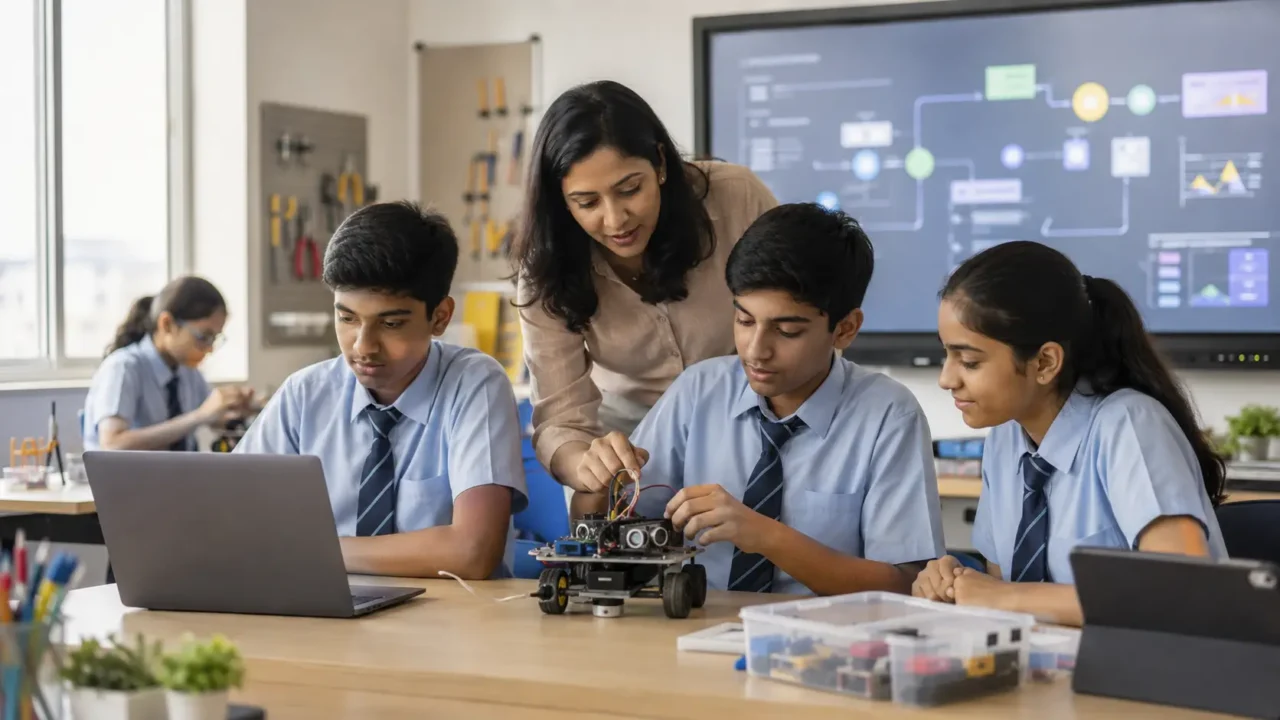
Robotics usually combines elements such as programming, electronics, sensors, mechanics and problem-solving.
A school may offer robotics through:
- A regular classroom programme;
- A robotics or innovation lab;
- A school club;
- Competitions;
- An external training provider;
- A paid extracurricular programme.
A robotics programme should therefore not automatically be described as a CBSE AI subject.
AI clubs and extracurricular programmes
Schools may also expose students to AI through workshops, clubs, innovation challenges, maker activities or external programmes.
These can provide useful learning experiences, but parents should distinguish them from a board-recognised academic subject.
What does vocational or skill education mean in CBSE?
CBSE’s skill-education framework covers a much wider range of subjects than AI.
The current Class IX curriculum page includes vocational and skill-learning options across multiple fields. Artificial Intelligence is one of those technology-related options, alongside subjects from several other sectors.
For parents, the broader point is important: skill education is not limited to coding or AI.
A student’s interests may be better suited to another skill subject, depending on what the school offers and what the student wants to explore.
Seven questions parents should ask the school
Before choosing an AI, coding or robotics programme, parents can ask these questions.
1. Is this CBSE Artificial Intelligence 417?
Ask for the subject name and CBSE subject code.
If it is AI 417, the school should be able to explain how it fits into its academic programme.
2. Is it part of the curriculum or an extracurricular activity?
An AI club and a formal skill subject serve different purposes.
Both can be valuable, but parents should know what they are paying for and what the student will receive.
3. Which classes can take the programme?
Do not assume a programme advertised by the school is available across all grades.
Ask exactly which classes participate.
4. Who teaches it?
Find out whether the programme is delivered by:
- Regular school teachers;
- Specialist teachers;
- An external education company;
- Or a combination.
If an external provider is involved, parents can ask for the provider’s name.
5. Is there an additional fee?
Some programmes may be included within normal school fees while others may be optional paid activities.
Parents should ask this before enrolment.
6. What do students actually build or learn?
A useful programme should be explainable in concrete terms.
Parents can ask about:
- Coding exercises;
- AI projects;
- Data activities;
- Robotics builds;
- Practical assignments;
- Presentations;
- Competitions.
The objective is not to count buzzwords but to understand what students actually do.
7. How is learning assessed?
Ask whether the programme involves:
- Formal assessment;
- Project evaluation;
- Practical work;
- Participation only;
- Or no assessment.
This helps parents understand whether it is an academic subject, enrichment programme or recreational club.
Ask for the school’s current document
One simple way to avoid confusion is to ask the school for its current 2026-27 subject-selection circular, curriculum handbook, parent circular or official programme page.
This is more reliable than relying only on promotional descriptions.
A school’s website may describe an AI or robotics facility, for example, without making clear whether every student takes the programme or whether it is an optional activity.
What about after-school coding and robotics?
Parents looking specifically for extracurricular learning can also explore PON’s guide to after-school coding, robotics, art and other classes in Noida.
That is a different question from whether AI or robotics forms part of a child’s regular school curriculum.
Keeping the two categories separate can make it easier to decide whether a child needs additional training outside school.
What happens after school-level AI learning?
School-level exposure is only one part of a much larger skills pathway.
Noida has also seen initiatives focused on AI, robotics and digital career skills for young people, while Greater Noida is developing a broader skills and vocational-training ecosystem.
Students looking beyond school can also use PON’s guide to job-oriented skill development and training options in Noida.
None of these pathways means a child needs to specialise in AI at an early age. For parents, the more immediate question is whether a programme is appropriate for the student’s interests and whether the school clearly explains what is being taught.
What PON is checking next
Pulse of Noida is separately working on a comparison of AI, coding, robotics and vocational programmes offered by selected schools across Noida, Greater Noida and Greater Noida West.
That reporting will distinguish formal CBSE subjects from school-run clubs, extracurricular programmes and externally delivered courses.
Until that school-level reporting is complete, PON is not making a claim about how widely AI 417 or robotics is currently offered across Noida schools.
For now, parents considering a programme should start with three questions:
What exactly is the subject? Is it part of the school’s formal curriculum? And what will my child actually learn or build?
Those answers are more useful than the label “AI” alone.
Source attribution
Official sources
CBSE Academic: Skill Education Curriculum, 2026-27
CBSE Skill Education Curriculum
This is the controlling official source for the current CBSE skill-subject framework, including Artificial Intelligence 417.
CBSE Academic: Artificial Intelligence 417, Class IX, 2026-27
CBSE Artificial Intelligence 417 Class IX Curriculum
This is the controlling official source for the content of the Class IX AI 417 curriculum.
Editorial source note: The CBSE framework establishes what the board provides. It does not establish that every CBSE-affiliated school in Noida, Greater Noida or Greater Noida West offers AI 417, coding, robotics or any particular skill subject.