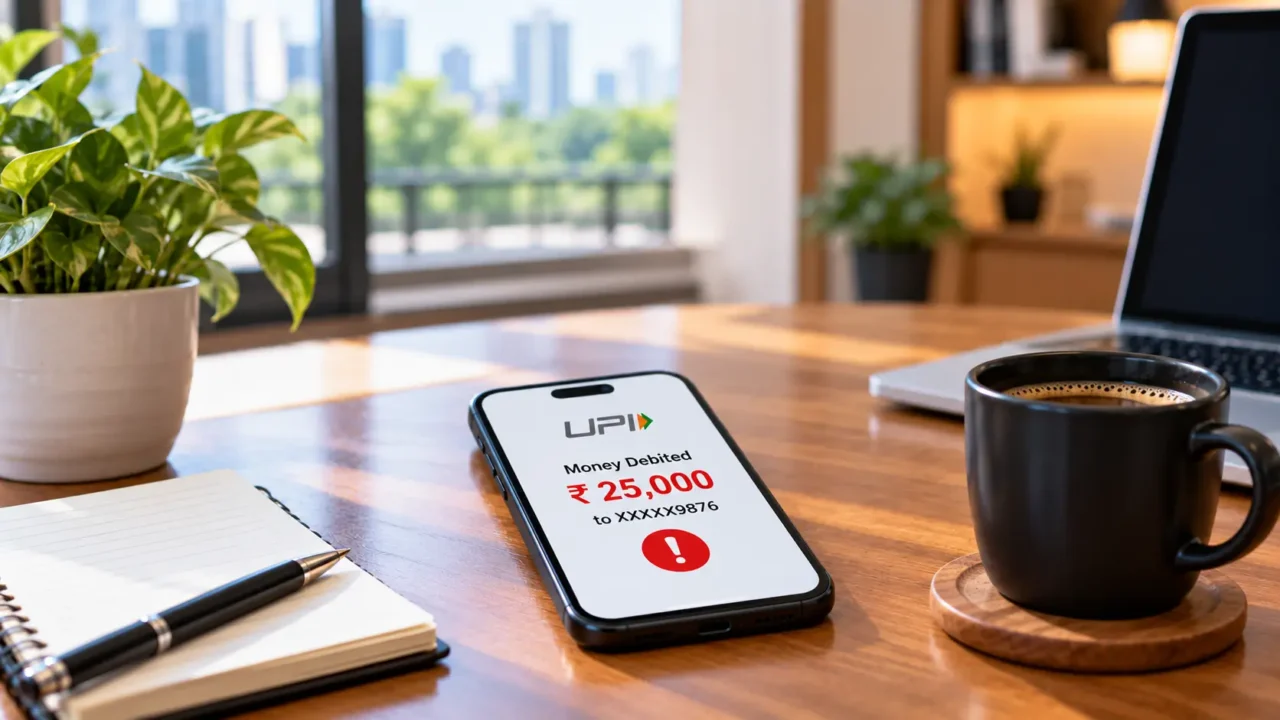
If you have transferred money to a fraudster through UPI, a banking app or another online payment service, report the transaction as soon as possible. Residents of Noida, Greater Noida and Greater Noida West can use the national cybercrime helpline 1930, contact their bank and submit a complaint through the government’s cybercrime portal.
These steps can help authorities and financial institutions respond to the fraud. However, reporting a transaction does not guarantee that the money will be recovered.
The reporting process applies nationwide, including Gautam Buddh Nagar. You do not need to wait for a separate Noida-specific complaint portal.
What should you do immediately after an online payment scam?
If money has already left your account, take these steps without unnecessary delay.
- Call the national cybercrime helpline on 1930 and report the financial fraud.
- Contact your bank through its official customer-care number, banking app or fraud-reporting facility.
- Submit the complaint through the National Cyber Crime Reporting Portal at https://cybercrime.gov.in/
- Preserve the transaction ID, payment confirmation, bank messages and relevant conversations.
- Keep the acknowledgement numbers issued by the cybercrime portal and your bank.
If you disclosed your banking credentials or gave someone access to your device, immediately inform your bank and secure the affected account through its official channels.
Do not transfer additional money to anyone promising to recover the amount.
How to report UPI fraud through 1930
The national cybercrime helpline 1930 is intended for reporting financial cyber fraud.
When calling, explain what happened and provide the transaction information requested by the helpline operator.
You should keep the following details ready:
- Your mobile number.
- The name of the bank, payment wallet or merchant involved.
- The account or UPI details from which the payment was made.
- The transaction reference number.
- The transaction date and amount.
- Screenshots or other available evidence.
If you receive a complaint acknowledgement or reference number, save it.
Complete the required online complaint through the National Cyber Crime Reporting Portal. Do not assume that the initial telephone report is necessarily the final step.
The government’s financial cyber fraud reporting mechanism allows complaints to be forwarded for examination and appropriate action by the relevant authorities and financial institutions.
It does not guarantee an immediate refund.
How to file an online cybercrime complaint
Residents can use the official National Cyber Crime Reporting Portal: https://cybercrime.gov.in
Open the website directly rather than following an unfamiliar link received through WhatsApp, SMS or social media.
Select the relevant financial fraud reporting option and follow the portal’s instructions.
The portal’s published checklist asks complainants to keep information including:
- Incident date and time.
- Description of the incident.
- Bank, wallet or merchant name.
- Transaction ID or UTR number.
- Transaction date and amount.
- Relevant supporting evidence.
- Identity documentation where required by the selected complaint procedure.
Follow the file-format and document requirements displayed on the portal when submitting the complaint.
After submission, preserve the acknowledgement or complaint reference number. Use the portal’s complaint-tracking facility to check progress.
Official portal: https://cybercrime.gov.in/
Should you contact your bank after reporting cyber fraud?
Yes. Contact your bank promptly even if you have already reported the incident to 1930.
The Reserve Bank of India advises customers to report fraudulent or unauthorised electronic transactions to their bank immediately.
For a UPI transaction, contact the bank from which the money was debited. You can also raise a transaction-related complaint through the relevant UPI application, where the facility is available.
Tell the bank that the transaction involved suspected fraud.
Ask for a complaint acknowledgement and reference number. Explain whether the payment was made by you after being deceived or occurred without your authorisation.
This distinction can affect how the complaint is assessed.
NPCI’s official complaint guidance directs customers to their respective banks for fraudulent, unidentified or unauthorised transactions.
Official NPCI complaint information: https://www.npci.org.in/register-a-complaint
Can you get your money back after a UPI scam?
Recovery is possible in some cases, but it is not guaranteed.
The outcome depends on several factors, including the circumstances of the transaction, the response of the relevant financial institutions and action taken through the cybercrime reporting system.
A successful UPI transfer cannot ordinarily be cancelled simply by submitting a stop-payment request after it has been initiated.
Reporting quickly remains important because it allows the authorities and financial institutions to assess the incident without avoidable delay.
What if you authorised the payment after being tricked?
Suppose someone impersonates a customer-care executive, employer or seller and persuades you to transfer money voluntarily.
This is different from someone accessing your account and making a transaction without your authorisation.
The RBI’s rules on customer liability for unauthorised electronic banking transactions cannot automatically be treated as a guarantee of reimbursement for a payment made after deception.
The bank and relevant authorities must assess the facts.
What if money was deducted without your authorisation?
RBI’s customer-protection framework provides liability protections for qualifying unauthorised electronic banking transactions.
The applicable protection depends on factors including the cause of the transaction, whether the customer was negligent and how promptly the bank was informed.
In qualifying third-party breach cases where the deficiency lies neither with the bank nor the customer, reporting within three working days of receiving the bank’s communication can result in zero customer liability.
Different rules apply in other circumstances.
Residents should not assume that every fraudulent transfer qualifies for zero liability or an automatic refund.
RBI customer-protection guidance: https://www.rbi.org.in/commonman/English/scripts/Notification.aspx?Id=2623
What if the bank does not resolve your complaint?
First, follow the bank’s grievance-redressal procedure and preserve the complaint reference number.
For eligible complaints involving a deficiency in service by an RBI-regulated entity, the Reserve Bank’s Integrated Ombudsman Scheme, 2026, provides an escalation mechanism.
Under the scheme, a customer must first complain to the concerned regulated entity.
The RBI’s published guidance explains when a complaint can be escalated if the customer is dissatisfied with the response or the applicable response period has expired.
The escalation mechanism is not a substitute for immediately reporting a financial cybercrime.
Eligible complaints can be filed through: https://cms.rbi.org.in
The RBI Ombudsman examines complaints under the applicable scheme. Filing a complaint does not automatically establish bank liability or guarantee compensation.
What information should you preserve after online payment fraud?
Keep a record of the incident while the information remains accessible.
Useful evidence includes:
- Transaction ID or UTR number.
- Payment date, time and amount.
- Bank or UPI transaction confirmation.
- Screenshots of relevant messages.
- Phone numbers used to contact you.
- Fraudulent website links or social media accounts.
- Bank complaint reference number.
- Cybercrime complaint acknowledgement.
Preserve the original messages and records where possible.
Do not publicly post account numbers, identity documents or other sensitive personal information while seeking help.
Where can Noida and Greater Noida residents report cybercrime?
Residents can use the following national reporting channels regardless of whether they live in Noida, Greater Noida, Greater Noida West or another part of Gautam Buddh Nagar.
| Service | Contact | Purpose |
|---|---|---|
| National cybercrime helpline | 1930 | Report financial cyber fraud |
| National Cyber Crime Reporting Portal | https://cybercrime.gov.in/ | Register and track cybercrime complaints |
| Your bank | Official bank app, website or customer care | Report fraudulent transactions and seek account-related assistance |
| RBI Complaint Management System | https://cms.rbi.org.in/ | Escalate eligible financial-service complaints |
If further police assistance is needed, residents can also approach the appropriate local police or cybercrime unit.
For general information on recognising suspicious recruitment offers and payment requests, read Pulse of Noida’s existing guide
Frequently asked questions
What is the cybercrime helpline number for UPI fraud in Noida?
The national financial cybercrime helpline is 1930. It is available to residents across India, including Noida and Greater Noida.
Can I report a UPI scam online?
Yes. Financial cybercrime complaints can be submitted through the National Cyber Crime Reporting Portal at https://cybercrime.gov.in/.
Should I contact the bank or cybercrime helpline first?
Do both immediately, without delaying one while waiting for the other. Calling 1930 initiates the cybercrime reporting process, while notifying the bank allows it to assess the affected account and transaction.
Will my bank refund money lost to a UPI scam?
Not necessarily. Recovery and liability depend on the transaction circumstances and applicable protections. Reporting a scam does not guarantee reimbursement.
Can I report fraud if I transferred the money myself?
Yes. A payment made after deception can still be reported as suspected cyber fraud. However, an authorised payment induced by deception is not automatically covered by the RBI’s zero-liability rules for unauthorised transactions.
Do I need to visit a police station before filing online?
The National Cyber Crime Reporting Portal allows citizens to submit complaints online. Police may subsequently request additional information or action depending on the case.
The important takeaway
If you lose money through a suspected UPI or online payment scam, report it promptly through 1930, notify your bank and complete the necessary cybercrime complaint.
Keep your transaction records and complaint acknowledgements.
Quick reporting helps initiate the response process, but no reporting channel can guarantee that the money will be recovered.
Last verified: 27 October 2026