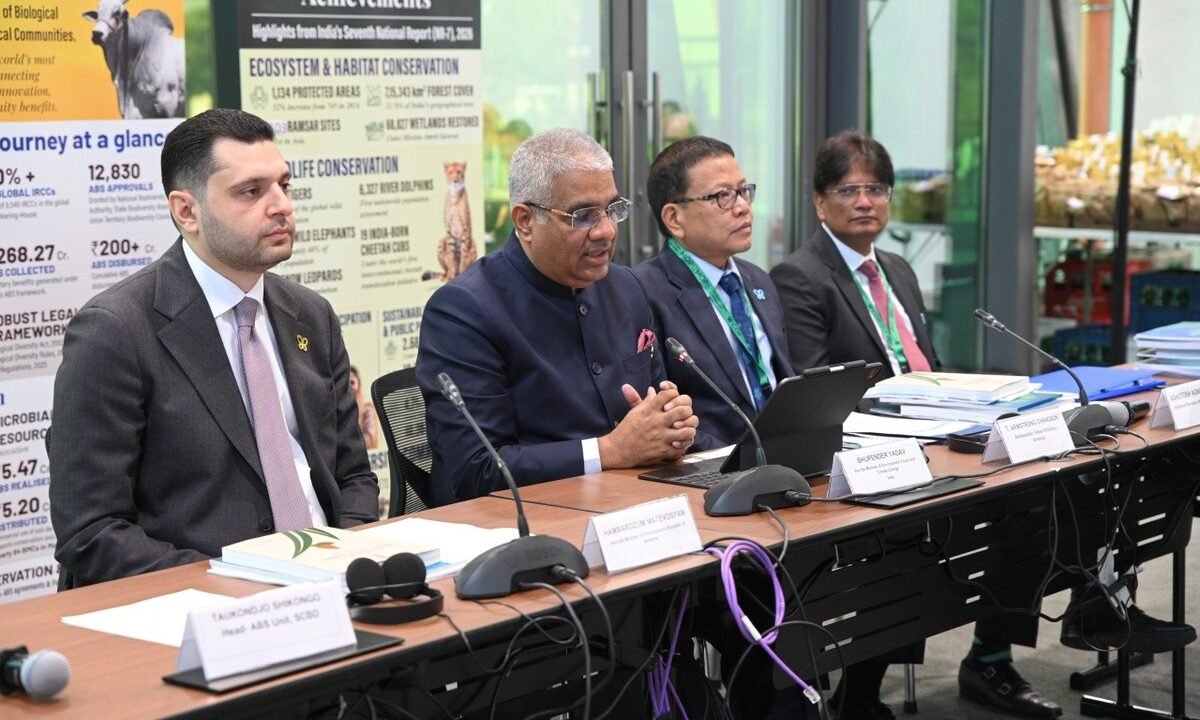
India released four publications on biodiversity conservation, biosafety and access and benefit-sharing at the 17th Conference of the Parties (COP17) to the Convention on Biological Diversity in Yerevan, Armenia, on October 28, 2026.
The publications were released during an event organised by the Ministry of Environment, Forest and Climate Change, in partnership with the National Biodiversity Authority and the United Nations Development Programme (UNDP).
Union Environment Minister Bhupender Yadav called for translating global biodiversity commitments into practical conservation outcomes, supported by sustainable financing, institutional capacity and international cooperation.
What Are the Four Biodiversity Publications Released by India?
According to the Ministry of Environment, Forest and Climate Change, the publications cover four important areas of biodiversity policy and implementation.
- Guidelines for the Designation of India’s Other Effective Area-Based Conservation Measures (I-OECMs) 2026: Guidance intended to help recognise effective biodiversity conservation outside conventional protected areas.
- 5th National Report on Cartagena Protocol on Biosafety: A national report relating to India’s biosafety governance and reporting obligations.
- The Convention on Biological Diversity Handbook: Reference Guide and Indian Perspective: A reference document explaining the international biodiversity framework from an Indian perspective.
- India’s ABS Success Story: A publication highlighting India’s experience with access and benefit-sharing involving biological resources.
What Is Access and Benefit-Sharing?
Access and benefit-sharing, commonly known as ABS, concerns how benefits arising from the use of genetic resources are shared fairly.
For example, when biological resources are used in research or commercial development, benefit-sharing arrangements can help ensure that eligible stakeholders receive benefits under applicable rules.
Depending on the legal framework and specific arrangements, these benefits may be monetary or non-monetary.
In India, the Biological Diversity Act and associated regulations provide the legal framework for managing access to biological resources and benefit-sharing.
Why Does Biodiversity Conservation Matter?
Biodiversity conservation is not limited to forests, national parks and wildlife sanctuaries.
It also concerns biological resources used in agriculture, research and other sectors, as well as the institutions and communities involved in their conservation.
The newly released conservation guidelines may help identify qualifying areas outside conventional protected areas where effective biodiversity conservation is already taking place.
However, the release of guidelines does not automatically mean new conservation areas have been formally recognised.
Similarly, a publication highlighting benefit-sharing practices does not establish that additional benefits have already been distributed to communities.
Such outcomes require separate implementation, monitoring and reporting.
What Happens Next?
The important developments to monitor include how the conservation guidelines are adopted, which areas qualify for recognition, how biosafety reporting is used and whether benefit-sharing arrangements produce measurable outcomes.
COP17 is being held in Yerevan, Armenia, from October 19 to 30, 2026.
The release of these four publications is a documented step in India’s biodiversity policy work. Their practical impact will depend on subsequent implementation.
Official Sources and Further Information
Government announcement: Ministry of Environment, Forest and Climate Change, Government of India, October 28, 2026.
Conference information: Convention on Biological Diversity, COP17.
Official news update: DD News on X.