Saffron Farming Reimagined in Urban Noida
Saffron is globally recognized as the most expensive spice in the world, heavily dependent on the cool, specific climate of the Kashmir valley. However, a groundbreaking agricultural experiment in Noida has proven that urban spaces can also cultivate this premium crop. Ramesh Gera, a 65-year-old retired engineer, has successfully grown saffron inside a standard 100-square-foot room. His innovative, soil-less farming approach is redefining urban agriculture in the National Capital Region and offering a highly lucrative business model for city residents.
The Visionary Behind the Harvest
Ramesh Gera spent his career working as an electrical engineer with an additional degree in Operations Management. The inspiration for his post-retirement venture struck during a professional trip to South Korea in 2002. During his six-month stay, he observed advanced soil-less farming techniques like hydroponics and indoor microgreen cultivation. Eager to stay active after retiring, he decided to bring these modern agricultural practices to his home in Noida. In 2017, he began transforming an empty room into an artificial agricultural haven, eventually focusing entirely on the highly profitable saffron crop.
Recreating Kashmir in a Closed Room
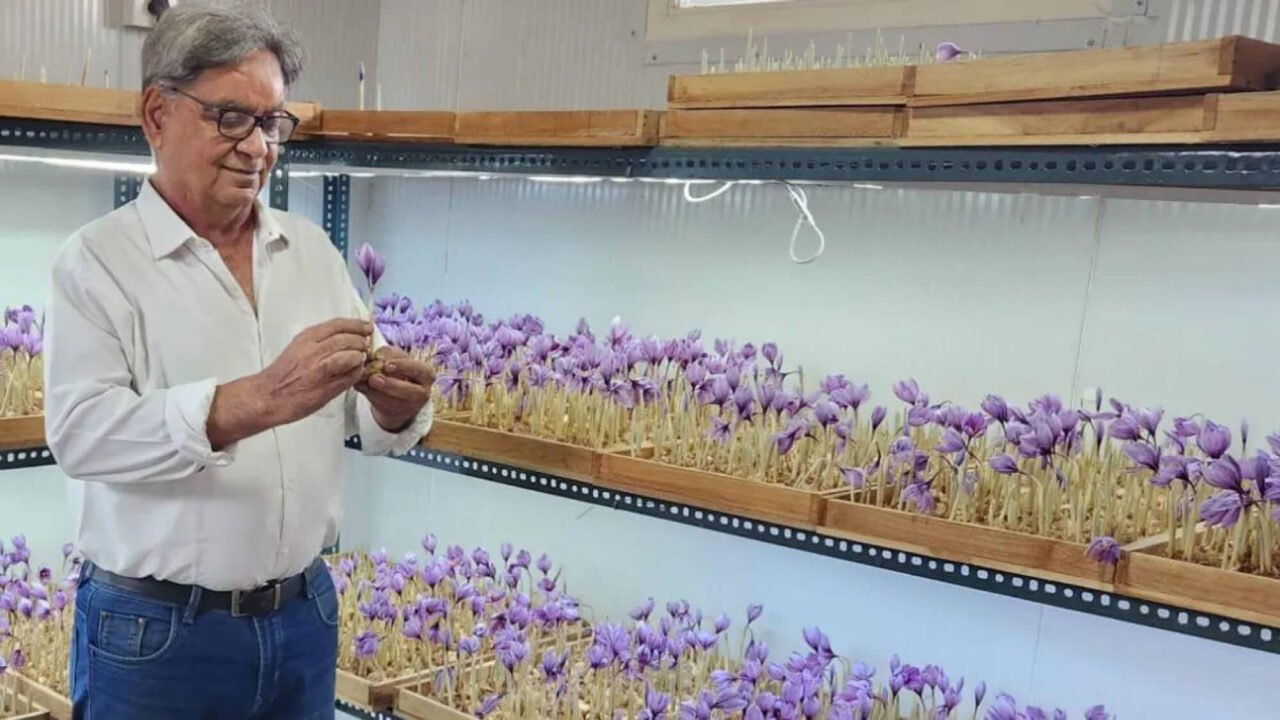
Growing saffron requires strict climatic parameters, which Gera meticulously replicates using modern technology. By converting his room into an artificial greenhouse, he completely eliminated the need for soil and bypassed unpredictable weather conditions. Instead, he relies on a fully controlled indoor environment where temperature, humidity, and light intensity are rigorously monitored.
To ensure authentic quality, Gera procures high-grade saffron bulbs directly from Kashmir to serve as his seeds. These bulbs are carefully placed in slotted angle racks. To mimic the chilling winter climate of Kashmir, he installed specialized chilling devices and industrial humidifiers. Light exposure is managed simply by covering windows and adjusting heavy curtains at specific times. Because the entire germination cycle happens indoors, the saffron remains entirely protected from urban pollution, outdoor pests, and sudden climatic fluctuations. The complete growth cycle takes about three months, usually culminating in a successful harvest by November.
Beating the Noida Heat: The Ultimate Climate Test
What makes Gera’s achievement truly remarkable is the sheer contrast between the natural habitat of saffron and the harsh reality of the National Capital Region. Saffron is notoriously fragile, natively thriving in the pristine, chilly valleys of Pampore, Kashmir. In stark contrast, Noida experiences blistering summer temperatures that frequently cross 45°C, unpredictable monsoons, and high levels of urban smog.
By choosing to launch his venture in his Noida residence, Gera effectively created the ultimate stress test for his soil-less technology. His 100-square-foot room is completely insulated from Noida’s extreme heat and pollution. By successfully simulating Kashmir’s delicate micro-climate in the middle of a bustling concrete jungle, Gera proved a groundbreaking concept: if you can grow the world’s most expensive and climate-sensitive spice in Noida, you can successfully grow it anywhere in the world.
Impressive Financial Returns
The financial viability of this indoor saffron farm is exceptional. Gera launched his urban farming venture with a one-time capital investment of approximately Rs 6 lakh. This initial cost covered the chilling infrastructure, humidifiers, shelving racks, and the first batch of premium Kashmiri seeds. Today, this compact setup generates an impressive monthly revenue of up to Rs 3.5 lakh. The recurring operational costs remain remarkably low, making this a highly sustainable and profitable business model for urban entrepreneurs with limited real estate.
Empowering Others Through Akarshak Saffron Institute
Driven by his remarkable success, Gera established the Akarshak Saffron Institute to share his technical expertise. Registered as an MSME firm and originally based in Noida, the institute is dedicated to teaching advanced soil-less farming techniques. Gera conducts comprehensive training programs and has already educated over 370 individuals in the complex art of indoor saffron cultivation.
The institute offers detailed online and offline courses every month. Students learn the precise scientific parameters required to grow saffron at home, and the two-day intensive training is followed by a full year of guided professional support to ensure their own harvests are successful. This empowering initiative has opened doors for city dwellers, retirees, and young professionals to launch highly profitable agricultural startups right from their apartments.
💡 Did You Know?
Why is Saffron the World’s Most Expensive Spice?
Saffron (Kesar) is often called “Red Gold” because of its incredibly labor-intensive harvesting process. Each saffron crocus flower produces only three tiny crimson stigmas (threads). To produce just one kilogram of pure saffron, it takes approximately 150,000 to 170,000 delicate flowers, all of which must be carefully picked by hand!
Frequently Asked Questions
1. Won’t running an AC constantly in Noida cause a massive electricity bill?
Since the cultivation room is small (typically 100 to 150 sq. ft.) and kept completely sealed and insulated, the cooling units do not need to work as hard as they would in a normal living room. Most indoor saffron farmers report an additional electricity cost of around ₹3,000 to ₹5,000 per month during the peak cooling phases, which is easily offset by the high profit margins of the harvest.
2. Can I use any spare room or balcony in my Noida flat?
You need a fully enclosed, insulated room where sunlight, temperature, and humidity can be artificially controlled. Open balconies or well-ventilated terraces will not work because they expose the delicate bulbs to Noida’s ambient heat and pollution. A spare bedroom or a closed store room is perfect.
3. Do I need an agricultural license to do this in a residential society?
No special agricultural license is required for small-scale, indoor soil-less farming inside your own private residence. However, if you plan to scale up and sell commercially under a brand name, registering as an MSME and obtaining an FSSAI (Food Safety) license is highly recommended.
How to Learn from Ramesh Gera: Course Details
If you are interested in starting your own indoor saffron farm, the Akarshak Saffron Institute offers comprehensive, hands-on training. While originally founded in Noida Sector 63, the institute recently expanded with a state-of-the-art offline facility in Panchkula.
Course Overview & Fees:
- Online Training (via Zoom): ₹12,000
- Offline/Classroom Training (Panchkula Facility): ₹16,000 (Participants must arrange their own boarding/lodging, though the institute provides local hotel recommendations).
- Duration: The intensive core training lasts for 2 days.
- Frequency: One online and one offline batch is conducted every month.
What You Will Learn:
The training covers the complete scientific setup of an indoor farm, including aeroponics and hydroponics basics, temperature regulation, industrial humidifier installation, and how to select high-quality saffron corms (seeds).
Lifelong Post-Training Support:
What sets the institute apart is its “3Tr Principle” (Truth, Trust, and Transparency). After the initial 2-day training, candidates receive a full year of closely guided support, which effectively continues for a lifetime at no additional charge. The institute also provides trusted, verified vendor contacts for purchasing greenhouse equipment and authentic Kashmiri seeds so candidates do not get scammed.
How to Register & Contact Details:
To receive the training brochure (which includes the full curriculum, upcoming batch dates, and timings), candidates must register via WhatsApp.
- WhatsApp / Contact Number: +91 74284 96656
- Email: gera.ramesh@gmail.com
- Official Website: akarshakfarms.com
(Note to readers: To register, simply send your name and city to the WhatsApp number provided above, and the team will reply with the complete registration process.)