Updated August 4, 2026: This article was first published as a pre-launch explainer and updated after electric buses were flagged off for Noida, Greater Noida and the YEIDA region on June 12. It has now been reviewed to remove outdated future-tense references. The launch is confirmed, but a consolidated official route-wise timetable, complete stop list, current operating frequency and final fare chart remain awaited from the responsible authorities.
Noida’s AC electric bus service has moved from announcement to the launch phase.
Uttar Pradesh Chief Minister Yogi Adityanath flagged off electric buses for Noida, Greater Noida and the Yamuna Expressway Industrial Development Authority region on June 12, 2026. Airport connectivity was identified as one of the principal objectives of the regional network.
For daily commuters, office-goers, airport passengers and residents of Greater Noida West, Pari Chowk, Sector 62, Surajpur and YEIDA areas, the service could become an important public-transport option.
However, commuters should note that a consolidated official route-wise timetable, complete stop list, first and last bus timings, operating frequency and final public fare chart are still awaited. The routes, fares and frequencies below should therefore be treated as reported details rather than a complete confirmed timetable.
What changed after the June 12 launch
The principal development is that the electric bus service was formally flagged off on June 12, moving it beyond the proposal stage.
Government-linked launch information stated that 45 electric buses and three hydrogen buses were flagged off for Noida, Greater Noida and YEIDA.
Other launch-period reports referred to an immediate first phase involving 30 buses, with 10 buses each for Noida, Greater Noida and Yamuna Authority areas.
The differing fleet numbers appear to reflect a phased rollout. They should not be interpreted as confirmation that every announced bus was operating on every route from the first day.
Launch-period reporting also indicated that the wider fleet could increase to around 110 electric buses. This figure should be treated as a rollout target, not as confirmation that 110 buses are currently operating across all corridors.
For commuters, the main takeaway is clear: the launch has taken place, but the service’s practical usefulness will depend on the publication of regular routes, authorised stops, operating schedules and fare details.
Noida electric bus service at a glance
| Detail | Current status |
|---|---|
| Launch status | Flagged off on June 12, 2026 |
| Fleet announced at launch | 45 electric buses and 3 hydrogen buses |
| Service areas | Noida, Greater Noida and YEIDA |
| Operator | UPSRTC |
| Airport connectivity | A key part of the announced network |
| Reported fare range | ₹20 to ₹50 |
| Reported frequency | Approximately 30 to 60 minutes |
| Complete official timetable | Awaited |
| Final route-wise fare chart | Awaited |
| Reported rollout target | Around 110 electric buses; current route-wise operating count not confirmed |
| Double-decker buses | Discussed earlier; operational confirmation awaited |
Who is operating the service
The electric bus service is being operated through the Uttar Pradesh State Road Transport Corporation, with the development authorities involved in supporting the wider rollout.
Earlier, Noida Authority CEO Krishna Karunesh said that operations would be handled by UPSRTC, while viability-gap funding would be borne by Noida Authority.
The larger mobility plan involves Noida Authority, Greater Noida Authority and YEIDA.
This is important because the electric bus network is not intended to function only as an airport shuttle. It is part of a broader regional public-transport system for Gautam Buddh Nagar.
Noida electric bus routes reported so far
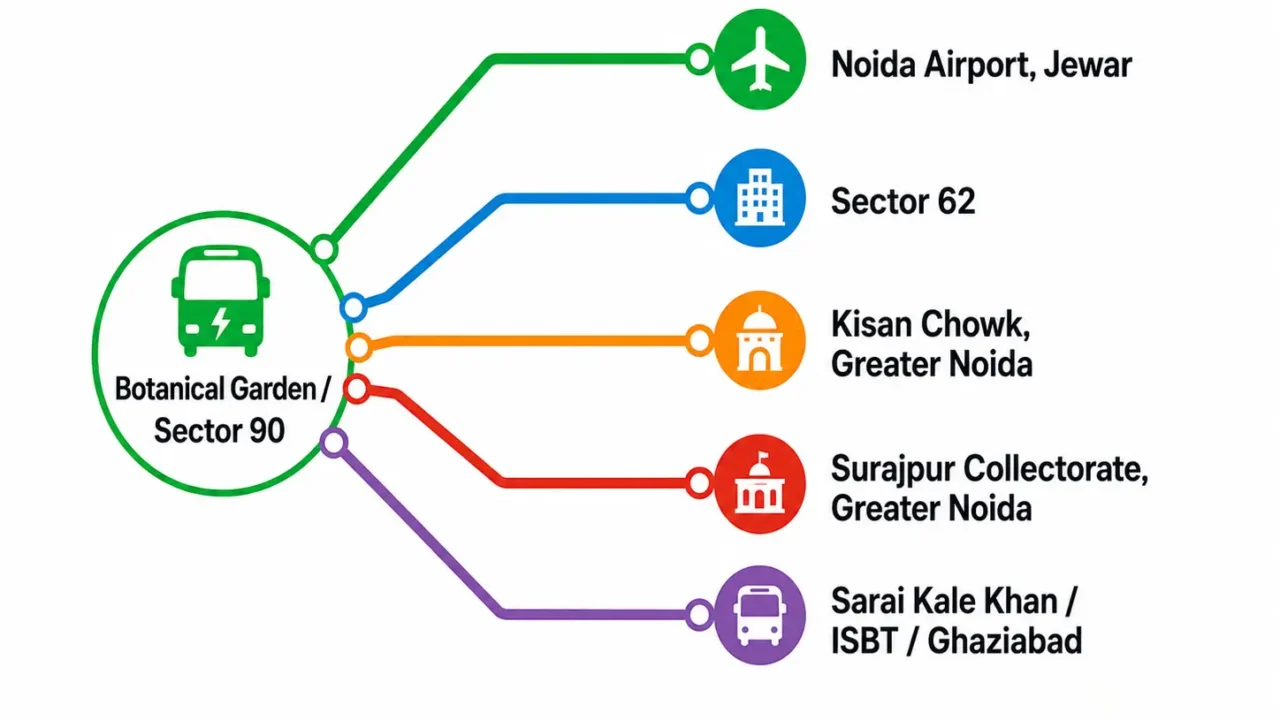
Earlier route planning identified Sector 90 Depot and Botanical Garden as important starting points for Noida’s city bus network.
The reported route structure included the following corridors.
Route 1: Botanical Garden or Sector 90 Depot to Kisan Chowk and Ek Murti
This route is intended to improve connectivity between Noida and residential areas of Greater Noida West.
Potentially useful points include:
- Botanical Garden
- Sector 90 Depot
- Kisan Chowk
- Ek Murti
- Nearby Greater Noida West residential clusters
Commuters should confirm the actual boarding point, authorised stops and current operating schedule before travelling.
Route 2: Botanical Garden or Sector 90 Depot to Noida International Airport
This is the most important reported route for airport passengers.
If regular operations, stops and timings are confirmed, the Botanical Garden to Jewar airport corridor could become a useful lower-cost public-transport option for passengers travelling from central Noida.
Its usefulness will depend on:
- first and last bus timings;
- route-wise frequency;
- authorised boarding points;
- journey duration;
- luggage arrangements;
- compatibility with flight-reporting times.
Passengers should not depend on an unverified bus schedule for a time-sensitive airport journey.
Route 3: Botanical Garden or Sector 90 Depot to Sector 62
Sector 62 is one of Noida’s most important office, institutional and technology corridors.
A reliable electric bus connection could help commuters who currently depend on:
- metro services combined with last-mile transport;
- autos and shared vehicles;
- app-based cabs;
- private cars and two-wheelers.
The current public stop list and operating frequency for this corridor still require official confirmation.
Route 4: Botanical Garden or Sector 90 Depot to Phase 2 and Surajpur Collectorate
This route is intended to connect Noida’s residential and industrial areas with the Surajpur administrative and employment corridor in Greater Noida.
Potentially useful locations include:
- Noida Phase 2;
- industrial sectors;
- Surajpur;
- Surajpur Collectorate;
- connecting Greater Noida corridors.
Residents should verify whether their intended stop is included in the active service.
Route 5: Regional connectivity towards Delhi and Ghaziabad hubs
Earlier planning also mentioned possible or extended connectivity towards:
- Sarai Kale Khan;
- Anand Vihar;
- Kashmere Gate ISBT;
- Ghaziabad.
These links may be useful for intercity commuters, but they should be treated as part of the wider route plan until the authorities publish a confirmed operational list.
Greater Noida electric bus routes
The Greater Noida side of the network is important for residents of Greater Noida West, Pari Chowk and institutional and industrial areas.
Reported route points include:
- Chaar Murti Chowk;
- Greater Noida West;
- 130-metre road;
- Pari Chowk;
- Government Institute of Medical Sciences;
- Surajpur;
- industrial sectors;
- Noida International Airport.
Residents should verify whether a listed location is a starting point, terminal or intermediate stop. A reported route point does not automatically confirm an authorised passenger stop.
YEIDA and Jewar electric bus connectivity
The YEIDA portion of the network is expected to serve developing residential, institutional, rural and industrial areas around the Yamuna Expressway and Jewar.
Locations mentioned in route planning include:
- Gautam Buddha University;
- Dankaur;
- Rabupura;
- Bilaspur;
- Jahangirpur;
- Jewar;
- GIMS;
- Pari Chowk;
- Surajpur;
- Noida International Airport.
This part of the network could be useful for students, industrial workers, airport employees and residents who currently have limited public-transport choices.
What is the Noida electric bus fare?
The fare structure became clearer during the launch period, but a final official route-wise fare chart has not been located publicly.
Earlier planning reports had referred to ₹10, ₹20 and ₹30 slabs. Launch-period reporting later indicated a revised range of ₹20 to ₹50.
Some reports described ₹50 as the upper fare for airport-linked routes.
Until an official route-wise chart is published, commuters should treat ₹20 to ₹50 as the safest reported range rather than a confirmed fare for every journey.
| Fare detail | Current position |
|---|---|
| Reported lower slab | ₹20 |
| Reported middle slab | ₹30 |
| Reported upper slab | ₹50 |
| Airport-linked fare | ₹50 reported in some launch-period coverage |
| Final route-wise fare chart | Awaited |
The amount charged may vary according to distance, route and service category.
Noida electric bus timings and frequency
Launch-period reporting indicated that buses could initially operate at intervals of approximately 30 to 60 minutes.
This should not be treated as a substitute for an official route timetable.
The following details remain important for commuters:
- first bus timing;
- last bus timing;
- weekday and weekend schedules;
- route-wise frequency;
- airport-specific timings;
- expected journey duration;
- complete stop list;
- ticketing method;
- digital-payment availability;
- monthly or commuter passes;
- early-morning and late-night operations.
Passengers travelling for a flight should keep sufficient buffer time and a backup transport option until route-specific schedules are officially published.
Are double-decker electric buses operating in Noida?
Double-decker electric buses were discussed as part of the wider public-transport plan before the launch.
However, the June 12 launch information focused primarily on electric buses and hydrogen buses. A controlling official public document confirming current double-decker routes, schedules or commencement dates has not been located.
Residents should therefore treat double-decker operations as awaited rather than as a regular available service.
What are the hydrogen buses?
Three hydrogen buses were included in the June 12 launch for the YEIDA region.
Government-linked information stated that:
- the buses were connected with NTPC;
- they were intended for operation in the Yamuna Authority area;
- the Jewar airport region formed part of the broader mobility plan.
A separate confirmed route and timetable for these hydrogen buses remains awaited.
Why this service matters for Noida residents
Better public transport across the region
Noida has long needed a stronger city-bus network. Metro services are useful, but many residential, industrial and institutional areas continue to depend on autos, cabs, shared vehicles and private transport.
Potential airport connectivity
Road-based public transport is expected to play an important role in airport access.
A dependable airport bus could reduce reliance on comparatively expensive private taxis for:
- airport workers;
- students;
- families;
- budget travellers;
- frequent passengers.
Support for office and industrial commuters
Sector 62, Phase 2, Surajpur, Greater Noida West and YEIDA’s industrial areas generate substantial daily travel.
Predictable bus services could help reduce dependence on private vehicles if routes, schedules and stops are communicated clearly.
Cleaner mobility
Electric and hydrogen buses can reduce local tailpipe emissions compared with conventional diesel buses.
The practical environmental benefit will depend on fleet utilisation, route coverage, reliability and passenger adoption.
Details still awaited as of August 4, 2026
Residents should continue to watch for official confirmation of:
- the complete list of operational routes;
- authorised bus stops;
- route-wise first and last bus timings;
- the current number of buses operating;
- frequency on each route;
- the final fare chart;
- airport-specific services;
- ticketing and digital-payment methods;
- monthly or commuter passes;
- live-tracking availability;
- double-decker bus operations;
- hydrogen-bus routes.
For airport passengers, the key question is not only whether a route has been announced. The more important issue is whether its timing matches flight-reporting requirements.
What this means for airport connectivity
Noida International Airport began commercial flight operations on June 15, 2026, with IndiGo operating the first commercial flight.
This makes the electric-bus rollout particularly important because road-based public transport will play a major role in connecting Noida, Greater Noida and the airport during the initial phase.
The bus service can become a dependable airport option only if three conditions are met:
- Reliable frequency
- A clear public timetable
- Predictable journey times
Until route-specific schedules are officially published, passengers should confirm the current service and maintain a backup travel plan.ssengers should confirm the current service directly and maintain a backup travel plan.
Pulse of Noida view
The launch is an important step, but the real test is whether residents can depend on the service for daily travel.
Noida does not only need buses to be announced. It needs buses that residents can use confidently for:
- office commutes;
- airport travel;
- college routes;
- industrial employment corridors;
- regional transport connections.
The success of the service will depend on punctuality, clean and accessible stops, clear route maps, digital payments, predictable frequency and reliable last-mile connectivity.
The next essential update for residents is the publication of a complete official timetable.
Editor’s note
This article was first published as a pre-launch explainer and updated on June 12, 2026, after the electric-bus service was flagged off.
It was reviewed again on August 4, 2026, to remove outdated future-tense wording.
Because the available source record contains different fleet figures and does not include a consolidated route-wise timetable or final fare chart, the article continues to describe the rollout as phased and clearly labels operational details that remain reported or unconfirmed.
Pulse of Noida will update this guide when UPSRTC, Noida Authority, Greater Noida Authority or YEIDA publishes a complete current timetable, stop list and fare chart.
Official and government-linked sources
- Information and Public Relations Department, Uttar Pradesh, official update on electric buses for Noida International Airport connectivity
https://x.com/InfoDeptUP/status/2059940241180651955 - Noida International Airport announcement regarding the scheduled start of commercial operations
https://www.niairport.in/en/company/news/2026/2026-06-15 - Noida Authority official press-release page
https://noidaauthorityonline.in/en/pressrelease - DD India government-linked report on the electric and hydrogen bus launch
https://ddindia.co.in/2026/06/electric-buses-rolled-out-in-noida-greater-noida-3-hydrogen-buses-to-ply-to-jewar-airport/ - News On AIR announcement regarding the airport’s scheduled commercial-operations date
https://www.newsonair.gov.in/noida-international-airport-to-begin-commercial-flight-operations-from-15-june-2026/