Quick ReadAI-assisted summary, reviewed by an editor
- Financial security after 40: Job uncertainty can affect home loans, children's education and retirement planning. Noida professionals should review their household finances before a potential income disruption.
- Protect essential savings: Build an emergency fund, review personal health and term insurance, understand EPF withdrawal rules and assess EMIs before taking on new financial commitments.
- Plan for retirement: Calculate future expenses, review investments and adjust SIP contributions to match your circumstances. The article's retirement calculations are illustrative, and investment returns are not guaranteed.
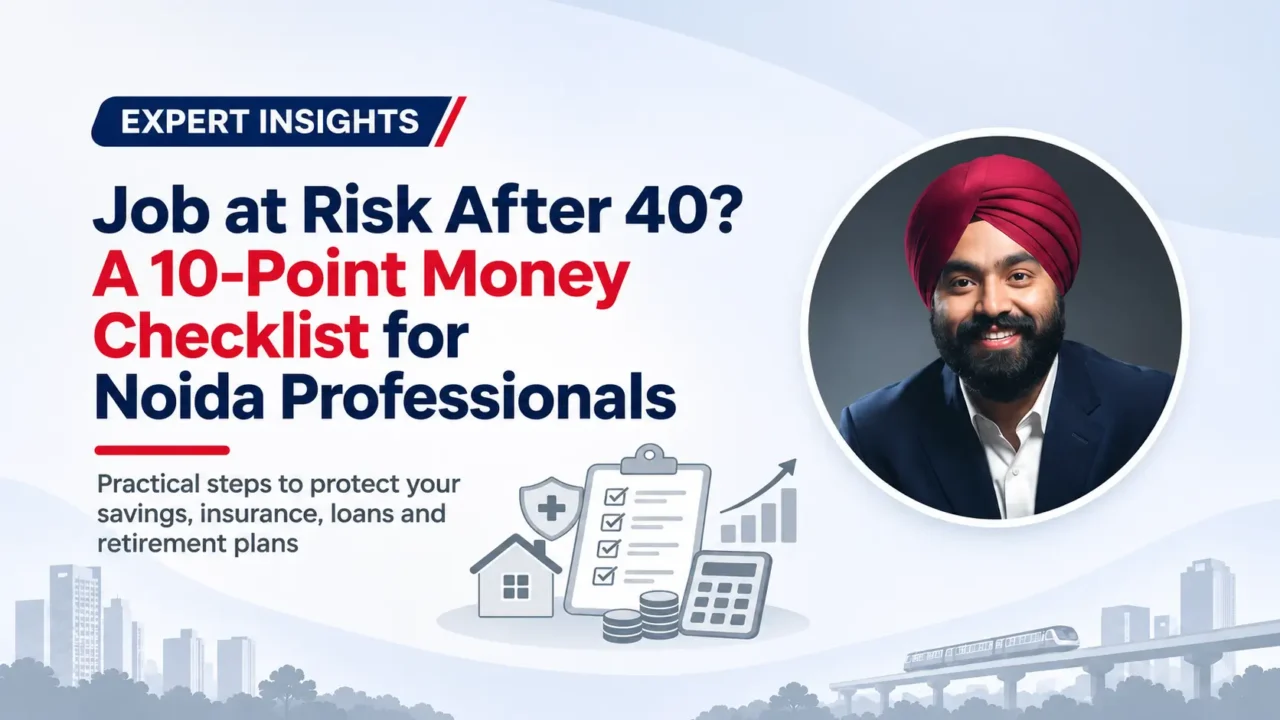
Contributed by Inderpreet Singh, Founder, SampadaSarathi
Job uncertainty has a different weight when you are 42 instead of 28.
For professionals working in Noida’s IT and corporate offices, the concern is not only about finding another job. It is also about protecting a family’s finances when responsibilities are at their highest.
The employment picture can change quickly. Noida-headquartered HCLTech, for example, reported a net reduction of 3,292 employees during the April-June 2026 quarter, followed by a net addition of 6,450 in the July-September quarter. These figures cover the company’s global workforce and do not establish how many Noida employees lost their jobs.
The figures are available in HCLTech’s official quarterly financial results.
For an individual professional, however, job uncertainty remains a reason to review financial preparedness.
If you are over 40, a job loss is not just a career problem. It can affect school and college fees, a home loan, parents who need care and a retirement that may be less than 20 years away.
The good news is that planning can reduce the financial pressure of an unexpected job loss. A clear checklist can help you understand what needs protection, what can wait and where your money stands.
Here are 10 things to review, whether your job is at risk or not.
Part 1: Protect Your Family First
1. Build an Emergency Fund Covering 9 to 12 Months
The usual advice is to keep six months of essential expenses in an emergency fund. After 40, consider whether you need a longer safety net.
Senior positions may take longer to find, and a job search can extend beyond your original expectations.
If your household spends ₹80,000 a month on essential expenses, a nine-month reserve would be ₹7.2 lakh. A 12-month reserve would be ₹9.6 lakh.
Keep this money somewhere accessible, such as a savings account, suitable bank deposits or other low-risk, liquid options.
Do not depend on selling equity investments during a market downturn to pay your household bills.
The appropriate amount depends on your family responsibilities, available income, job security and existing savings.
2. Get Your Own Health Insurance While You Are Employed
Many professionals rely entirely on their company’s group health insurance.
The problem is that coverage linked to employment may end when you leave the organisation, depending on the policy terms.
Buying an individual policy later may involve medical underwriting, higher premiums, exclusions or waiting periods.
Consider having a personal health insurance policy or family floater alongside your employer’s cover.
If you are leaving your job, ask the insurer about migration from group coverage to an individual or family policy. Eligibility, continuity benefits and timelines depend on the applicable rules and policy conditions.
Check the sum insured, waiting periods, exclusions and hospital network before making a decision.
3. Check Whether Your Term Insurance Is Independent of Your Employer
Your employer may provide group life insurance, but that protection may not continue after your employment ends.
If your family depends on your income, review whether you need a separate personal term insurance policy.
A commonly used starting point is coverage of 10 to 15 times annual income. However, that is only a rough guideline.
The appropriate amount also depends on your outstanding loans, dependants, existing savings, future financial responsibilities and insurance already in place.
The objective is simple: your family’s financial security should not depend entirely on your employer.
4. Do Not Empty Your EPF Without Understanding the Consequences
Your Employees’ Provident Fund (EPF) is an important part of your retirement savings.
Under the applicable EPFO withdrawal framework, eligible members may be able to access up to 75% of their provident fund balance, subject to the prescribed conditions and minimum balance requirements.
In ordinary unemployment cases, final settlement of the remaining balance may generally become available after 12 months of continuous unemployment.
Different provisions can apply in circumstances such as retrenchment, retirement, permanent incapacity or moving abroad permanently.
The Employees’ Pension Scheme (EPS) has separate rules and eligibility requirements.
Before withdrawing, check the latest provisions under the Employees’ Provident Funds Scheme, 2026 and confirm which conditions apply to your situation.
The government has also explained the EPFO withdrawal reforms and eligibility conditions.
Every withdrawal reduces the amount available for future compounding. Treat your EPF as an important financial safety net, not automatically as your first source of money after losing a job.
5. Know Your Exit Money and Its Tax Treatment
Before signing your final settlement documents, understand exactly what you are entitled to receive.
Prepare a list covering:
- Notice-period salary: Salary or payment in lieu of notice.
- Severance or retrenchment compensation: Where applicable.
- Gratuity: Based on statutory eligibility and calculations.
- Leave encashment: Payment for eligible accumulated leave.
- Bonuses: Pending incentives or performance-related payments.
- ESOPs and RSUs: Employee stock options or restricted stock units, including vesting conditions.
- Other benefits: Final provident fund and employee benefits.
Do not assume that every component will receive the same tax treatment.
For eligible non-government employees, the maximum gratuity tax exemption can be ₹20 lakh, subject to statutory calculations and conditions.
Leave encashment on retirement or resignation may qualify for an exemption of up to ₹25 lakh, again subject to applicable conditions.
The treatment of severance, retrenchment compensation and other termination payments depends on the nature of the payment and relevant tax provisions.
The Income Tax Department’s guidance on retirement benefits explains the applicable exemption calculations and conditions.
Ask your HR department for a detailed settlement statement and consult a qualified tax professional where necessary.
Your actual after-tax settlement amount is what matters when calculating how long you can manage without employment.
6. Pause New Loans and Review Your EMIs
This may not be the right time for a car upgrade, another property purchase or a large discretionary loan.
Review your monthly repayments.
If your EMIs consume around 40% or more of your take-home income, it is worth examining how manageable those obligations would be without a salary.
List each loan with its outstanding balance, interest rate, EMI and remaining tenure.
Credit card debt and high-interest personal loans deserve particular attention.
However, do not use up your entire emergency fund to prepay loans immediately after losing employment. Maintaining enough cash for essential expenses may be more important.
If you anticipate repayment difficulties, contact your lender early to understand the available options.
Part 2: Review Where You Stand
7. Put Your Entire Financial Life on One Page
This exercise can take less than two hours.
Write down four things.
What You Own
EPF, PPF, NPS, mutual funds, fixed deposits, shares, gold, property and other savings.
What You Owe
Home loans, vehicle loans, personal loans, credit card balances and other liabilities.
What You Spend
Your monthly household expenses, including EMIs, school fees, medical expenses and recurring commitments.
What You Need Money For
Children’s higher education, parents’ care, a home purchase, retirement and other financial goals.
Once everything is in one place, you can calculate your approximate net worth and identify potential gaps.
Most people have never seen their entire financial position on one page.
The exercise may be reassuring, uncomfortable or both. But it gives you a starting point for making better decisions.
8. Calculate Your Retirement Number
This is one of the most important calculations for professionals in their 40s.
Consider a hypothetical example.
Rohit is 42 and lives in Noida’s Sector 62. His family spends ₹1 lakh a month. He has ₹40 lakh saved across EPF, mutual funds and fixed deposits.
He wants to retire at 60.
Here is what his retirement planning could look like.
Step 1: Account for Inflation
At an assumed inflation rate of 6% annually, today’s monthly spending of ₹1 lakh could grow to approximately ₹2.85 lakh by the time Rohit turns 60.
Step 2: Estimate the Retirement Corpus
Assuming 30 years of retirement, 6% annual inflation and 7% annual investment returns after retirement, Rohit may need approximately ₹8.9 crore, rounded to ₹9 crore, at age 60 to meet those projected expenses.
Step 3: Calculate What Existing Savings Could Become
If his current ₹40 lakh grows at an assumed annual return of 11% for 18 years, it could reach approximately ₹2.62 crore.
Step 4: Identify the Retirement Funding Gap
Using the rounded retirement target of ₹9 crore, that leaves an estimated retirement funding gap of approximately ₹6.38 crore.
Step 5: Work Out the Monthly Investment Required
If a new monthly SIP earns an assumed return of 1% per month, Rohit would need to invest approximately ₹85,000 per month for 18 years to close the rounded funding gap.
Alternatively, if he increases his SIP by 10% each year, he could start at approximately ₹45,000 per month under the same assumptions.
What Happens If You Start Five Years Later?
Now consider the cost of waiting.
If Rohit delays starting those new investments until age 47, leaving only 13 years until retirement, the same funding gap would require approximately ₹1.7 lakh a month.
With a 10% annual increase in contributions, the starting amount would be approximately ₹1.06 lakh a month.
This illustrates why beginning retirement planning earlier can make a significant difference.
Important: These are hypothetical projections, not guaranteed outcomes or personalised investment recommendations. They assume 6% annual inflation, 7% annual returns after retirement, 11% annual growth on existing savings and a simplified 1% monthly return assumption for new SIP contributions. The latter is equivalent to approximately 12.68% effective annual growth, before costs and taxes. The calculations use rounded amounts, and actual outcomes may differ substantially.
Taxes, investment costs, changes in expenses and market volatility are not fully reflected.
Your retirement number will depend on your circumstances, risk tolerance and financial goals.
Part 3: Review Your Investments and Alternative Income Options
9. Start or Review Your SIPs and Investment Mix
At 40-plus, you may still have 15 to 20 years before retirement.
That is a meaningful investment horizon, but it is also a period when financial responsibilities can be substantial.
Your investments should balance growth, stability and access to money.
For illustration, a diversified portfolio might include:
- Equity: Long-term growth through appropriately diversified equity investments, including mutual funds.
- Debt and stable assets: EPF, PPF, fixed-income products and suitable debt investments. NPS holdings should be assessed according to their actual equity and debt allocation.
- Gold: A limited allocation as a diversifying asset, where suitable.
One illustrative mix could be 60% equity, 30% debt and 10% gold. This is not a recommendation for every person in their 40s.
The right allocation depends on how long you have until each goal, your existing investments, income stability and ability to tolerate market losses.
Review your investments periodically rather than assuming that one allocation will remain appropriate for the next 20 years.
If your income rises, consider whether you can increase your long-term savings and SIP contributions.
What If You Lose Your Job?
Reassess your investments based on available cash.
Essential expenses, insurance premiums, minimum debt repayments and emergency liquidity should take priority.
If necessary, reducing or pausing discretionary SIP contributions may be more appropriate than exhausting your emergency fund.
Avoid making rushed investment decisions simply because markets are temporarily falling.
10. Plan an Alternative Source of Income If the Job Search Runs Long
If your job search extends beyond six months, review how long your available savings can support your household.
Consider whether part-time consulting, freelancing, training or project-based work is possible in your area of expertise.
Even an additional ₹40,000 a month can reduce the pressure on an emergency fund.
If appropriate, you could also examine systematic withdrawal plans (SWPs) or planned withdrawals from suitable investments.
However, an SWP does not guarantee income or protect your capital. Investment values can fall, and withdrawals may have tax consequences.
Choose withdrawal sources carefully and avoid taking unnecessary risks simply to maintain your previous standard of living.
A temporary reduction in spending, combined with alternative income, may help preserve your long-term retirement savings.
The One Thing to Do This Week
You cannot control every restructuring decision your employer makes.
You can control how prepared your family is.
Block two hours this weekend.
Put your finances on one page. Check your emergency savings. Review your health and life insurance. Calculate your retirement target.
Identify one action you can take immediately.
If the picture remains unclear, consider getting your finances reviewed by a suitably qualified professional and revisit the plan at least once a year.
A layoff after 40 can be a serious setback. But preparation can help prevent a career disruption from becoming a prolonged financial crisis.
About the Expert Contributor
Inderpreet Singh | Founder, SampadaSarathi
Inderpreet Singh is the founder of SampadaSarathi, a Gurugram-based personal finance business.
He has around 20 years of experience in business leadership and works in personal financial planning and mutual fund distribution.
Website: SampadaSarathi
Editorial and Financial Disclaimer
This is an unpaid Expert Insights contribution. The views and financial planning illustrations are those of the contributor. Pulse of Noida retains editorial control over the article.
This content is for general information and financial education only. It is not personalised investment, insurance, tax or legal advice.
All investment projections are illustrative, and returns are not guaranteed. Readers should assess their circumstances and consult appropriately qualified professionals before making financial decisions.
Mutual fund investments are subject to market risks. Read all scheme-related documents carefully.
More from Expert Insights
Children’s Dental Health: Questions Every Parent Should Ask
Dental surgeon Dr. Samiksha Wali answers common questions about children’s oral health, dental hygiene and preventive care.
Read the article: Children’s Dental Health: Questions Every Parent Should Ask