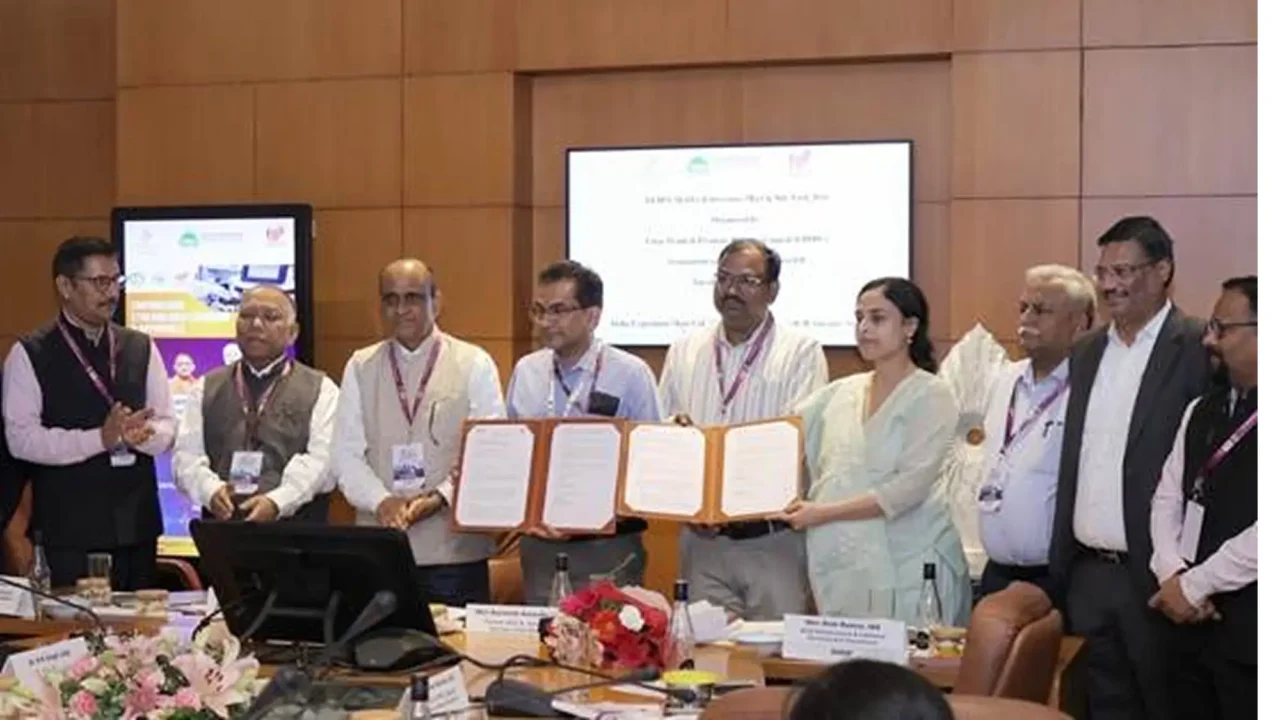
The Indian Pharmacopoeia Commission and Uttar Pradesh Promote Pharma Council have signed a Memorandum of Understanding aimed at strengthening quality standards, regulatory compliance, innovation and patient safety across Uttar Pradesh’s pharmaceutical and medical-device ecosystem.
The agreement was signed during the YEIDA MedTech Investors Meet & Site Visit 2026, held at India Expo Mart, Greater Noida, on 14 July 2026. The Ministry of Health and Family Welfare announced the partnership through the Press Information Bureau on 15 July.
The collaboration covers training, research, pharmacovigilance, materiovigilance, digital adverse-event reporting tools for MSMEs and stronger post-market surveillance.
It is an institutional cooperation framework rather than a new investment, factory or industrial-plot announcement.
Agreement at a glance
| Detail | Information |
|---|---|
| Organisations | Indian Pharmacopoeia Commission and Uttar Pradesh Promote Pharma Council |
| Agreement | Memorandum of Understanding |
| Signed on | 14 July 2026 |
| Venue | India Expo Mart, Greater Noida |
| Event | YEIDA MedTech Investors Meet & Site Visit 2026 |
| Main focus | Quality standards, compliance, innovation and patient safety |
| MSME support | Digital adverse-event reporting tools |
| Training | Joint programmes, workshops and awareness initiatives |
| Research | Industry-academia collaboration |
| Budget announced | Not disclosed |
| Implementation timeline | Not disclosed |
| Employment target | Not disclosed |
What will IPC and UPPPC work on?
According to the official Ministry of Health and Family Welfare release, the partnership covers six principal areas.
Strengthening quality standards and compliance
The two organisations will work to strengthen quality standards and regulatory compliance in the pharmaceutical and medical-device industries.
For manufacturers, this could improve awareness of quality-control systems, testing requirements, technical documentation and regulatory responsibilities.
The agreement does not create a new certification, inspection or product-approval process.
Promoting the Indian Pharmacopoeia
IPC and UPPPC will promote awareness of the Indian Pharmacopoeia, along with pharmacovigilance and materiovigilance.
The Indian Pharmacopoeia is India’s official book of drug standards. According to IPC’s official guidance, its standards provide specifications relating to the identity, purity and quality of medicines covered by the publication.
Training and stakeholder awareness
The partnership includes joint training programmes, workshops and stakeholder-awareness initiatives.
These activities could be relevant to pharmaceutical and medical-device manufacturers, quality-control teams, regulatory professionals, researchers, academic institutions and MSMEs with limited internal compliance resources.
No training calendar, registration process or eligibility criteria have yet been announced.
Pharmacovigilance and materiovigilance
Pharmacovigilance involves monitoring and reporting suspected adverse effects associated with medicines.
Materiovigilance performs a similar safety-monitoring role for medical devices. It helps identify and examine incidents involving malfunctioning, defective or potentially unsafe devices after they reach healthcare professionals and patients.
The MoU seeks to improve awareness and participation in both safety-monitoring systems.
Digital reporting tools for MSMEs
One of the most practical elements of the agreement is support for micro, small and medium enterprises through digital adverse-event reporting tools.
Such tools could help smaller manufacturers record and report safety concerns linked to medicines or medical devices.
However, the official announcement does not yet explain:
- Which platform will be used
- When the tools will become available
- Which MSMEs will be eligible
- Whether access will be free
- What training will be provided
- How submitted reports will be assessed
The practical value of this commitment will therefore depend on the implementation details released later.
Research and industry-academia collaboration
The partnership will also promote research, innovation and collaboration between businesses and academic institutions.
Potential areas may include product-quality research, regulatory science, technical studies, professional training and laboratory collaboration.
No university, laboratory, research project or funding allocation has been named in the announcement.
Patient safety and post-market surveillance
IPC and UPPPC will work to strengthen patient safety through quality assurance and post-market surveillance.
Post-market surveillance refers to monitoring medicines and medical devices after they enter the market and are used in real-world conditions.
It can help manufacturers and regulators identify:
- Recurring product defects
- Unexpected adverse events
- Device malfunctions
- Manufacturing problems
- Inadequate instructions or warnings
- Safety concerns requiring corrective action
The MoU establishes an intention to strengthen this system. It does not guarantee an immediate increase in reporting, recalls or enforcement action.
What is the Indian Pharmacopoeia Commission?
The Indian Pharmacopoeia Commission is an autonomous institution under the Union Ministry of Health and Family Welfare.
Its work includes setting and publishing official drug standards, providing reference substances, supporting quality assurance and coordinating national pharmacovigilance and materiovigilance programmes.
The Indian Pharmacopoeia provides standards intended to help establish the identity, purity and quality of medicines manufactured or marketed in India.
Why is the Greater Noida location significant?
The MoU was signed during a YEIDA-led medtech investor event at India Expo Mart, giving the agreement a direct connection to the emerging pharmaceutical and medical-device ecosystem around Greater Noida and the Yamuna Expressway.
Separately, YEIDA is developing a Medical Device Park in Sector 28. The project is intended to provide medical-device manufacturers with access to industrial land and shared testing and scientific infrastructure.
This park is regional background and is not part of the IPC–UPPPC agreement itself.
The PIB release does not state that the partnership applies only to companies located in YEIDA’s Medical Device Park. Its stated scope covers Uttar Pradesh’s wider pharmaceutical and medical-device ecosystem.
How could this support the regional medical-device ecosystem?
A medical-device manufacturing cluster requires more than industrial land and factory buildings.
Companies also need:
- Quality-management systems
- Product testing and validation
- Trained regulatory professionals
- Adverse-event reporting mechanisms
- Post-market monitoring
- Research partnerships
- Technical standards
- Access to specialised laboratories
The IPC–UPPPC partnership could potentially strengthen some of these capabilities through training, standards awareness, digital tools and research collaboration.
However, no programme has yet been announced specifically for manufacturers operating in YEIDA’s Medical Device Park.
What could the agreement mean for MSMEs?
Smaller manufacturers may have fewer regulatory and technical resources than large pharmaceutical or healthcare companies.
The agreement’s focus on capacity building and digital reporting could potentially help eligible MSMEs:
- Understand applicable quality standards
- Train quality and regulatory teams
- Report product-related adverse events
- Improve regulatory documentation
- Participate in workshops
- Connect with researchers and academic institutions
- Strengthen post-market monitoring
These are potential outcomes based on the agreement’s stated objectives. They are not yet confirmed services available to individual businesses.
No application procedure, eligibility rules or programme schedule have been published.
How could stronger reporting improve patient safety?
Medical devices range from diagnostic equipment and surgical instruments to implants, hospital equipment, monitoring systems and disposable products.
When a medicine or device causes an unexpected reaction, fails to perform correctly or contributes to patient harm, timely reporting can help determine whether the incident is isolated or part of a wider pattern.
A stronger reporting system can support:
- Earlier identification of defects
- Corrective action by manufacturers
- Safety alerts for healthcare professionals
- Product recalls where required
- Improved product design
- Better manufacturing processes
- More informed regulatory decisions
The agreement could strengthen awareness and reporting, but its impact will depend on participation by manufacturers, hospitals, healthcare professionals and other stakeholders.
Is this a new regulatory authority?
No.
The MoU does not establish a regulator or replace the Central Drugs Standard Control Organisation, state licensing authorities or other existing regulatory bodies.
It creates a collaborative framework between the Indian Pharmacopoeia Commission and Uttar Pradesh Promote Pharma Council for standards awareness, training, reporting, research, innovation and patient-safety initiatives.
IPC publishes official drug standards but does not itself approve medicines or medical devices.
What has not been announced?
The official release does not provide:
- An implementation budget
- A detailed action plan
- A training calendar
- The name of the digital reporting platform
- Eligibility rules for MSME support
- A list of participating manufacturers
- Investment or employment commitments
- Factory or plot-allotment announcements
- Measurable programme targets
The MoU should therefore be treated as an institutional starting point. Its practical impact will depend on how quickly the partnership produces training programmes, accessible reporting tools, industry participation and measurable safety outcomes.
What businesses should watch next
The next meaningful developments will include:
- Joint workshops and training programmes
- Details of the digital reporting tools
- MSME eligibility and access rules
- Partnerships with universities, hospitals or laboratories
- Programmes involving manufacturers in the YEIDA region
- Published implementation targets
- Evidence of increased adverse-event reporting
- Case studies showing improvements in compliance or patient safety
Without these details, it is too early to measure the practical impact of the agreement.
Why this matters for Greater Noida
Greater Noida and the Yamuna Expressway region are being developed as centres for medical-device manufacturing and airport-linked industrial growth.
The IPC–UPPPC agreement adds quality standards, regulatory awareness, research and patient safety to that development narrative.
For businesses, the potential value lies in training, standards awareness, reporting support and research collaboration.
For healthcare professionals and patients, the more important outcome would be better monitoring of medicines and medical devices after they enter the market.
The agreement is a positive institutional step. Its long-term significance will depend on whether it results in accessible reporting tools, practical training, industry participation and measurable safety improvements.
Important note
Businesses interested in YEIDA’s Medical Device Park should rely on official YEIDA scheme documents and allotment notices.
Pharmaceutical and medical-device manufacturers should consult the relevant regulatory authorities and qualified compliance professionals for product-specific requirements.
Source attribution
The MoU date, venue, participating organisations and stated areas of cooperation are based on the official Ministry of Health and Family Welfare release published through the Press Information Bureau.
Background on the Indian Pharmacopoeia Commission and the legal status of Indian Pharmacopoeia standards is based on the IPC official website and IPC Frequently Asked Questions.
The Medical Device Park context is based on YEIDA’s official Medical Device Park information. It is included as regional background and is not presented as part of the MoU.