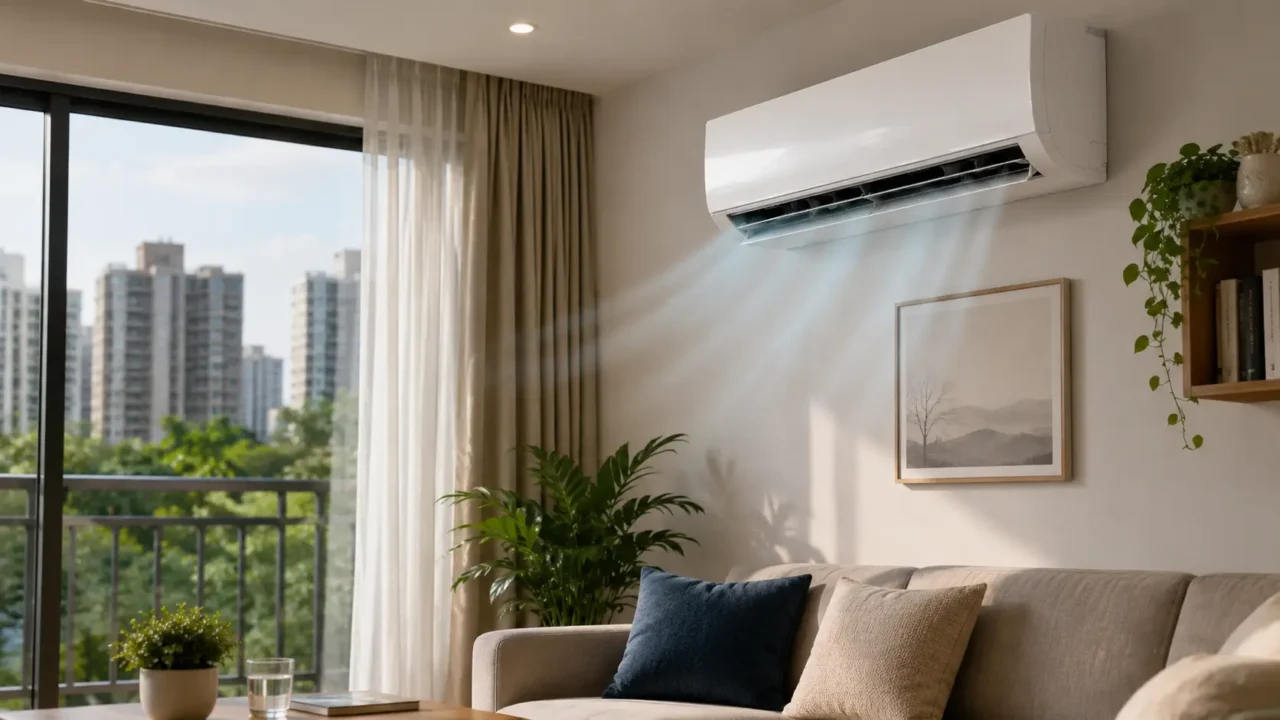
For many Noida and Greater Noida residents, summer AC trouble has become a familiar household story.
The AC starts leaking at night. The room smells damp when the machine starts. Cooling drops even when the remote is set to 18°C. A technician arrives and says, “gas kam hai” — meaning “the gas is low”. The gas is refilled, the AC works for a few days or weeks, and then the same problem returns.
The issue is not always the AC brand.
In Noida, AC problems often become worse because of a mix of local conditions: long summer usage, humid monsoon nights, dust, construction activity, closed outdoor shafts in high-rise buildings, poor installation, blocked drain pipes, waterlogging-prone pockets and, in some areas, open drains or sewage smell.
Noida’s drainage and sewerage issues are not imaginary. Residents in sectors including 120, 99, 100, 119 and 51 have faced blocked sewers, sewage overflow and flooded green areas, according to a Times of India report. The Noida Authority has also looked at expert-supported drainage improvements to tackle waterlogging and drain redesign issues in parts of the city.
But here is the important part: open drains and waterlogging do not automatically mean they are the direct reason your AC is leaking.
In most homes, water leakage from an indoor AC unit is usually caused by a blocked drain pipe, wrong drain slope, dirty filter, frozen coil, low refrigerant, poor installation or a unit that is not level. Local conditions such as humidity, dust, stagnant water and poor outdoor ventilation can make these problems more frequent or more severe.\
This guide explains the problem, the likely causes, what residents should check before paying for repair, and how to choose an AC that is better suited for Noida homes.=
Why ACs Leak Water Indoors
An air-conditioner does not only cool the room. It also removes moisture from indoor air. This moisture turns into water on the evaporator coil and is supposed to flow out through the drain tray and drain pipe.
When that path is blocked or badly installed, water starts dripping from the indoor unit.
Haier India explains that clogged drain lines, dirty air filters and low refrigerant levels are among the common causes of AC water leakage, and that a clogged condensate drain line can make water back up and overflow.
| Cause | What Happens |
|---|---|
| Clogged drain pipe | Dust, algae and sludge can block the condensate drain pipe. When water cannot flow out, it backs up and leaks indoors. |
| Wrong drain pipe slope | The drain pipe should slope downward. If it is lifted, bent, blocked or installed badly, water can flow back. |
| Dirty indoor filter | A dirty filter reduces airflow. This can affect cooling and may contribute to ice formation on the coil. |
| Dirty evaporator coil | Dust on the indoor coil reduces heat exchange. The AC may cool poorly, smell bad or leak. |
| Frozen coil | A coil can freeze because of low refrigerant, blocked airflow or dirty filters. When the ice melts, water may overflow. |
| Low refrigerant | Low refrigerant is a real issue, but it should not be used as a lazy diagnosis. If gas is low, residents should ask where the leak is. |
| Indoor unit not level | If the indoor unit is tilted or badly mounted, water may collect on one side and drip. |
| High humidity | During humid weather, the AC removes more moisture from the air. If the drain line is even partly blocked, leakage becomes visible faster. |
Why ACs Cool Poorly in Noida Homes
Poor cooling is not always a sign that the AC is defective. In Noida homes, it can happen because the AC is working in the wrong environment.
1. Outdoor unit in a closed shaft
Many high-rise flats have outdoor AC units placed in shafts. If the shaft is poorly ventilated, hot air from the outdoor unit gets trapped and circulates back into the unit. The AC then struggles to reject heat.
Result: Poor cooling, compressor strain, noise and higher electricity use.
2. Dust on outdoor condenser coil
Noida and Greater Noida have many road-facing, market-facing and construction-adjacent homes. Dust can collect on the outdoor coil and reduce heat rejection.
Result: The AC runs longer but cools less.
3. Top-floor heat load
Top-floor rooms and west-facing bedrooms absorb more heat. A 1-ton AC may not be enough for a hot, sun-facing room, even if the room area looks small on paper.
4. Wrong tonnage
An undersized AC will run continuously and still not cool properly. Oversizing can also create comfort and humidity issues. The room size, sun exposure, ceiling height and insulation all matter.
5. Dirty filters
This is the easiest thing to check and the most commonly ignored.
6. Low refrigerant
Low refrigerant may reduce cooling and cause ice formation, but repeated gas refilling without leak detection is a warning sign.
Can Open Drains, Sewage Smell or Waterlogging Affect ACs?
They can be a possible stress factor, but they should not be blamed for every AC fault.
Open drains, sewage smell, stagnant water and waterlogging may create a harsher outdoor environment for some AC units, especially ground-floor units, drain-facing balconies or homes where the outdoor unit is close to moisture and foul air.
Possible impacts include:
- Faster rusting of outdoor unit body or brackets
- More smell and dampness around the unit
- Higher dust and grime accumulation
- More frequent cleaning requirement
- Greater risk of corrosion in exposed components over time
A leaking indoor AC is still usually a drainage, installation, airflow, coil or refrigerant problem. Open drains and waterlogging may worsen the operating environment, but they do not replace proper technical diagnosis.
Common Noida AC Scenarios and What Residents Should Do
Scenario 1: Drain-facing balcony or ground-floor home
What residents notice:
- Bad smell near the AC
- Rust on outdoor unit
- Frequent servicing
- Poor cooling
Why it may happen:
The outdoor unit may be exposed to moisture, foul smell, stagnant water, dust and poor ventilation.
What to do:
- Keep the outdoor unit elevated and ventilated
- Get the outdoor coil cleaned before peak summer
- Check for rust on brackets and fins
- Consider models with copper condenser and anti-corrosion coating when buying a new AC
Do not do this:
Do not ignore visible rust or keep the unit close to waterlogging if relocation is possible.
Scenario 2: High-rise flat with outdoor unit in a closed shaft
What residents notice:
- AC runs continuously
- Poor cooling
- Compressor noise
- Higher electricity bill
Why it may happen:
The outdoor unit cannot release heat properly because hot air is trapped inside the shaft.
What to do:
- Do not block shaft vents
- Ask the technician to check airflow around the outdoor unit
- Get the condenser coil cleaned
- If the unit placement is very poor, ask whether relocation is possible
Do not do this:
Do not keep buying higher-tonnage ACs without fixing outdoor ventilation.
Scenario 3: Top-floor or west-facing bedroom
What residents notice:
- The room remains warm even at 18°C or 20°C
- AC runs for hours
- Electricity bill rises
Why it may happen:
Heat load is too high. The room may have direct sun exposure, poor insulation, large windows or wrong AC capacity.
What to do:
- Use curtains or blinds
- Seal gaps
- Check room size and heat load before buying
- For long daily use, a 5-star inverter AC may make more sense
Do not do this:
Do not assume every top-floor cooling problem is gas leakage.
Scenario 4: Road-facing or construction-zone flat
What residents notice:
- Cooling improves after servicing but drops again quickly
- Filters become black or dusty within weeks
Why it may happen:
Dust clogs filters and coils faster.
What to do:
- Clean indoor filters every 2 to 4 weeks during peak summer or dusty periods
- Schedule deeper servicing before summer and before monsoon
Do not do this:
Do not wait for annual service if your home faces heavy dust.
Scenario 5: Rented flat with repeated gas refill
What residents notice:
- Gas is refilled again and again
- Cooling fails after some time
Why it may happen:
There may be an unresolved leak in copper piping, joints, coil or installation.
What to do:
- Ask for leak detection before gas refill
- Ask for a written service record
- If the AC belongs to the landlord, document the problem with photos and service slips
Do not do this:
Do not pay repeatedly for gas refill without knowing where the gas is leaking.
Scenario 6: AC leaking during humid monsoon nights
What residents notice:
- Water drips from the indoor unit, especially at night or during humid weather
Why it may happen:
Humidity increases condensation. If the drain pipe is blocked or badly sloped, water overflows indoors.
What to do:
- Switch off the AC
- Check whether water is coming out of the drain pipe
- Clean the filter
- Call a technician to flush the drain line if needed
Do not do this:
Do not keep running the AC while water is dripping onto the wall, socket or electrical points.
Before Paying for AC Repair, Check This
Residents should not accept “gas kam hai” as the first and final diagnosis.
| Check | What It Tells You |
|---|---|
| Is water coming out of the drain pipe? | If not, drain pipe may be blocked |
| Is the indoor filter clean? | Dirty filter can reduce airflow and cooling |
| Is the drain pipe bent, lifted or blocked? | Wrong slope can cause leakage |
| Is the indoor unit level? | Tilted unit can leak |
| Is there ice on the indoor coil? | Could mean dirty filter, low gas or airflow issue |
| Is the outdoor unit in a closed shaft? | Poor ventilation can reduce cooling |
| Is the outdoor coil dusty? | Dirty condenser reduces heat rejection |
| Are there oily marks near copper joints? | Possible refrigerant leak |
| Is there rust on the outdoor unit or bracket? | Corrosion risk needs attention |
| Did the technician check for leak before gas refill? | Refill without diagnosis can waste money |
If gas is low, ask the technician: where is the leak?
What Noida Residents Should Ask an AC Technician
- Is the drain pipe blocked?
- Is the drain slope correct?
- Is the indoor filter dirty?
- Is the evaporator coil dirty?
- Is there ice formation?
- Is the refrigerant actually low?
- If gas is low, where is the leak?
- Did you check the copper joints?
- Is the outdoor unit getting enough ventilation?
- Will you give a service record or job sheet?
Which AC Should Noida Residents Actually Buy?
For most Noida homes, the answer should begin with the room, not the brand.
A premium AC with the wrong capacity can still cool poorly. A good AC installed badly can still leak. A cheaper AC with the right tonnage, proper drain slope, copper condenser and reliable service may work better than an expensive model installed carelessly.
So, before choosing a brand, residents should first decide the right tonnage, star rating, installation quality and service support.
The Bureau of Energy Efficiency says its Standards and Labelling programme helps consumers make informed choices about appliances based on energy-efficiency performance and potential cost savings. Buyers should check the official BEE label and ISEER value before relying only on marketplace claims.
Note: BEE star-rating thresholds can change over time. Always check the label period, current BEE rating and ISEER value on the unit itself — not just the marketplace listing.
Practical Default for Many Noida Flats
For a standard Noida bedroom of around 110 to 160 sq ft, the safest starting point is:
- Buy a 1.5-ton inverter split AC
- Prefer 5-star if used daily for long hours
- A 3-star inverter may be enough for occasional use
- Prioritise copper condenser, anti-corrosion coating, dry mode and authorised service support
Brands residents can compare include: Daikin, LG, Blue Star, Voltas, Hitachi and Panasonic
This is not a ranking. These are commonly considered AC brands in India. The final decision should depend on the specific model, warranty, BEE label, ISEER value and service availability in the resident’s Noida or Greater Noida sector.
Tonnage Guide for Noida Homes
| Your Room or Home Situation | What to Buy | Brands to Compare |
|---|---|---|
| Small bedroom or study, up to 110 sq ft | 1-ton inverter split AC | Daikin, LG, Voltas, Blue Star, Panasonic |
| Standard bedroom, 110–160 sq ft | 1.5-ton inverter split AC | Daikin, LG, Blue Star, Voltas, Hitachi, Panasonic |
| Large bedroom or living room, 160–220 sq ft | 2-ton inverter split AC | Daikin, Blue Star, Hitachi, LG, O General, Mitsubishi Electric |
| Top-floor room | 1.5-ton high-capacity inverter or 2-ton after heat-load assessment | Daikin, Hitachi, Blue Star, O General, Mitsubishi Electric |
| West-facing room with large windows | 1.5-ton or 2-ton after checking heat load | Daikin, LG, Blue Star, Hitachi, Panasonic |
| Drain-facing, humid or waterlogging-prone home | Tonnage by room size — prioritise copper condenser and anti-corrosion coating | LG, Daikin, Blue Star, Voltas, Hitachi |
| Road-facing or construction-zone flat | Usually 1.5-ton for bedroom, easy filter cleaning and reliable service | Voltas, LG, Blue Star, Panasonic, Daikin |
| Rented flat or occasional use | 1-ton or 1.5-ton 3-star inverter | Voltas, Blue Star, LG, Panasonic, Lloyd, Carrier |
| Premium long-term use | 1.5-ton or 2-ton 5-star inverter | Daikin, Mitsubishi Electric, O General, Hitachi, Blue Star |
Important: For top-floor, west-facing or large-window rooms, do not decide only by square feet. Heat load matters. A compact room with direct sun may need a higher-capacity AC than a shaded room of the same size. Standard ceiling height of around 9 to 10 ft is assumed above. Higher ceilings or open layouts may need professional assessment.
Brand-Wise Practical Guidance for Noida Buyers
Daikin
Daikin is worth comparing for residents who prioritise cooling performance and long-term use. Buyers should check the specific model’s BEE star rating, ISEER value, condenser type, warranty and authorised service availability in their sector.
Good fit for: Top-floor rooms, west-facing bedrooms, long daily usage
Suggested tonnage: 1 ton for small rooms · 1.5 ton for standard bedrooms · 2 ton for large or high heat-load rooms
LG
LG offers inverter split ACs with features such as dual inverter technology, convertible cooling modes and smart connectivity on selected models. Some models also include anti-corrosion protection on copper tubes. Buyers should verify which exact model carries these features.
Good fit for: Family bedrooms, smart-feature users, standard flats
Suggested tonnage: 1 ton for small rooms · 1.5 ton for most bedrooms · 2 ton for larger rooms
Blue Star
Blue Star is an India-based air-conditioning brand with a wide range of inverter split ACs. Some models are described by the company as having anti-corrosion features for harsh climates. Buyers should compare model-specific specifications before deciding.
Good fit for: Standard bedrooms, high-use rooms, buyers looking for cooling-focused options
Suggested tonnage: 1 ton for small rooms · 1.5 ton for standard rooms · 2 ton for high heat-load rooms after assessment
Voltas
Voltas offers split AC models across multiple tonnages and star ratings and is widely stocked in retail channels. It is worth comparing for residents who want practical pricing and broad availability, but buyers should still verify service support in their sector.
Good fit for: Budget-conscious buyers, rented flats, occasional-use rooms
Suggested tonnage: 1 ton for small rooms · 1.5 ton for standard bedrooms · 2 ton only for larger or hotter rooms
Hitachi
Hitachi is positioned in the premium AC segment. Buyers considering Hitachi should verify model-specific BEE rating, copper condenser, anti-corrosion features and authorised service support before buying.
Good fit for: Top-floor rooms, west-facing rooms, long summer usage
Suggested tonnage: 1.5 ton for standard bedrooms · 2 ton for larger or high heat-load rooms
Panasonic, Samsung, Carrier and Lloyd
These brands offer a range of split AC models at different price points. Buyers should compare specific models for copper condenser, anti-corrosion protection, BEE rating, warranty and service availability in Noida and Greater Noida.
Good fit for: Budget to mid-range buyers, smart-feature users, rented homes
Suggested tonnage: 1 ton for small rooms · 1.5 ton for standard bedrooms · 2 ton for larger rooms
Mitsubishi Electric and O General
These brands operate in the premium segment and are often considered for stronger cooling requirements. However, authorised service access may vary by Noida or Greater Noida sector. Buyers should confirm the nearest service centre and expected response time before purchase.
Good fit for: Large rooms, top-floor heat load, premium long-term use
Suggested tonnage: 1.5 ton for standard to large bedrooms · 2 ton for large or high heat-load spaces
If You Want the Short Answer
For most Noida bedrooms:
Buy a 1.5-ton inverter split AC with copper condenser + anti-corrosion coating + dry mode + valid BEE label + reliable local service.
Compare: Daikin, LG, Blue Star, Voltas, Hitachi and Panasonic
For a small room:
Buy a 1-ton inverter split AC.
Compare: Daikin, LG, Voltas, Blue Star and Panasonic
If the room is top-floor or gets strong afternoon sun, consider 1.5 ton after checking heat load.
For a top-floor or west-facing room:
Buy a 1.5-ton high-capacity or 2-ton inverter AC after assessment.
Compare: Daikin, Hitachi, Blue Star, O General and Mitsubishi Electric
Also improve curtains, insulation and outdoor-unit ventilation. A bigger AC without reducing heat load may not solve the problem fully.
For a drain-facing, humid or waterlogging-prone home:
Buy according to room size, but prioritise: copper condenser, anti-corrosion coating, proper outdoor unit placement and reliable service.
Compare: LG, Daikin, Blue Star, Voltas and Hitachi
The outdoor unit’s location and maintenance matter as much as the brand.
For a budget or rented flat:
Buy a 3-star inverter AC, 1 ton or 1.5 ton depending on room size.
Compare: Voltas, Blue Star, LG, Panasonic, Lloyd and Carrier
Do not overspend on premium features if usage is low. But do not compromise on installation quality.
A Note on Copper Condenser and Anti-Corrosion Coating
In Noida homes near open drains, waterlogging-prone areas or heavy-dust zones, copper condenser and anti-corrosion coating are features worth prioritising when comparing models.
For standard, well-ventilated installations, they remain useful but may not be critical for every buyer.
These are features to ask about and compare. They are not a guarantee that any specific model or brand will be problem-free in Noida conditions.
What to Ask the Dealer Before Buying
Before buying an AC in Noida, ask:
- Is this model copper condenser or aluminium?
- Does it have anti-corrosion coating?
- What is the BEE star rating?
- What is the ISEER value?
- What is the compressor warranty?
- What is the PCB warranty?
- Is installation by brand technician or dealer technician?
- Will installation include proper drain slope check?
- Is authorised service available in my sector?
- What is not covered in warranty?
What PON Readers Should Remember Before Buying
A good AC decision follows this order:
- Correct tonnage
- Proper installation
- Outdoor unit placement
- Copper condenser
- Anti-corrosion protection
- BEE star rating and ISEER
- Warranty
- Local service support
- Brand name
- DiscountThe cheapest deal is not always the cheapest AC in the long run. Poor installation, repeated gas refill, bad drainage slope and weak service can cost more than the initial discount.
Maintenance Calendar for Noida Homes
| Time | Action |
|---|---|
| March to April | Pre-summer service. Clean filters, indoor coil, outdoor coil and drain pipe. |
| May to June | Check filters every 2 to 4 weeks. Watch for weak cooling and leakage. |
| July to September | Monsoon drain check. Use dry mode when needed. Watch for smell, dampness and water leakage. |
| October | Post-monsoon cleaning if smell or dust buildup is visible. |
| All year | Keep bills, job sheets and complaint numbers. |
If Repair or Installation Goes Wrong
Residents should keep:
- Purchase bill
- Warranty card
- Installation slip
- Technician job sheet
- Photos or videos of leakage, rust or poor installation
- Complaint numbers from brand service centre
If the brand or dealer does not resolve a valid complaint, consumers can approach the National Consumer Helpline. Toll-free: 1915 and 1800-11-4000 · WhatsApp: +91 8800001915 · Email: nch-ca@gov.in
The Bottom Line for Noida Residents
In Noida, AC trouble is often a combination problem.
Heat, humidity, dust, construction activity, poor installation, blocked drain pipes, closed outdoor shafts, waterlogging and local civic conditions can all play a role.
The solution is not just buying a premium AC. The real solution is:
- Buy the right capacity
- Choose a model suited to your room
- Check BEE rating and ISEER
- Prefer copper condenser and anti-corrosion protection in harsher locations
- Install the AC correctly
- Keep the outdoor unit ventilated
- Clean filters regularly
- Flush the drain pipe before monsoon
- Demand leak detection before gas refill
Before you pay for another gas refill, check the drain pipe, filter, coil, outdoor unit and installation first. For many Noida homes, that may solve the problem faster and save money.
Editorial Note
This is a buying framework, not a brand ranking or endorsement. Pulse of Noida has not independently tested these brands for Noida-specific performance. Prices, model availability, BEE star ratings, warranty terms and service network details change frequently. Residents should verify the exact model number, current BEE label, ISEER value, warranty terms and authorised service availability in their sector before purchase. Pulse of Noida does not have any commercial arrangement with any brand listed in this guide.