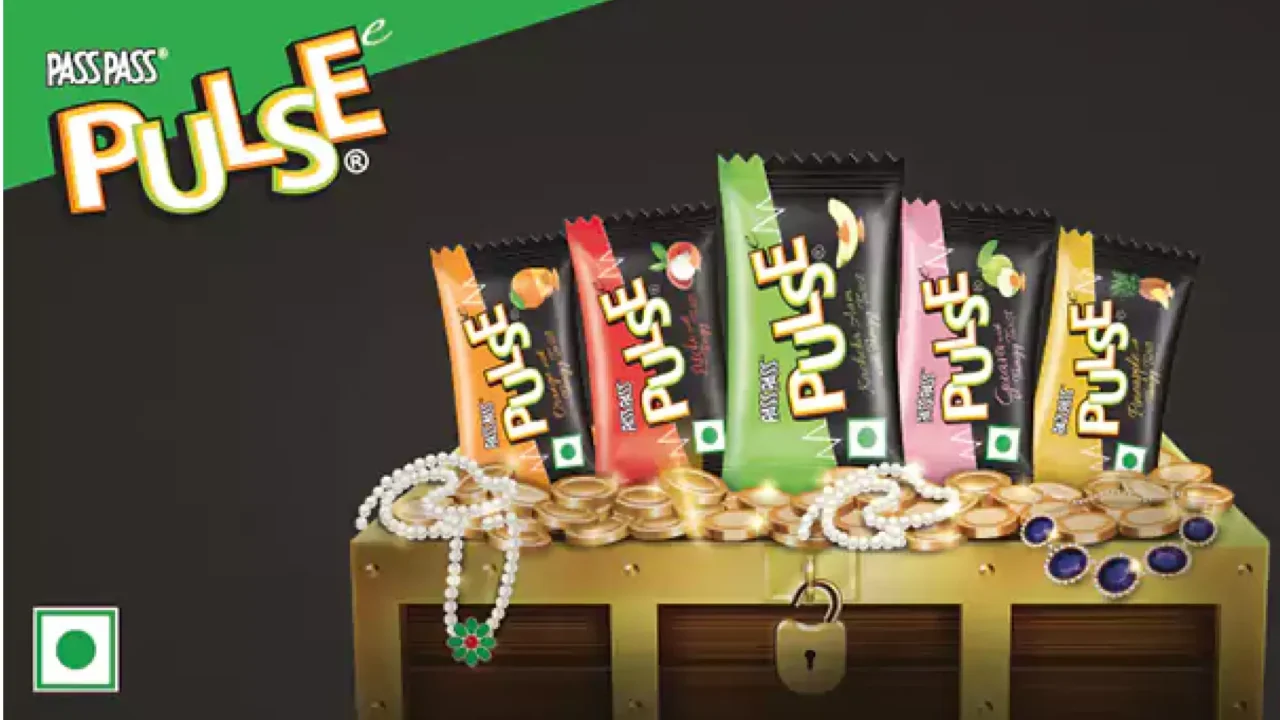
Pulse began with a simple proposition: A ₹1 hard-boiled candy built around the familiar Indian combination of raw mango and tangy masala.
A decade later, the brand has become one of the more notable growth stories in India’s confectionery market.
Pulse Candy is owned by Dharampal Satyapal Group, better known as DS Group. The group is headquartered in Sector 67, Noida. According to DS Group, Pulse crossed ₹750 crore at consumer price in FY 2024-25, with approximately 750 crore candies sold during the year.
That distinction matters.
The ₹750-crore figure refers to value at consumer price. It should not automatically be interpreted as DS Group’s net revenue from the brand, nor as the valuation of Pulse. The company’s own primary communication describes the milestone as value “at consumer price”, and this article uses the same definition.
For Noida, the story has another layer.
One of India’s most recognisable confectionery brands belongs to a large business group headquartered in the city. Pulse therefore offers a useful case study in product design, consumer behaviour, pricing, distribution and brand-building.
Who owns Pulse Candy?
Pulse Candy is a brand of DS Group, also known as Dharampal Satyapal Group.
DS Group describes itself as a multi-business Indian corporation with interests across food and beverages, confectionery, mouth fresheners, dairy, hospitality and other sectors.
Its corporate headquarters is located at:
C 6-10, Dharampal Satyapal Road, Sector 67, Noida, Uttar Pradesh 201309.
It is accurate to describe Pulse as a brand of the Noida-headquartered DS Group.
However, public information reviewed for this story does not establish that Pulse was invented in Noida or identify a specific Noida factory as the product’s manufacturing location. DS Group lists several manufacturing facilities in the Noida and Greater Noida region, but does not publicly attribute Pulse production to a particular facility.
The consumer insight behind Pulse
Pulse did not create India’s love for raw mango and masala.
It recognised an existing taste preference and redesigned it for the packaged confectionery market.
DS Group says the brand was built around the familiar experience of eating kachcha aam with spices. The product combined a fruit-flavoured hard outer candy with a tangy masala-filled centre.
That format created a layered experience:
Fruity outer candy
+
Tangy masala centre
+
A sudden change in flavour
The centre became the product’s defining feature.
Pulse was not only selling mango flavour. It was selling anticipation. Consumers knew there was a sharper, tangier moment waiting inside the candy.
For product teams and consumer startups, this is an important distinction.
The brand proposition was built into the product itself. Consumers did not need an advertisement to understand what made it different. The experience became the message.
Why the ₹1 price was a strategic decision
When Pulse entered the market, much of India’s hard-boiled candy category operated at the 50-paise price point.
DS Group says Pulse was launched at ₹1 at a time when around 86% of the category was priced at 50 paise.
The decision created an unusual combination:
Premium relative to the category
+
Affordable for mass consumption
Pulse did not become an expensive confectionery product.
Instead, it asked consumers to pay slightly more for a visibly differentiated experience.
The higher price was supported by:
- a distinctive masala-filled centre
- stronger perceived product value
- memorable packaging
- a flavour profile rooted in Indian taste preferences
This created what can be described as an affordable premium within a mass category.
The pricing lesson is not that a higher price automatically creates value.
The lesson is that consumers may accept a higher price when the product gives them a clear and repeatable reason to do so.
A candy for adults as well as children
Candy is often marketed primarily to children.
Pulse challenged that assumption.
DS Group’s brand narrative positioned the product for adults as well, expanding the potential consumption occasion beyond the traditional children’s confectionery market.
That widened the product’s relevance.
Pulse could become:
- an impulse purchase at a neighbourhood shop
- an after-meal candy
- an office-desk product
- something shared among friends or colleagues
- a familiar small purchase for adults
The broader audience helped the brand operate beyond the conventional idea of candy as a children-only category.
Product first, advertising later
One of the most frequently discussed elements of the Pulse story is the sequence of its growth.
The brand’s early momentum was driven heavily by product trial, word of mouth, consumer curiosity and organic social conversation before a large conventional advertising push.
DS Group has described how early enthusiasm was supported by word of mouth, social sharing, user-generated content and organic attention.
The broad sequence was:
Distinctive product
→ Consumer trial
→ Word of mouth
→ Wider availability
→ Mass advertising
This is different from launching a large campaign first and attempting to build product availability later.
For a low-priced impulse product, that order is commercially significant.
Advertising can create awareness, but awareness becomes frustrating when consumers cannot find the product.
Pulse’s growth therefore depended not only on generating interest, but also on ensuring that consumers could act on that interest at retail counters.
Distribution became part of the brand strategy
Distribution is often treated as an operational function.
For an impulse candy, it is also a marketing advantage.
Consumers generally do not plan extensively before buying a ₹1 candy. The brand needs to be visible and available at the moment of purchase.
According to DS Group, Pulse reached more than 35 lakh retail outlets across India.
That level of availability matters because every retail counter can become:
- a discovery point
- a reminder of the brand
- a repeat-purchase opportunity
- a place where consumer curiosity converts into sales
The company’s strategy evolved over time from expanding reach to improving distribution efficiency, inventory movement and market responsiveness.
For consumer businesses, the lesson is straightforward:
A memorable product may create demand, but distribution determines how much of that demand becomes actual purchase.
Pulse Candy growth metrics reported by DS Group
| Metric | Reported figure |
|---|---|
| Launch year | 2015 |
| First major milestone | ₹100 crore within eight months |
| FY 2024-25 value | More than ₹750 crore at consumer price |
| Candies sold in FY 2024-25 | Approximately 750 crore units |
| Reported hard-boiled candy segment share | 19% |
| Reported three-year CAGR | 15% |
| Reported category CAGR for comparison | 9% |
| Retail distribution reach | More than 35 lakh outlets |
| Stated next ambition | ₹1,000-crore consumer brand |
Pulse crossed the ₹100-crore milestone within eight months of launch, according to DS Group. The company later reported more than ₹750 crore at consumer price in FY 2024-25.
DS Group also reported:
- approximately 750 crore candies sold during FY 2024-25
- a 19% share of India’s hard-boiled candy segment
- a 15% compound annual growth rate over the previous three fiscal years
- category growth of approximately 9% during the same comparison period
- distribution through more than 35 lakh retail outlets
These market-share, growth and distribution figures are based on DS Group disclosures.
They should not be treated as independently audited category estimates unless supported by separate market-research data.
A crowded category, but a distinctive proposition
Pulse operates in a competitive confectionery market alongside long-established brands such as Alpenliebe, Candyman, Mango Bite and other hard-boiled candy portfolios.
DS Group reports that Pulse holds a 19% share of India’s hard-boiled candy segment. No current independent competitor-by-competitor market-share table was identified during the research reviewed for this article.
For that reason, individual rival brands should not be ranked without additional market data.
Pulse’s differentiation appears to come from four elements working together:
- a familiar Indian flavour
- a distinctive tangy centre
- mass-accessible ₹1 pricing
- extensive retail availability
Individually, none of these elements would necessarily create a large brand.
Together, they made the product easier to remember and more difficult to substitute.
From word of mouth to culture-led marketing
Pulse’s marketing has evolved significantly since its early product-led growth phase.
The brand now uses digital participation, communities, regional culture and youth-focused experiences to remain relevant.
In early 2026, Pulse participated in the Anime India Convention in Kolkata with gaming, cosplay, creator participation and experiential brand activity aimed at younger audiences.
The brand also launched the “Pulse of Moving India” campaign around World Compliment Day. The initiative recognised gig workers and essential-service providers and used localised outdoor communication, regional social content and targeted digital engagement.
The shift can be viewed as:
Product-led word of mouth
→ Mass brand-building
→ Digital participation
→ Culture and community engagement
The product remains a candy.
However, the marketing increasingly tries to place Pulse inside conversations, fandoms, communities and everyday social behaviour.
Can virality be manufactured?
The Pulse story is often described through the language of virality.
But the more useful lesson may be that consumer conversation followed a memorable product experience.
Early attention was supported by several factors:
- the unusual tangy centre
- strong repeatability
- easy sharing
- affordable pricing
- broad retail availability
- organic consumer conversation
The product gave consumers something simple to describe:
A sweet candy with a surprising masala centre.
That clarity helped word of mouth.
For marketers, this is an important distinction.
Virality may create short-term attention, but sustained growth requires:
Product value
+
Availability
+
Repeat purchase
+
Continued relevance
Pulse’s long-term growth cannot be explained by one campaign alone.
How Pulse expanded beyond the original green candy
Long-running impulse brands face a difficult challenge.
Consumers may continue to remember the original product, but novelty can fade.
Pulse has expanded its portfolio while retaining the core idea of fruit flavour combined with tanginess.
The official brand portfolio includes:
- Kachcha Aam
- Guava
- Orange
- Pineapple
- Litchi
The company has also introduced formats such as Pulse Shots and adjacent products built around similar flavour cues.
The expansion strategy appears designed to create more consumption occasions without abandoning the brand’s central identity.
The core remains:
Fruit
+
Tanginess
+
Surprise
What comes next for Pulse?
DS Group has said it expects Pulse to become a ₹1,000-crore consumer brand over the coming years.
The company has discussed growth through:
- deeper distribution
- new product formats
- adjacent categories
- regional flavours
- domestic market expansion
- international opportunities
The next phase will test whether Pulse can broaden its presence without weakening the simplicity that made the original product distinctive.
That challenge is common for successful consumer brands.
Expansion creates new opportunities, but too many extensions can dilute the original proposition.
For Pulse, the strategic question is likely to be:
How far can the brand move beyond the original candy while retaining its identity around tanginess, Indian flavour and surprise?
What Noida entrepreneurs can learn from Pulse
Pulse offers several practical lessons for founders, marketers and consumer-product teams.
1. Start with an existing consumer behaviour
Pulse did not ask consumers to learn an unfamiliar taste.
It used the familiar combination of raw mango and masala, then converted it into a packaged product.
2. Build differentiation into the product
The tangy centre was not only an advertising claim.
Consumers experienced the difference directly.
3. Affordable does not always mean lowest-priced
Pulse launched at ₹1 when much of the category was priced at 50 paise.
The higher price was supported by a stronger product experience.
4. Distribution can become a competitive advantage
A low-priced impulse product needs to be available when the consumer wants it.
Wide retail reach helped turn brand awareness into actual purchase.
5. Product experience can create conversation
The masala centre gave consumers something memorable to discuss and share.
Word of mouth became a consequence of the product.
6. Advertising works better when availability is already strong
Demand generation becomes more effective when the product is easy to find.
7. Extend the brand without losing its core
New flavours and formats continue to revolve around the original promise of fruit, tanginess and surprise.
Why the Noida connection matters
Noida is often discussed through infrastructure, technology companies, startups and real estate.
DS Group represents another side of the city’s economic identity: nationally distributed consumer brands, large-scale corporate operations and diversified business growth.
The verified local connection is clear.
DS Group is headquartered in Sector 67, Noida.
That does not mean every DS Group product is designed or manufactured in the city.
But it does mean that one of India’s better-known confectionery brands belongs to a business group whose corporate base is in Noida.
For local entrepreneurs and business leaders, that makes the Pulse story more than a national FMCG case study.
It is also a locally relevant example of how consumer insight, product differentiation, pricing and distribution can combine to build scale.
The larger lesson behind the ₹1 candy
Pulse’s growth was not built around one marketing campaign or one distribution decision.
It combined:
- a familiar Indian taste
- a differentiated product format
- affordable premium pricing
- broad retail availability
- consumer word of mouth
- continued cultural relevance
For Noida entrepreneurs, product teams and consumer startups, the lesson may be straightforward:
Strong brands often begin with a simple consumer truth, but scale depends on execution across product, pricing, distribution and relevance.
Pulse may be sold as a small candy.
Its business story is much larger.
Frequently Asked Questions
Who owns Pulse Candy?
Pulse Candy is owned by DS Group, also known as Dharampal Satyapal Group. DS Group is headquartered in Sector 67, Noida.
When was Pulse Candy launched?
Pulse Candy was launched in 2015.
Did Pulse Candy cross ₹750 crore in sales?
DS Group said Pulse recorded more than ₹750 crore at consumer price in FY 2024-25, with approximately 750 crore candies sold during the year. The figure should not automatically be interpreted as DS Group’s net revenue from the brand.
Is Pulse Candy made in Noida?
The verified fact is that DS Group is headquartered in Noida. Public information reviewed for this story does not identify a specific Noida manufacturing facility for Pulse Candy.
Why did Pulse Candy become popular?
The brand combined a familiar raw-mango flavour with a tangy masala-filled centre, ₹1 pricing, broad distribution and strong consumer word of mouth.
What flavours does Pulse Candy offer?
The official Pulse portfolio includes Kachcha Aam, Guava, Orange, Pineapple and Litchi variants.
Source Attribution
Sources: DS Group official corporate, brand, office, manufacturing and media-centre pages; DS Group public business disclosures; and reputable business and marketing publications used for additional context. Consumer-price, market-share, growth and distribution figures are attributed to DS Group.
Editorial Disclosure
This is an independent Pulse of Noida business feature based on publicly available corporate and business sources. It is not sponsored content.