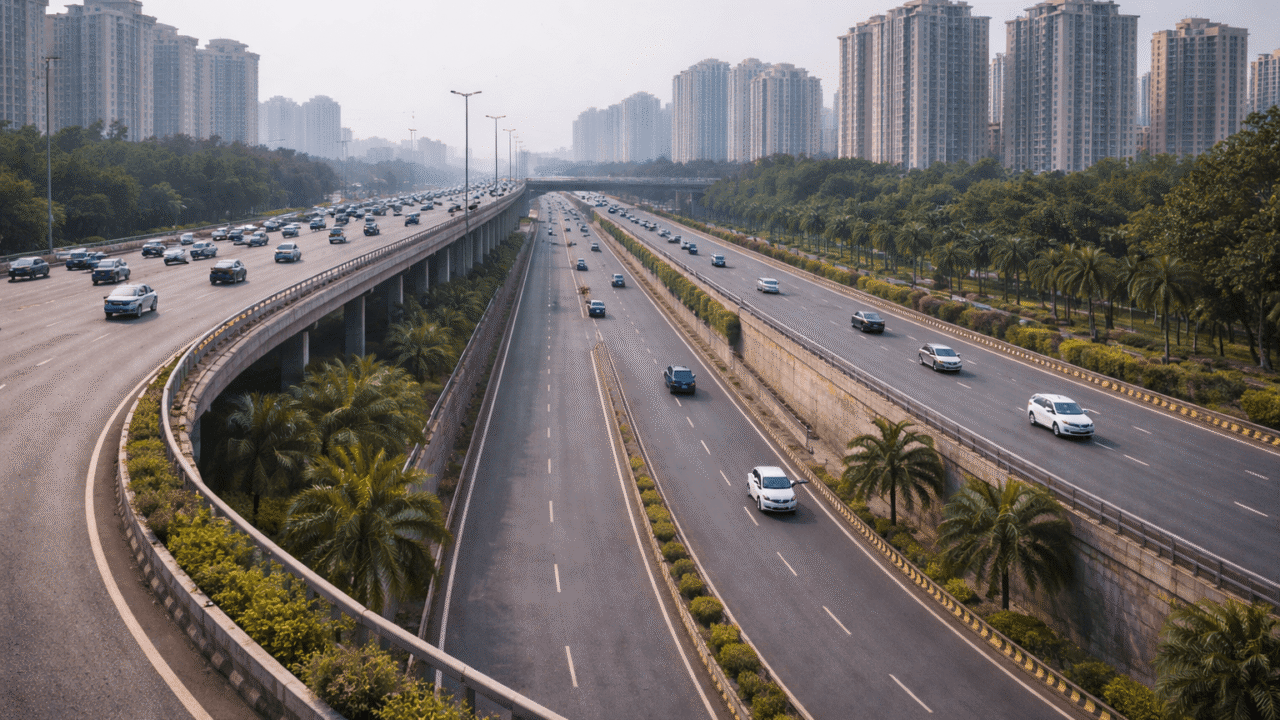
Noida is often described as one of India’s most planned cities, especially when it comes to road infrastructure. One of the most visible features of this planning is the large number of flyovers, underpasses, and grade separators spread across the city. From arterial roads near Sector 62 to major corridors along the Noida Greater Noida Expressway, grade-separated roads are a defining part of daily commuting in Noida.
This approach is not accidental. It is the result of long-term traffic planning driven by rapid population growth, high vehicle density, and the city’s role as a major employment hub in the National Capital Region.
Why Noida Chose Flyovers and Underpasses Over Traffic Signals
Traditional traffic signals work well in smaller cities or low-density areas. In a fast-growing urban region like Noida, signals often become choke points due to continuous traffic flow from multiple directions.
Flyovers and underpasses allow uninterrupted movement of vehicles by separating traffic streams vertically. This reduces waiting time, fuel consumption, and the risk of collisions at intersections. According to planning guidelines followed by the Noida Authority, grade separation is preferred on high-traffic corridors where daily vehicle volume exceeds manageable limits for signalised intersections.
Difference Between Flyovers, Underpasses, and Grade Separators
A flyover carries traffic above an intersection, allowing vehicles to cross without stopping. An underpass moves traffic below ground level, often used where elevation constraints exist. Grade separators include both these structures and are designed based on traffic flow direction, land availability, and surrounding development.
In Noida, underpasses are commonly used near residential sectors to minimise visual and noise impact, while flyovers are preferred on expressways and wide arterial roads.
How These Structures Reduce Traffic Congestion
Traffic congestion is caused mainly by stoppages, merging conflicts, and uneven vehicle flow. Flyovers and underpasses address all three issues. Vehicles moving straight do not have to stop for cross traffic. Pedestrian movement is often redirected through foot overbridges or subways, further improving safety and flow.
Studies referenced by urban planning agencies show that grade-separated intersections can improve average travel speed by 20 to 40 percent during peak hours when compared to signal-controlled junctions.
Improving Road Safety in a High-Speed Urban Environment
Road safety is a major concern in rapidly urbanising cities. Intersections are among the most accident-prone zones due to turning conflicts and pedestrian crossings. By eliminating direct crossing points, flyovers and underpasses significantly reduce the chances of side-impact collisions.
Noida’s road design also incorporates service roads, controlled entry and exit points, and clear signage. Together, these features create predictable driving conditions, which is a key factor in reducing accidents.
Supporting Noida’s Long-Term Urban Growth
Noida was planned with future expansion in mind. Areas that once saw moderate traffic now experience heavy movement due to IT parks, commercial hubs, and high-density housing. Building flyovers and underpasses early helps the city absorb growth without constant traffic breakdowns.
Infrastructure planning by the Noida Authority aligns with regional frameworks such as the National Urban Transport Policy, which encourages cities to adopt designs that support efficiency, safety, and economic productivity.
Challenges and Public Concerns
Despite their benefits, flyovers and underpasses are not without criticism. Construction phases can disrupt traffic temporarily, and poorly designed access points may cause confusion. Maintenance, drainage during monsoons, and pedestrian accessibility also require continuous attention.
Urban planners increasingly emphasise the need to balance road infrastructure with public transport, walking, and cycling facilities to ensure sustainable mobility.
The Bigger Picture
Flyovers and underpasses are not just concrete structures. They represent Noida’s attempt to stay ahead of urban challenges through planned infrastructure. When integrated with metro connectivity, public transport, and last-mile solutions, these road projects play a crucial role in keeping the city functional and liveable.
As Noida continues to grow, the focus will need to shift from simply building more roads to managing demand smarter. For now, grade-separated roads remain one of the strongest pillars of Noida’s traffic management strategy.
Official Sources and References
- Noida Authority Official Website
https://noidaauthorityonline.in/en - Ministry of Housing and Urban Affairs
https://mohua.gov.in