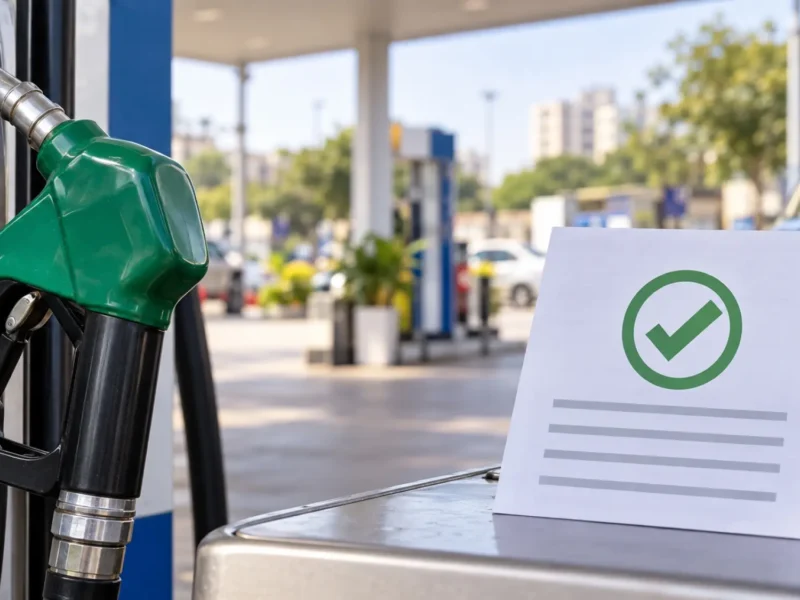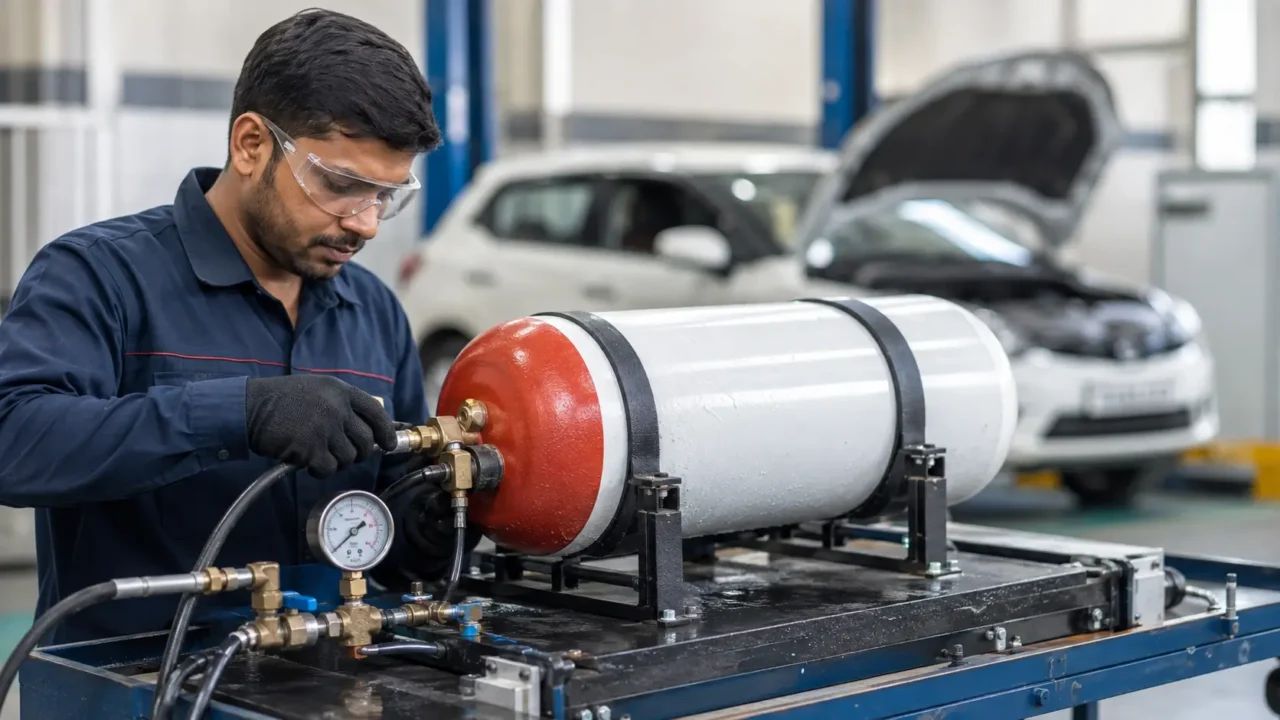
If you drive a CNG car or commercial vehicle in Noida or Greater Noida, there is one document worth checking before your next refuelling stop: the periodic test certificate for the onboard CNG cylinder.
The Petroleum and Explosives Safety Organisation, or PESO, reiterated in a circular dated July 7, 2026 that an onboard CNG cylinder whose periodic testing or examination is due should not be filled with compressed natural gas.
PESO has also introduced an online system for verification of CNG cylinder test certificates and publishes information on approved cylinder-testing stations.
For motorists, this makes cylinder-test validity more than a workshop-maintenance issue. It is directly relevant to whether the cylinder is eligible to be refilled.
At a glance
- Regulator: Petroleum and Explosives Safety Organisation
- Key requirement: A CNG cylinder due for periodic testing or examination should not be filled
- Verification: PESO provides an online CNG cylinder test-certificate verification system
- Testing stations: PESO publishes information on approved CNG cylinder-testing stations
- Testing interval: Indraprastha Gas Limited advises CNG users to have cylinders hydro-tested every three years
- Safety rule: Do not attempt to inspect, repair, open or alter a high-pressure CNG cylinder yourself
What PESO says about overdue CNG cylinders
PESO’s July 2026 circular refers to Rule 35 of the Gas Cylinders Rules, 2016.
Under this framework, cylinders that have become due for prescribed periodic examination and testing should not be filled with compressed gas.
For CNG vehicle owners, the practical takeaway is straightforward: check that the cylinder’s periodic test remains valid rather than waiting for a problem at the filling station.
The rule applies to the cylinder’s testing status. It should not be confused with routine vehicle servicing, pollution-under-control certification or fuel-system maintenance.
How motorists can verify a CNG test certificate
PESO provides an online facility for CNG cylinder test-certificate verification.
Check your CNG cylinder certificate: PESO → Status → Rule (Gas Cylinders Rules) → Form Action → Search CNG Certificate by Vehicle Number
Vehicle owners should use PESO’s official service rather than relying only on a sticker, handwritten workshop note or an unverified message from a local service provider.
When checking a certificate, make sure the information corresponds to your actual vehicle and cylinder records.
If there is a mismatch or the certificate cannot be verified, contact an authorised testing facility or the relevant service provider before refuelling.
How often should a CNG cylinder be tested?
Indraprastha Gas Limited advises CNG vehicle users to have their cylinders hydro-tested every three years.
This interval is being cited here as IGL’s consumer guidance.
PESO’s July 2026 circular establishes the regulatory requirement that cylinders due for periodic examination or testing should not be filled, while vehicle owners should follow the applicable testing schedule for their cylinder and vehicle.
If you are unsure when your cylinder was last tested, do not estimate the date from memory. Check the certificate or records associated with the cylinder.
Where can you get a CNG cylinder tested?
CNG cylinders should be tested only at recognised or authorised cylinder-testing facilities.
PESO maintains information on approved CNG cylinder-testing stations.
IGL also publishes a list of PESO-authorised hydro-testing centres for customers. Its current listing includes facilities in Greater Noida, but motorists should verify the latest status against the PESO-approved registry before travelling to a particular centre.
Because authorisations and listings can change, Pulse of Noida recommends checking the official registry rather than relying on an old saved address or third-party directory.
What happens if the cylinder test is overdue?
An overdue test is not something to solve at the filling station.
PESO’s regulatory position is that a cylinder that has become due for its prescribed periodic test or examination should not be filled.
The appropriate next step is therefore to arrange testing through an approved facility.
Do not attempt to:
- Open or remove cylinder valves yourself
- Release or vent CNG manually
- Repair dents, fittings or valves at home
- Modify the CNG system to bypass a test requirement
- Use an unverified workshop simply because it offers a faster certificate
CNG is stored under high pressure. Inspection, testing and repair should be handled by appropriately authorised professionals.
Factory-fitted or retrofitted CNG: check your own records
CNG systems may be factory-installed or added later through an approved retrofit process.
For the purpose of periodic cylinder testing, motorists should check the documentation applicable to the cylinder and installation fitted to their own vehicle.
Do not assume that another driver’s certificate, sticker format or workshop process necessarily applies to your vehicle.
Where vehicle-specific requirements are unclear, check with the manufacturer, authorised retrofit provider, transport authority or approved testing facility.
Before your next CNG fill-up
A few checks can reduce confusion at the station:
- Check when your CNG cylinder was last tested
- Verify the test certificate through the official PESO facility where possible
- Use only approved testing stations
- Keep valid cylinder and vehicle records accessible
- Follow filling-station safety instructions
- Do not attempt DIY repairs or modifications to the high-pressure system
If your cylinder is already due for testing, arrange the test before the next refill rather than expecting the filling station to overlook it.
CNG safety is different from fuel compatibility
CNG-cylinder testing concerns the condition and regulatory validity of the high-pressure gas cylinder.
That is different from questions about whether a petrol vehicle is compatible with a particular fuel blend.
Owners of petrol cars and two-wheelers looking for guidance on ethanol-blended petrol can separately read Pulse of Noida’s E20 petrol compatibility guide for older cars and bikes.
Why the July 2026 PESO circular matters
PESO’s latest circular adds an important verification layer.
It reiterates the prohibition on filling cylinders whose periodic test is due and points stakeholders towards test-certificate verification for onboard CNG cylinders.
For motorists, that creates a clear practical habit: do not treat the hydro-test date as something to check only when a workshop or filling station raises an objection.
It can be checked proactively.
What Pulse of Noida recommends
Before relying on a testing centre, certificate or service provider:
- Use PESO’s official certificate-verification and approved-station resources
- Check that the certificate corresponds to your cylinder
- Treat IGL’s hydro-testing information as operator guidance
- Avoid third-party claims that cannot be checked against an official record
- Never pay someone to “bypass” testing requirements
If there is uncertainty about a cylinder’s condition or test status, stop using guesswork and consult an authorised facility.
The central safety rule is simple: a CNG cylinder that is due for its prescribed periodic testing or examination should not be refilled until the required process has been completed.
Source attribution
Official sources
- PESO: July 7, 2026 circular on verification of test certificates for onboard CNG cylinders
- PESO: Approved CNG Cylinder Testing Stations
- PESO: Role, Responsibilities and Activities