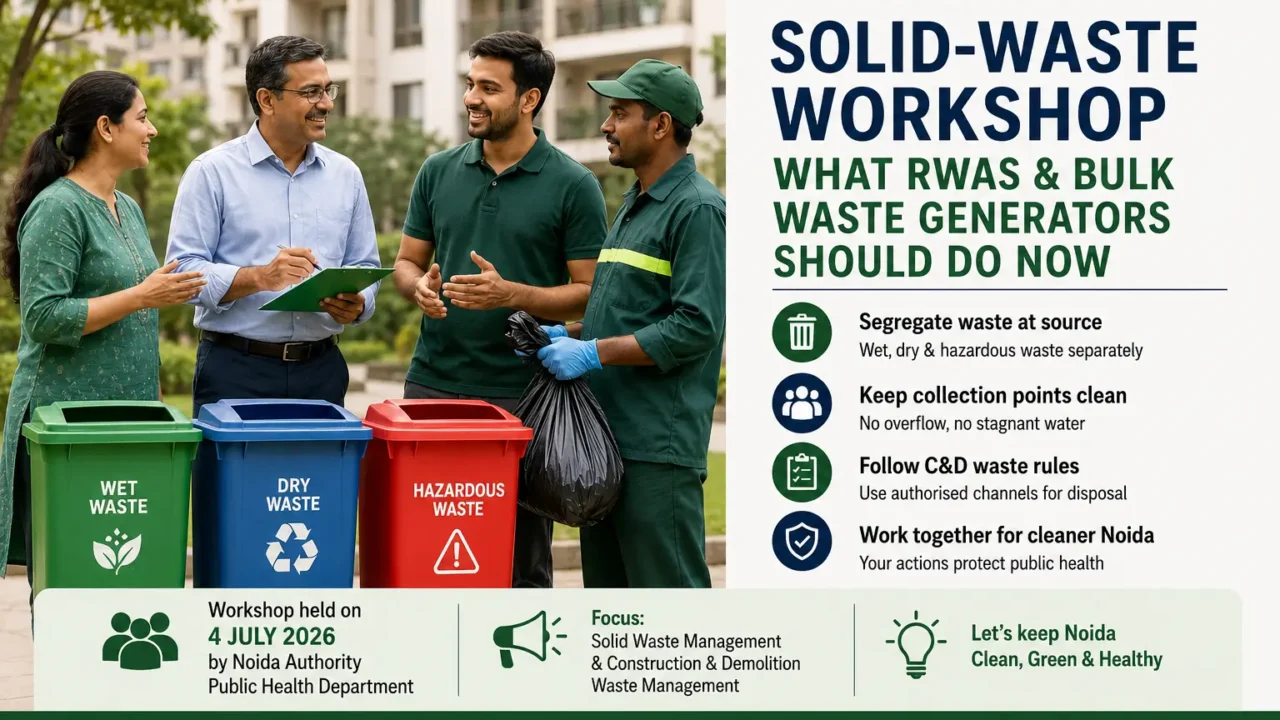
Noida Authority’s July 4 solid-waste management workshop is a useful reminder for residents, RWAs, AOAs and bulk waste generators to check the basics: segregation at source, clean collection points and proper disposal of C&D waste.
The Authority’s public post confirms that its Public Health Department held the workshop under a capacity-building programme. However, the detailed agenda, attendee list and any enforcement timeline linked to the workshop were not available in the public post reviewed by Pulse of Noida.
For residents and facility teams, the immediate takeaway is practical: tighten waste handling before monsoon-related sanitation problems become larger.
Read more: PON monsoon dengue guide
Why this matters during monsoon
During monsoon weeks, mixed waste, wet garbage, clogged bins and open dumping can create odour, attract insects and make common areas harder to clean. If garbage points are close to stagnant water, drains or basement areas, the risk becomes more serious for housing societies, markets and public spaces.
Noida Authority’s Public Health page hosts documents related to Swachh Bharat Mission, solid waste management, C&D waste and penalties for throwing waste in the open or not segregating it properly. Residents should note that several of these supporting documents are older uploads from June 2021. They may not reflect current fine amounts, fresh enforcement timing or any new 2026 penalty rules unless Noida Authority issues an updated circular.
What residents should check at home
Residents can begin with a simple three-bin habit:
- Wet waste: kitchen waste and food scraps
- Dry waste: paper, plastic, packaging, cardboard and clean recyclable material
- Domestic hazardous waste: sanitary waste, blades, batteries, broken glass, medicine strips and similar items
The exact handover process may vary by society or sector, so residents should follow the RWA, AOA or waste collector’s local system. The key is not to mix wet and dry waste at source.
What RWAs and AOAs should check
RWAs and AOAs should review:
- whether wet and dry waste is being collected separately
- whether bins are labelled and accessible
- whether housekeeping staff are trained in segregation
- whether garbage collection points are cleaned daily
- whether leachate or dirty water is collecting near bins
- whether bulk garden waste is being handled properly
- whether C&D waste is being dumped at the wrong point
- whether residents are being reminded without creating panic or blame
A short notice at the lift lobby or society gate can often work better than repeated WhatsApp forwards.
What bulk waste generators should review
Bulk waste generators, such as large housing societies, institutions, markets, malls, hotels, offices and commercial premises, should check whether their waste handling process is documented and whether wet waste, dry waste and other categories are being handled as required.
They should also verify whether their housekeeping, vendor and facility teams understand the difference between regular municipal waste, garden waste, construction and demolition waste, and biomedical or hazardous waste where applicable.
What not to assume yet
The July 4 workshop confirms that Noida Authority’s Public Health Department has conducted a solid-waste management capacity-building session. What it does not confirm, at least from the public material reviewed by Pulse of Noida, is a new fine date, a sector-wise enforcement drive or a fresh compliance deadline.
The practical takeaway is simple: RWAs, AOAs, residents and bulk waste generators should use the workshop as a reminder to strengthen waste segregation, bin hygiene and reporting systems. It should not be read as an announcement of a new penalty drive unless Noida Authority issues a specific order.
Read more: PON civic grievance guide
A simple RWA checklist for this week
- Put visible labels on wet and dry waste bins
- Ensure no open garbage remains overnight
- Check basement, garbage room and service areas for stagnant water
- Tell residents how to dispose of sanitary and sharp waste
- Keep a record of collection gaps
- Report irregular collection through official channels
- Do not allow C&D waste to be dumped near society gates or drains
- Share one clear waste-segregation reminder with residents
The bottom line
Solid waste management is not only a cleanliness issue. In monsoon months, it becomes a public-health issue for homes, societies, markets and neighbourhoods. Noida Authority’s workshop is a timely reminder for residents and facility teams to revisit basic segregation, clean collection points and proper reporting before problems become larger.
Sources
Noida Authority social media post confirming the July 4 solid-waste management workshop; Noida Authority Public Health page; older official documents on SWM, C&D waste and penalties hosted on the Noida Authority website. Pulse of Noida reviewed the public material available and did not find a detailed circular linking the July 4 workshop to a new penalty date or fresh 2026 enforcement deadline.