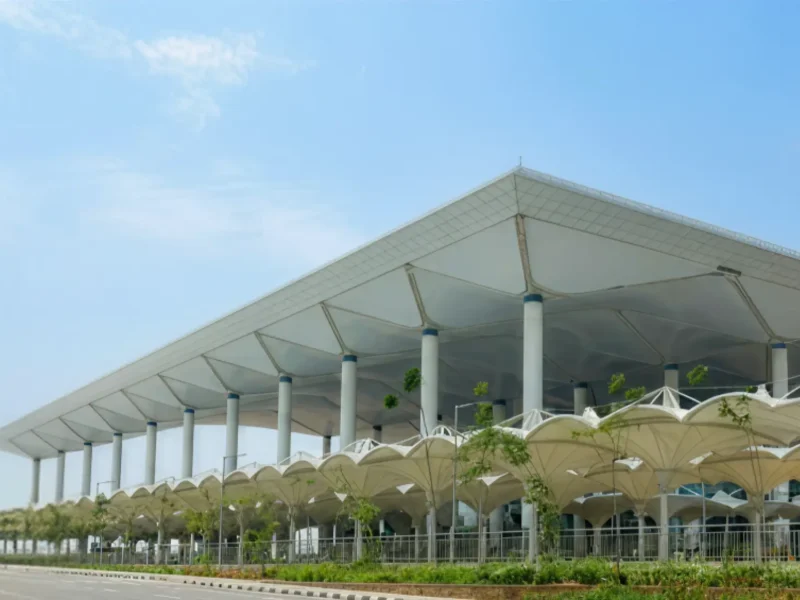
A traveller enters the terminal at Noida International Airport, clears the first formalities, and then pauses.
Ahead is not just a wall. It is a sweep of orange, yellow and gold. The colours feel like sunrise. The scenes feel familiar even to someone who may not have visited them all: river ghats, sacred cities, old monuments, flowing water, bells, memory and movement.
This is the point where the airport stops being only infrastructure.
It begins to speak.
At Noida International Airport, expected to begin commercial operations from June 15, 2026, artist Paresh Maity’s two public artworks are being placed as part of the airport’s larger cultural identity. As Pulse of Noida has reported, Noida International Airport begins commercial flights from June 15, with IndiGo set to operate the first flight and other airlines to follow.
For Noida, Greater Noida and the Yamuna Expressway region, this matters because the airport is not just a transport project. It is the region’s new gateway to India and the world.
For travellers, the first impression will not be a blank terminal. It will be Uttar Pradesh, presented through art.
What Is Jagriti?
The first major work is titled Jagriti, meaning awakening.
It is made up of six large panels in oil acrylics on canvas. Together, the panels create a wide visual journey through India’s river-linked cultural and spiritual landscape, with Uttar Pradesh at the centre of the story.
The panels depict iconic sites along India’s rivers, the Varanasi ghats, the Sanchi Stupa of Sarnath, and the Taj Mahal, capturing the state’s spiritual geography, its river culture, its monuments and its continuing role in India’s civilisational imagination.
Maity has described the panels as connected by the idea of awakening. The sunrise-like palette, dominant oranges and golds, is part of that thought. It gives the work a sense of beginning, which fits an airport terminal where journeys start every day.
The airport is set to begin commercial operations from June 15, 2026. With art already installed, the terminal is closer to ready than the runways-only story suggests.
Why Uttar Pradesh’s Heritage Was Chosen
The choice of UP’s cultural markers is important.
Noida International Airport is located in Jewar, but its impact stretches across Noida, Greater Noida, Western Uttar Pradesh and the wider National Capital Region. For many passengers, it will become their first point of contact with this region.
That is why the art inside the terminal cannot be treated as decoration alone.
Through Jagriti, the airport places Uttar Pradesh’s heritage in front of travellers before they board a flight. Varanasi, Sarnath and Agra are presented as part of one connected civilisational landscape. The message is clear: this airport belongs to a state with deep cultural memory, not just a rapidly expanding economy.
It also gives Noida a more layered identity. The city is often described through expressways, offices, housing projects and technology corridors. The airport’s art programme adds another vocabulary: rivers, sacred architecture, public culture and shared memory.
What Is Mystic Abode?
The second work is Mystic Abode, a hut-shaped bell installation made with more than 8,000 brass bells and steel bars.
The work was originally created in 2014. At Noida International Airport, it is being positioned as an experiential installation, not just a sculpture to be viewed from a distance.
Its form is simple: a hut-like structure covered with bells. But its meaning is larger.
Bells are part of Indian homes, temples, rituals and thresholds. They mark entry, prayer, attention and transition. In an airport where people are often rushing, waiting, worrying or separating from families, the sound and symbolism of bells create a very different emotional register.
Maity has described the work as being aimed at bringing “joy, peace and harmony” to people travelling through the airport. In a space built for movement, Mystic Abode introduces stillness.
That matters because airports are usually designed around efficiency: check-in, security, boarding, baggage. A bell installation inside such a space asks the traveller to slow down for a moment.
Maity’s Intent: Art That Is for Everybody
Maity’s stated intention is also important for how this story should be read.
He has said that the works were kept classical “because public art is for everybody.”
Public art inside an airport cannot be too private, too coded or too inaccessible. It has to work for a first-time flyer, a student, a business traveller, a tourist, an elderly passenger and someone who may only have a few seconds to look at it.
That is why the works rely on recognisable forms: ghats, rivers, monuments, bells, homes and sunrise colours. The airport may be new, but the visual language is deliberately familiar.
The Bigger Picture for Noida
For Noida, this is more than an art story.
Noida International Airport is already being followed through the lens of connectivity, real estate, jobs, airline routes and passenger charges. Pulse of Noida has also covered how domestic flyers will pay ₹490 as UDF at Noida Airport.
But infrastructure is not only about runways and terminals.
The cultural choices inside the terminal will shape how people remember the airport. A passenger may forget the exact gate number or baggage belt. But they may remember the glow of Jagriti or the brass-bell form of Mystic Abode.
That is the larger point.
Noida’s airport is being built as a transport hub. Its art is trying to make it a cultural gateway.
Why This Matters to the Noida Reader
For residents of Noida and Greater Noida, the airport has long been discussed as a promise: better connectivity, higher land values, more jobs, more business and a stronger place on the national map.
The art inside the terminal adds a softer but equally important layer.
It says that the region’s new gateway will not only move passengers. It will also carry a story.
Through Paresh Maity’s brushstrokes and bells, the airport presents Uttar Pradesh as spiritual, rooted, warm, classical and open to the world. Before a traveller boards a flight, the terminal gives them an introduction to the state.
That is why these artworks deserve attention.
They are not only inside Noida Airport.
They are part of what Noida Airport wants to say.
Sources
- Noida International Airport official commercial operations announcement — Noida International Airport to Welcome Passengers from 15th June 2026, niairport.in, May 1, 2026
- Paresh Maity artworks Jagriti and Mystic Abode at Noida International Airport — PTI (Press Trust of India), May 27, 2026
- Artwork details and dimensions — Art Alive Gallery, official Instagram, @artalivegallery, March 30, 2026
- Airport UDF charges — Noida Airport UDF Fixed: Domestic Flyers to Pay ₹490 on Departure, Pulse of Noida