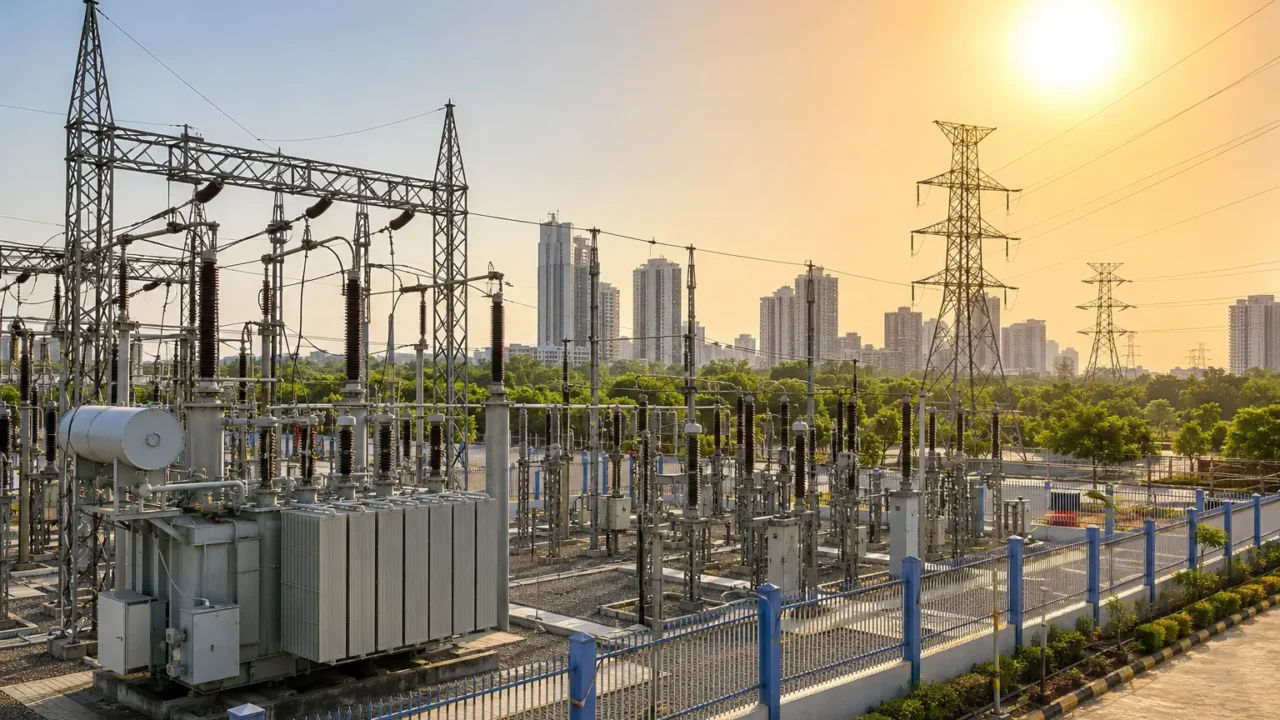
The severe heatwave across Gautam Budh Nagar is beginning to show up not only in temperature readings, but also in the region’s electricity demand.
As temperatures touched around 44°C, Noida’s power demand rose sharply by 561 MW in one week, reaching 2,609 MW. Greater Noida also saw a steep rise, with demand increasing by 115 MW to touch 852 MW, according to current local reporting based on power distribution figures.
For residents, this is not just a power-sector number. It directly affects daily life inside apartments, gated societies, markets, offices and industrial areas, especially during peak evening and night-time cooling hours.
Why power demand has jumped
The main reason is the sustained heatwave.
When temperatures remain above 40°C for several days, electricity use rises sharply because of extended use of:
- Air conditioners
- Air coolers
- Fans
- Refrigeration systems
- Commercial and industrial cooling systems
- Water pumps and backup systems in residential societies
In high-density sectors and group housing societies, the load can increase very quickly during late evening and night hours, when most homes are occupied and cooling appliances are running together.
This is why residents may experience localised tripping or voltage fluctuation even when the wider city grid remains functional.
Noida’s spike reflects a national pattern
The local rise in demand mirrors a wider national trend.
India’s peak electricity demand crossed 256 GW in late April 2026, according to official reporting, and has since touched 265.4 GW amid continuing heatwave conditions. The latest record has been linked to intense summer temperatures and higher use of cooling appliances across homes, offices and industry.
This matters for Noida and Greater Noida because both cities are fast-growing urban and industrial zones. More homes, more offices, more malls, more data-driven businesses and more cooling-dependent infrastructure mean power demand is no longer limited to traditional summer peaks.
What authorities and power distributors are doing
Power distribution agencies have been preparing for summer load, especially in areas where consumption rises sharply during heatwave periods.
In Greater Noida, Noida Power Company Limited has sought regulatory approval for short-term power procurement to meet expected summer demand between April and September 2026. Available reporting says NPCL approached the Uttar Pradesh Electricity Regulatory Commission for approval linked to short-term power arrangements for the summer period.
The available reports differ on the exact structure and capacity of procurement, with one report referring to around 170 MW and another mentioning up to 100 MW of round-the-clock and peak power. For residents, the broader point is that additional summer supply planning is being pursued to manage peak demand.
In earlier reporting, NPCL-linked capacity upgrades at key substations were also highlighted as part of efforts to strengthen supply in Greater Noida’s high-growth areas. These upgrades are important because electricity demand is not only rising citywide, but also concentrating in specific residential and industrial pockets.
What residents should watch
1. Local transformer load
Many outages are local, not citywide.
A sector, society or block may face tripping when the combined use of air conditioners and high-load appliances exceeds the capacity of the local transformer or feeder.
Residents should watch for repeated tripping in the same lane, tower, block or pocket. If this happens, the issue may need to be escalated to the local discom, society maintenance team or AOA/RWA.
2. Night-time grid pressure
Peak demand often shifts into the night during extreme summer.
Between late evening and early morning, residential cooling demand rises as families return home and run ACs for longer hours. For high-rise societies, this can mean higher load on internal electrical systems, diesel generator backup, lifts, pumps and common-area systems.
3. Voltage fluctuation
Voltage fluctuation can damage appliances and also indicate stress on the local distribution network.
Residents should avoid running too many heavy appliances at the same time during peak hours, especially if voltage fluctuation is already visible.
4. Backup power readiness
Housing societies should check whether backup systems are ready for longer summer use.
This includes:
- Diesel generator maintenance
- Fuel availability
- Load-sharing rules
- Lift backup
- Water pump backup
- Emergency lighting
- Communication with residents during outages
5. Official advisories
Residents should track official updates from PVVNL, NPCL, the district administration and local RWAs or AOAs.
Planned shutdowns for repair or maintenance should be taken seriously during heatwave periods because even short disruptions can affect elderly residents, children, patients and people working from home.
What housing societies can do
Apartment societies and RWAs can reduce local stress by taking simple steps during heatwave peaks.
They can:
- Share power-saving advisories with residents
- Avoid non-essential high-load common-area use during peak hours
- Check transformer and panel rooms for overheating risk
- Keep electricians and generator operators available during peak evening hours
- Report repeated feeder-level faults quickly
- Maintain a basic resident communication channel for outage updates
These steps will not solve citywide demand pressure, but they can reduce panic and improve response time during local failures.
What individual residents can do
Residents can also help reduce peak load pressure without compromising basic comfort.
Useful steps include:
- Set ACs at 24°C to 26°C where possible
- Clean AC filters for better efficiency
- Avoid running washing machines, geysers and heavy appliances during peak night hours
- Switch off unused lights and appliances
- Keep power banks and emergency lights charged
- Save local discom complaint numbers
- Check society notices for planned maintenance
For residents working from home, it is also useful to keep mobile internet backup and laptop batteries charged during heatwave periods.
Why this matters for Noida
Noida and Greater Noida are expanding rapidly as residential, commercial, industrial and technology hubs. Rising power demand is therefore not only a weather story. It is also an urban infrastructure story.
The current heatwave shows how closely city life now depends on reliable electricity. Apartments, offices, schools, hospitals, lifts, water systems, traffic signals, retail spaces and digital businesses all depend on a stable power supply.
For a growing urban region, the next challenge is not just producing or procuring more electricity. It is also strengthening local distribution infrastructure so that transformers, feeders and substations can handle sharper summer peaks.
As the heatwave continues, residents should expect power demand to remain high and should stay alert for local advisories, planned shutdowns and neighbourhood-level supply issues.
Official and Validated Sources
- Ministry of Power, Government of India: Official data on national peak power demand and grid capacity reporting.
https://powermin.gov.in/ - Uttar Pradesh Electricity Regulatory Commission (UPERC): Regulatory filings and approvals for Noida Power Company Limited (NPCL) short-term power procurement.
https://www.uperc.org/ - India Meteorological Department (IMD): Official heatwave and severe weather alerts for West Uttar Pradesh.
https://mausam.imd.gov.in/